
Why Your Toes Are the Key to Better Balance and Back Health
I was standing at a neighborhood cookout last summer, gripping a lukewarm soda, when that familiar, nagging ache started crawling up my lower lumbar. It wasn’t the first time. For years, I’d blamed my “bad back” on everything from my office chair to my mattress. But that day, I happened to look down. My toes were jammed into a pair of narrow sneakers, literally clawing at the insoles just to keep me upright. It was a lightbulb moment: I was trying to build a stable house on a foundation of crumbling toothpicks. [IMAGE_PLACEHOLDER]
Stop Blaming Your Spine and Look at Your Feet
For a long time, I made the classic mistake of treating my back like an isolated island. I’d stretch my hamstrings until they screamed, but the relief never lasted. If you’ve ever felt like your Sacramento massage only provides temporary relief, you know exactly what I’m talking about. The truth is, your feet are your body’s primary sensory input for balance. When your toes are smashed together and lose their ability to splay, your brain panics. It sends signals to your calves and lower back to tighten up just to keep you from falling over. Today, we are going to fix that foundation. I’m going to show you how a few simple changes to how you use your feet can drastically reduce your chronic back pain and improve your stability. We aren’t just talking about shoes; we’re talking about re-learning how to stand.
Can something as small as a toe really fix my back?
It sounds a bit “woo-woo” at first, I get it. But consider this: the human foot contains 26 bones and 33 joints. According to a study published in the Journal of Foot and Ankle Research, foot posture and function are directly linked to the mechanical load on the lumbar spine. If your big toe isn’t doing its job to push off the ground, your glutes stop firing. When your glutes fall asleep, your lower back has to pick up the slack. I spent years wearing “supportive” shoes that were actually making my feet weak. I thought I was helping myself, but I was just putting a cast on a muscle that needed to work. Have you ever felt like you’re losing your balance more often than you used to? Or maybe you’ve noticed that tight calves and morning back pain go hand-in-hand for you? Before we dive into the specific drills, I want to hear from you—have you ever noticed your toes curling or “clawing” when you’re just standing around? Reach out to me on the contact page and let me know. Realizing your feet are the culprit is the first step toward a mobile and pain-free life. We’re about to look at exactly how to wake those toes up and give your back the break it deserves.
Build a Better Foundation Without Buying New Shoes
If you want to stop the cycle of back pain, you have to treat your feet like the precision instruments they are. Think of your foot as a tripod: your heel, the base of your big toe, and the base of your pinky toe should all have equal pressure. If one leg of that tripod is “short” or weak because your toes are curled or your arch is collapsed, the whole structure—your pelvis and your spine—must tilt to compensate. It is a mechanical chain reaction that no amount of Ibuprofen can fix.
The Barefoot Five-Minute Rule
Start by ditching the slippers the moment you walk through your front door. We spend so much time in rigid, cushioned soles that our foot muscles essentially go into a coma. I started by taking small breaks from my sneakers throughout the day to let my feet feel the floor. This isn’t just about comfort; it is about providing your brain with the neurological feedback it needs to balance your weight. You will find that how a 5-minute walk barefoot can help your chronic back tension is not a myth—it works by forcing those tiny intrinsic muscles to wake up and support your weight without the crutch of a rubber sole.
Wake Up Your Big Toe
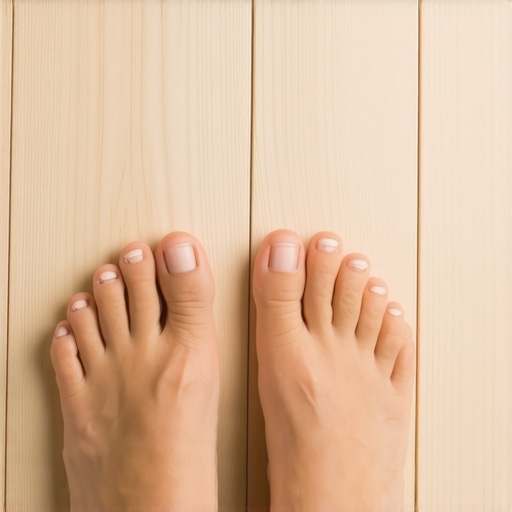
This was the hardest part for me. I remember sitting on my living room rug, staring at my right foot like it belonged to a stranger. I tried to lift just my big toe while keeping the other four toes flat. Nothing happened. My pinky toe twitched, my ankle rolled, but that big toe stayed glued to the floor. This disconnect is a major red flag and is one of the reasons the one-legged standing test for hidden spinal instability often reveals deeper issues. If you cannot control your big toe, you cannot stabilize your arch, which means your glutes will not fire correctly when you walk. When your glutes fall asleep, your lower back is forced to take the hit for every step you take. Try the “Big Toe Lift” for 30 seconds every morning while you brush your teeth to re-establish that brain-to-toe connection.
Check Your Shoe Box
We have to address the “coffin” shape of modern footwear. Most sneakers and dress shoes taper significantly at the front, squeezing your toes into a narrow point. This creates a literal bottleneck for your movement. You do not necessarily need to switch to toe shoes overnight, but why your choice of work shoes matters more than your chair becomes obvious when you realize a wider toe box allows for natural splay and a wider base of support. Just be cautious; a minimalist shoes warning is necessary because if you jump into zero-drop shoes too fast, your spine might lose its shock absorption before your feet are strong enough to handle the impact. Transition slowly to give your tendons time to adapt.
The Tennis Ball Release
If your feet feel like stiff bricks, you need to break up the “fascial glue” underneath. Take a tennis ball or a lacrosse ball and roll it under your arch with moderate pressure for two minutes per side. This is the daily foot massage habit that relaxes your entire back because it releases the posterior chain tension that starts at the sole and travels all the way to the base of your skull. When I first committed to this, I felt a literal “thaw” in my tight hamstrings that I had not felt in years. It is all one continuous line of tissue, and the foot is the anchor.
We’ve all been there: your lower back feels like a coiled spring, so you instinctively reach for your toes. It feels like the right thing to do, doesn’t it? But here is the contrarian truth that most personal trainers won’t tell you: your hamstrings might not actually be ‘tight’ in the way you think they are. In many cases, those muscles are ‘locked long’ as a protective shield for your spine. When you force a stretch on a muscle that is already overextended, you aren’t releasing tension; you are actually screaming at your nervous system to tighten up even more. This is exactly why hamstring tightness is a defense mechanism for your back and why your daily stretching routine might be the very thing keeping you in a pain loop.
Is your ‘stretch’ actually a nerve tug-of-war?
If you feel a burning or zingy sensation when you reach for your toes, you aren’t stretching a muscle—you are yanking on your sciatic nerve. Muscles are elastic, but nerves are like guitar strings; they do not like to be pulled. According to a study published in the Journal of Manual & Manipulative Therapy, neural mobilization—often called ‘nerve gliding’—is far more effective for resolving lower-limb discomfort than traditional static stretching. When you aggressively pull on your hamstrings, you risk aggravating the sheath around the nerve. This is why stretching your hamstrings often makes your sciatica worse. Instead of pulling, we need to help the nerve ‘slide’ through the surrounding tissue. If you aren’t sure which one you’re dealing with, learning how to tell if your leg pain is sciatica or a deep muscle knot is the first step to choosing the right movement.

The ‘oops’ factor I see most often involves people trying to power through the pain. They think ‘no pain, no gain’ applies to spinal health. It doesn’t. If you have a burning sensation down your leg, you should immediately pivot to the nerve glide exercise that calms burning leg pain. This move encourages the nerve to move freely without the trauma of a sustained pull. Another common mistake is how we stand while ‘resting.’ You might think you’re helping your posture by engaging your muscles, but you should stop squeezing your glutes when you stand because it actually jams the femur into the hip socket and increases lumbar pressure. Have you ever fallen into this trap of over-stretching or over-squeezing? Let me know in the comments—I’d love to hear how your body reacted when you finally stopped forcing the range of motion.
The hidden nuance of ‘locked’ joints
True mobility isn’t just about being flexible; it’s about having control over your joints in their full range. Most people chasing swift relief for sciatica focus on the back, but the real culprit is often a ‘sticky’ hip or a foot that can’t ground itself. When we look at back pain breakthroughs, they almost always point back to the joints above and below the spine. If your hips don’t rotate, your lower back has to. If your feet don’t splay, your knees and back take the shock. This is why simple exercises that make a difference focus on the whole chain, not just the spot that hurts. It’s time to stop chasing the symptom and start respecting the system.
Stop waiting for a spinal crisis to happen
I used to treat my back like an old car: I’d only look under the hood when smoke was pouring out or a wheel fell off. But the biggest lesson I’ve learned on this journey is that why maintenance care is better than waiting for a spinal crisis isn’t just a catchy phrase—it’s a survival strategy. If you only pay attention to your mobility when you’re in a flare-up, you’re playing a losing game of catch-up. Maintenance isn’t about doing an hour-long yoga flow every morning; it’s about micro-habits that keep the rust from settling in. I’ve realized that the ‘secret’ to staying pain-free is simply refusing to let the tissue get cold and stagnant during the workday.
The three tools that actually changed my life
Forget the expensive, vibrating gadgets that promise a miracle in 60 seconds. My ‘mobility kit’ is surprisingly low-tech and fits in a backpack. The most important tool I own is a standard lacrosse ball. It’s firmer than a tennis ball and doesn’t give way when you’re trying to pin down a stubborn knot in your glutes or upper back. I use it for how to use a tennis ball to release tension in your upper traps, which is my go-to move when the ‘tech neck’ starts to creep in after a long afternoon at the laptop. Second is a simple 12-inch loop resistance band. It’s essential for waking up the lateral glutes, which act as the stabilizers for your entire pelvic bowl. Finally, I swear by a dedicated lumbar roll for my car seat. It’s a tiny adjustment, but it prevents the ‘c-curve’ slouch that slowly dehydrates your discs during a commute.

As Dr. Stuart McGill, a world-renowned expert in spine biomechanics and author of Back Mechanic, emphasizes, ‘spinal hygiene’ is the foundation of recovery. He argues that most people don’t need more ‘stretching’; they need more ‘stability’ and better movement patterns throughout the day. This is why I’ve become obsessed with the 20-minute rule. I’ve found that why your body needs micro-breaks every 20 minutes to stay mobile is the most effective tool in my arsenal. Setting a vibrating timer on my watch reminds me to stand up, reset my pelvis, and take a deep diaphragmatic breath. It breaks the cycle of static loading before the pain signal even has a chance to reach my brain.
How do I maintain my back health over time?
Consistency beats intensity every single time. My maintenance routine is built on daily tips to keep your spine and joints healthy that I can do while I’m waiting for the coffee to brew or sitting on a conference call. Looking ahead, I predict we’re going to see a massive shift toward biometric-driven posture coaching. By 2025, expert tips on managing back pain in 2025 will likely involve wearable sensors that give you a haptic buzz the moment your lumbar spine starts to lose its neutral curve. We are moving away from ‘fixing’ pain and toward ‘engineering’ out the causes of it before they start. My challenge for you today is this: don’t wait for tomorrow’s technology. Try the 20-minute timer trick for just one afternoon and see how much lighter your lower back feels by 5:00 PM.
The hardest truth about why my back kept going out
For years, I looked for a single ‘cure’ for my pain, but I eventually realized that back health isn’t a destination—it’s a dialogue. One of the biggest myths I had to unlearn was that I needed to stretch more. In reality, my body was already too loose in some areas and ‘locked long’ as a protector. If you’re constantly digging into your hips, you should check how to tell if your hip tightness is actually a back issue before you keep cranking on the joint. I also learned that the truth about foam rolling your IT band is that it’s often a waste of time because that tissue is meant to be under tension. Finally, I realized that why maintenance care is better than waiting for a spinal crisis is because proactive movement keeps the tissue resilient before the injury occurs. When I stopped trying to silence the signal and started listening to my feet and hips, the flare-ups finally stopped.
The only three tools I actually use for mobility
My closet is full of abandoned massage gadgets, but only three things actually made the cut. First is the simple lacrosse ball; it is the best way to handle how to use a tennis ball to release tension in your upper traps when work stress hits. Second, I recommend the book Back Mechanic by Dr. Stuart McGill for a deep dive into spinal hygiene. Third, I prioritize ergonomic tips for everyday comfort over fancy office furniture. A simple lumbar roll and the habit of daily tips to keep your spine and joints healthy have done more for me than any high-end chair ever could.
You aren’t stuck with a ‘bad back’ forever
If there is one thing I want you to take away, it’s that your body is incredibly resilient. You weren’t born with a ‘bad back’; you just developed patterns that aren’t serving you anymore. By addressing your foundation and focusing on back pain breakthroughs like foot splay and big toe activation, you are giving your spine the space it needs to heal. We are moving toward a future where managing back pain in 2025 will be more about proactive engineering than reactive treatment. Don’t be afraid to start small—even a few minutes of barefoot walking a day makes a difference. If you ever feel stuck, feel free to reach out via the contact page. Have you noticed your back pain flares up more after wearing certain shoes or sitting for a specific amount of time? Let me know in the comments below!