
How to Use a Tennis Ball to Relieve Glute Tension
I was mid-conversation at a neighborhood barbecue when it hit me—that familiar, searing pinch right in the center of my glute. I spent the rest of the evening subtly shifting my weight like I was standing on hot coals, desperately trying to find a position that didn’t feel like a localized toothache in my hip. For months, I’d been convinced I had a major spinal issue. I’d even started Googling specialists, convinced my active life was over. It turns out, my body wasn’t fundamentally broken; it was just incredibly knotted up from a lethal combination of long drives and a soft office chair.
My $2 Secret to Walking Without That Deep Burning Ache
We often overcomplicate recovery. I spent hundreds on high-end massage guns and vibrating gadgets before realizing a standard tennis ball from the bottom of the garage could do the heavy lifting. If you’ve been struggling with that deep, nagging ache that makes you wonder if your leg pain is sciatica or just a massive knot, you are in exactly the right place. Today, I am going to show you how to pin down those stubborn trigger points so you can finally stand up without that immediate, sharp wince. Have you ever felt that sudden, sharp pinch while just trying to get out of your car or stand up from the couch?
Does This Cheap Little Ball Actually Work?
I get it. It sounds like a “life hack” that is far too simple to be effective. I was the biggest skeptic on the block until I stopped trying to squeeze my glutes every time I stood up to manage the pressure. My biggest mistake early on was thinking more pain meant more gain. I would jam the ball into my hip so hard I would see stars, thinking I was “breaking up” the tissue. Please, don’t do that. You are looking for “productive discomfort,” not a new bruise. According to the American Council on Exercise, self-myofascial release works by improving blood flow and “resetting” the neuromuscular system, but it requires a patient approach. Finding expert strategies for lasting comfort doesn’t always require a medical degree, but it does require knowing where to aim. We are going to dive into the specific spots to target, because adjusting your daily mobility habits is the first step toward a spine and joints that don’t constantly scream for attention. [image_placeholder]
Search for the Toothache in Your Hip
To get started, find a firm surface. A yoga mat on a hardwood floor is ideal because a soft carpet will swallow the tennis ball’s effectiveness. Sit down and place the ball under one side of your glutes. You aren’t just sitting on it; you are hunting for what I call the ‘hot spot.’ Think of your glute like a map of a city, and you’re looking for the one intersection where traffic is backed up for miles. When you find it, you’ll know. It feels like a localized, deep toothache. My first time doing this, I was so tense I actually rolled off the ball because the sensation was so intense—I wasn’t ready for how much tension I’d bottled up. I initially tried to do it on my old soft couch, but your soft couch is the worst place to sit when you are trying to create real change in your tissue. You need that resistance from the floor to pin the muscle down. 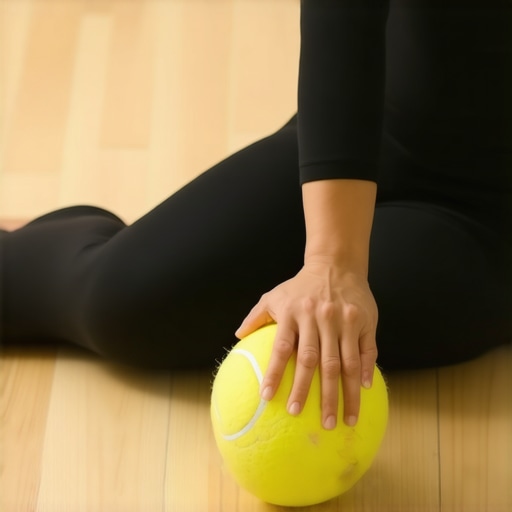
Breathe Into the Knot Instead of Fighting It
Once you’ve pinned the spot, your instinct will be to hold your breath and tense up every other muscle in your body. This is a mistake. If your brain thinks you’re under attack, it will tell your muscles to guard even harder. Instead, imagine your hip is a stick of cold butter and the tennis ball is a warm thumb pressing into it. You want to melt over the ball. I remember a particularly bad Tuesday when my hip felt like a block of concrete; I spent five minutes just focusing on exhaling while leaning into the ball. Eventually, I felt that ‘release’—a sudden warmth and a softening of the ache. This isn’t about rolling back and forth rapidly like a rolling pin on dough. It’s about ‘pin and stretch.’ While the ball is pressing into the knot, slowly move your knee out to the side and back in. If you find this too intense, you might need the 30-second stretch that relieves pressure on your sciatic nerve to calm things down first.
Why You Should Avoid Direct Nerve Pressure
A major warning: do not park the ball directly on your sciatic nerve. If you feel an electric shock running down to your toes, move the ball immediately. You want to target the muscle bellies around the nerve, not the nerve itself. Often, people confuse the two, but the difference between muscle soreness and nerve irritation is the key to safe recovery. If you keep hitting the nerve, you’re just going to inflame it further. This is why stretching your hamstrings often makes your sciatica worse—you’re yanking on a nerve that’s already screaming for space. Instead of aggressive stretching, try the nerve glide exercise that calms burning leg pain. It’s a much gentler way to tell your nervous system that it’s safe to let go. Think about your daily environment too. Even if you master the tennis ball, you’ll undo the work if you go right back to a poor seating position. I used to hop off the floor feeling great and then hop into my car with the seat tilted back like a lounge chair. I eventually realized that the correct way to tilt your car seat is vital to keeping that nerve happy. It’s about creating a ‘spine-friendly’ environment everywhere you go, not just during your ten minutes on the floor.
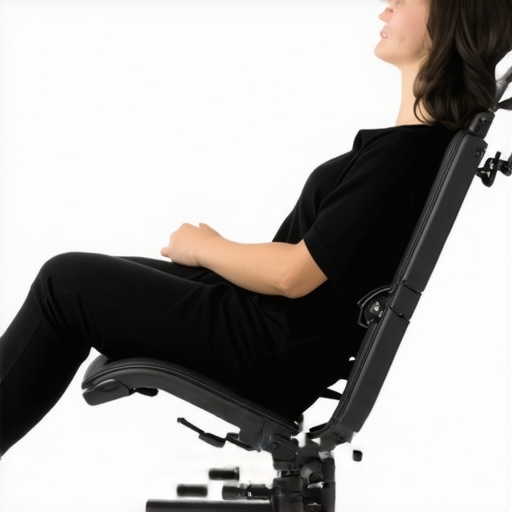
Let’s dig deeper. Most of us have been told since grade school to ‘sit up straight’ to fix our backs. But here’s the contrarian truth: that rigid, 90-degree posture might be the very thing keeping you in a pain cycle. When you force your spine into an artificial ‘perfect’ line, you’re often just trading one kind of strain for another. I’ve found that why sitting up straight might be giving you more back pain is because it creates constant muscular tension that never gets a break. A classic study by Dr. Alf Nachemson showed that sitting upright without support actually increases intradiscal pressure significantly compared to leaning back slightly—around 135 degrees is often the sweet spot for pressure reduction. By trying to be a ‘posture pro,’ you might be grinding your lumbar discs into submission. Have you ever fallen into this trap of trying to be too perfect with your posture? Let me know in the comments.
Why Does My Core Routine Feel Like a Back Attack?
Many of my readers come to me frustrated because they’re doing all the ‘right’ things—planks, sit-ups, and leg raises—yet their back pain is peaking. The nuance here is that why your core strength workout is actually destroying your lower back often comes down to internal pressure. If you have a disc issue, traditional crunches act like a nutcracker on your spine. You’re essentially squeezing the jelly out of the donut. Instead of mindless reps, focus on stabilization. I’m a huge advocate for the dead bug exercise because it is essential for every back pain sufferer to learn how to keep the spine neutral under load.
Stop Yanking on Your Hamstrings
The biggest ‘oops’ factor I see is the obsession with stretching hamstrings. When your back hurts, your hamstrings often feel like steel cables. Naturally, you want to stretch them. But wait—sometimes why hamstring tightness is a defense mechanism for your back is because your body is literally trying to splint your pelvis to protect an unstable spine. If you keep yanking on those muscles, you’re ripping away your body’s built-in security system. This is also why stretching your hamstrings might be making nerve pain worse; you’re not stretching a muscle, you’re tugging on a sensitized sciatic nerve. If you start feeling numbness or weakness, you need to step back and check if your back pain is a sign of something more serious. Always listen to those ‘red flag’ symptoms like progressive leg weakness. Otherwise, the goal is ‘gentle movement,’ not ‘aggressive correction.’ Understanding the difference between muscle soreness and nerve irritation will save you weeks of unnecessary flare-ups. You also have to consider that your body is a closed system; why your body needs micro-breaks every 20 minutes to stay mobile is because static loading is the enemy of recovery. Even the best position becomes toxic if you hold it for hours on end without a reset.
Once you’ve managed to lower the volume of your pain with the tennis ball technique, the real challenge begins: keeping it that way. I’ve learned the hard way that chasing the pain once it arrives is an exhausting game of catch-up. This is why maintenance care is better than waiting for a spinal crisis to happen. In my own recovery, I stopped treating my sessions as ‘fixes’ and started seeing them as ‘tune-ups.’
The High-Tech and Low-Tech Tools I Actually Use
I’m not here to sell you a vibrating massage chair, but there are a few items that live permanently in my living room. First is a simple Lumbar Roll. I take it everywhere—to the movies, on flights, and even in the car. It’s a physical reminder for my spine to stay in its natural curve so I don’t collapse into a ‘C’ shape. If you don’t want to buy one, learning how to use a towel roll to support your neck while watching TV is just as effective and costs zero dollars. Second, I’ve become obsessive about my screen height. Most people look down at their laptops, which puts forty pounds of pressure on those delicate neck joints. Following the 10-degree rule for laptop screens that ends daily neck fatigue was a complete game-changer for my afternoon headaches. I even applied this logic to my hobbies; I had to figure out how to set up your bike without agitating your sciatic nerve because I realized my leaning posture was undoing all my morning mobility work. 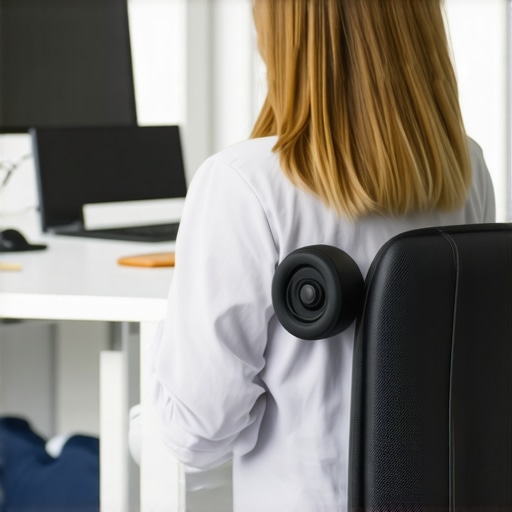
How do I maintain spinal health over the long haul?
The answer isn’t in a single 60-minute gym session; it’s in the hundreds of micro-decisions you make daily. You can enhance your back mobility with ergonomic tips for everyday comfort by simply changing how you reach for things or how you sit during a Zoom call. Dr. Stuart McGill, a world-renowned spine biomechanist and author of Low Back Disorders, emphasizes that ‘spinal hygiene’ is more about avoiding the ‘injury mechanism’ (like repetitive bending) than it is about doing a thousand sit-ups. I’ve integrated mobility mastery daily tips to keep your spine and joints healthy into my morning coffee routine. While the water boils, I perform the 10-second chin tuck to combat tech neck instantly. It takes almost no time, but the compound effect is massive.
The Future of Feeling Better
I predict that within the next five years, we are going to see a massive shift toward bio-feedback wearables that don’t just track steps, but actually monitor the tilt of your pelvis and the curve of your neck in real-time. We are moving away from passive ‘waiting for the doctor’ to active ‘self-correction’ powered by data. Until those gadgets are perfected, we have to be our own sensors. Start small: today, try to implement that 10-degree rule for your monitor. I want you to feel the difference that a simple three-inch shift in height can make for your shoulders by the time 5:00 PM rolls around. You might find that neck pain solutions and proven techniques are often hiding in the simplest adjustments to your environment. If you’ve felt that ‘stuck’ sensation before, use these simple exercises that make a difference to keep the gears turning smoothly.
Lessons My Living Room Floor Taught Me About Recovery
Spending hours rolling around on my rug taught me that consistency is the only real shortcut. I realized that why you feel stiff after a nap is often because your body was fighting to find a neutral position on a surface that doesn’t support it. My biggest lightbulb moment was understanding that why your glutes are falling asleep is usually a result of prolonged sitting, which puts the entire burden of movement on your lower back. I stopped looking for a one-time ‘fix’ and started focusing on managing back pain in 2025 through smarter, small adjustments throughout my day. [image_placeholder]
Tools That Stopped My Constant Search for Relief
I swear by a few items that don’t take up much space but make a massive impact. First, a simple lumbar roll for my desk chair is non-negotiable. If you’re on a budget, using a towel roll to support your neck while watching TV is a free way to see how much strain you can take off your cervical spine. I also recommend checking out navigating your path to restored mobility through Dr. Stuart McGill’s ‘Back Mechanic’—it is the gold standard for understanding spinal hygiene. Finally, never underestimate your screen setup; why your desk monitor should be higher than you think is often the missing piece for people suffering from chronic upper back knots and headaches.
Take Back Your Freedom One Move at a Time
You are not defined by your aches or an old scan result. Your body is a dynamic system capable of incredible resilience if you stop fighting it and start supporting it. Whether you try the 3-second pelvic reset while waiting for your coffee or you finally commit to boost your back mobility, every small win counts toward a more active future. Don’t wait for a crisis to make your spine a priority. What’s the one ‘hot spot’ in your hip that always seems to flare up during the workday? Let me know below.