
The thoracic bridge move that fixes slouching

I caught my reflection in a shop window last month and honestly? I didn’t recognize the person staring back. My head was craned forward, my shoulders were rolled toward my chest, and I looked about twenty years older than I actually am. It was that classic “tech neck” look, and it came with the fix for that constant burning sensation between your shoulder blades that I could never quite get rid of. I’d tried the usual advice. I bought the expensive chairs and attempted the Bruegger position to reset my posture at work, but the relief lasted maybe ten minutes. My biggest mistake early on was thinking I could just “force” my shoulders back with sheer willpower. Spoiler: your muscles eventually get tired and snap right back into the slouch. We’re going to fix that today with the thoracic bridge. It’s the one move that actually addresses the root cause—the stiffness in your mid-back.
Is one simple move really going to undo years of sitting?
I get it. You’ve probably tried every “hack” on social media and ended up just as stiff as before. Skepticism is your friend here because it keeps you from wasting time on fluff. But the thoracic bridge is different because it combines extension and rotation in a way that static stretches can’t touch. According to research from the Journal of Physical Therapy Science, improving thoracic mobility is the primary key to reducing neck strain and significantly improving respiratory function. It’s not a magic pill, but it’s the closest thing I’ve found to a structural “reset button” for the modern office worker.
Why your upper back is acting like a rusted hinge
Think about your spine like a series of gears. If the middle gear—your thoracic spine—is jammed or rusted into a forward curve, the gears above (your neck) and below (your low back) have to work twice as hard to keep you upright. This is exactly how people end up understanding the link between poor posture and chronic back pain the hard way. When I finally stopped trying to “sit up straight” and started focusing on opening up that mid-back hinge, the tension in my neck virtually vanished. Have you ever felt like no matter how much you stretch your neck, the tightness just comes right back the next morning?
The mechanics of the bridge versus basic stretching
Most people think a stretch is just about pulling on a muscle until it feels slightly uncomfortable. I used to do wall slides for shoulder blade relief, and while they are great for a quick fix, they didn’t provide the deep structural change I needed for long-term health. The thoracic bridge is a “weight-bearing” movement. By using your own body weight to drive rotation while your hand is planted, you’re telling your nervous system that it’s safe to move in these new, upright ranges. It’s the difference between gently tugging on a locked door and actually putting the key in the lock and turning it.
How I messed up my progress early on
When I first started working on my mobility, I made the classic error of overextending my lower back. I thought that if I could just arch my spine far enough, my posture would fix itself. All I ended up with was a sore lower back and the same rounded shoulders. The trick to the thoracic bridge is keeping your ribcage connected to your core. It’s about quality over quantity. If you feel the movement in your lumbar spine, you’ve gone too far. We want to target the area right behind your heart—the part that spends eight hours a day hunched over a laptop. Ready to feel what it’s like to actually stand tall without trying?To get the most out of this move, we have to treat it like a technical skill, not just another gym rep. Think of your body as a tripod during the movement. If one leg of that tripod is weak, the whole structure collapses, which is why most people fail to see results from the simple reach and rotate move for mid-back stiffness. You start seated on the floor with your knees bent and feet flat, just like you’re about to do a crab walk. Place one hand behind you, fingers pointing away from your body. This planted hand is your anchor; it’s the pivot point that allows your spine to actually rotate rather than just shifting side to side. 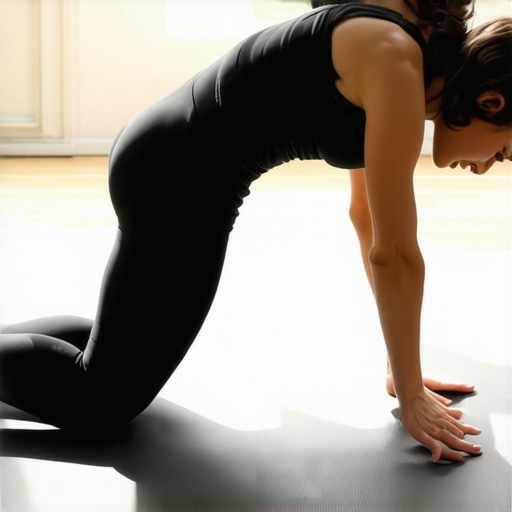
Set the foundation before you lift a single inch
Before you drive your hips up, you need to engage your core. Imagine someone is about to poke you in the stomach; that bracing sensation protects your lumbar spine. I remember the first time I tried this without bracing—I felt a sharp ‘zip’ in my lower back that reminded me of the difference between muscle soreness and nerve irritation. It wasn’t pleasant. Once you’re braced, drive through your heels to lift your hips toward the ceiling. Your goal isn’t to get as high as possible, but to create a straight line from your knees to your shoulders.
Drive your hips and reach for the ceiling
As your hips rise, take your free hand and reach diagonally across your body and over the opposite shoulder. This is where the magic happens. You’re not just reaching into the air; you’re trying to touch the floor behind you on the opposite side. This creates a massive opening through the ribcage and the front of the shoulder. If you’ve been struggling with neck pain solutions and proven techniques to regain your range of motion, you’ll feel an immediate release of pressure in that ‘tech neck’ area. The key is to keep your eyes on your reaching hand. Your neck follows your spine, so let your head rotate naturally with the movement.
Watch out for the lower back trap
The biggest mistake I see—and the one I made for months—is turning this into a lower back arch. When you over-arch, you completely bypass the thoracic spine, which is the very area we’re trying to hit for mobility mastery and daily tips to keep your spine and joints healthy. If you feel a pinch in your low back, you’ve gone too far. Focus on squeezing your glutes at the top of the bridge. Your glutes are the engines here; they should be doing the heavy lifting so your back doesn’t have to. When I finally mastered the glute drive, my mid-back felt like it had been oiled for the first time in a decade.
Refining the rotation for maximum relief
Don’t rush the descent. Lower your hips back to the floor with control, switch hands, and repeat on the other side. Think of it like wringing out a wet towel. You want to move slowly enough to feel every segment of your spine participating in the twist. This controlled tempo is what makes it one of the best ergonomic tips for everyday comfort because it teaches your muscles how to support your spine under load. I used to do five reps on each side every morning before my first cup of coffee, and within two weeks, that burning sensation between my blades was a distant memory. It’s about building a consistent habit of movement that offsets the hours of stillness.Once you’ve felt that initial release from the bridge, you’ll likely want to push further, but this is where most people hit a plateau. Most people think they just need more flexibility, but here’s the truth: your body might be creating stiffness as a protective mechanism because it doesn’t feel stable. If you’ve spent months doing simple exercises that make a difference but still feel ‘tight,’ you aren’t lacking range—you’re lacking control. This is the core reason why your perfect sitting posture is making you stiffer. By trying to force a static ‘upright’ position, you’re actually fatiguing your spinal stabilizers and creating more tension.
Stop pulling your knees to your chest for relief
I see this all the time with people suffering from lower back discomfort. They feel a ‘tightness’ in their glutes and immediately assume they need to stretch it out. However, if your pain is coming from a nerve, aggressive stretching is like pulling on a frayed wire. In fact, why stretching your hamstrings often makes your sciatica worse is one of the most important lessons for anyone dealing with radiating pain. You have to learn how to tell if your sciatica is a disc or muscle issue before you start yanking on your limbs. If you feel a sharp ‘zing’ instead of a dull muscle burn, you are likely irritating the nerve further, which is a classic example of the difference between muscle soreness and nerve irritation.
Can your breathing patterns lock up your mid-back?
This is the advanced level most people miss. Your thoracic spine and your ribcage are intimately connected through your diaphragm. If you are a ‘chest breather’—meaning your shoulders move up and down rather than your ribs moving out—your mid-back will never fully relax. According to research published in the Journal of Physical Therapy Science, there is a direct correlation between respiratory dysfunction and decreased thoracic mobility. Your lungs are essentially internal balloons; if you aren’t using them to expand the ribcage from the inside out, no amount of external stretching will keep that ‘rusted hinge’ open for long. #IMAGE_PLACE_HOLDER_C#
The stability trap you need to avoid
The biggest mistake I see as people progress is focusing purely on the ‘stretch’ of the thoracic bridge without the ‘brace.’ Without core tension, the movement just leaks into your lower back. This is why mobility mastery and daily tips to keep your spine and joints healthy always emphasizes the ‘canister’ position—keeping your ribs down and your pelvis neutral. When you combine this internal pressure with the external movement of the bridge, you’re finally addressing the root cause of ‘tech neck’ rather than just chasing symptoms. If you’re still feeling stuck or your pain feels more complex than a simple ‘tight muscle,’ don’t hesitate to contact us for a personalized assessment. Have you ever fallen into the trap of stretching a ‘tight’ muscle only to have it feel worse the next day? Let me know in the comments.The secret to staying pain-free isn’t doing a 90-minute yoga session once a week; it’s the little ‘micro-doses’ of movement you sprinkle into your day. If you’ve ever wondered why maintenance care is better than waiting for a spinal crisis, it’s because the cost of fixing a broken system is always higher than the cost of keeping it oiled. Personally, I don’t go anywhere without a standard lacrosse ball. It’s dense, cheap, and reaches deep into the tissues of the upper traps where a soft foam roller just skims the surface. When you’re trying to figure out how to use a foam roller on your neck without injury, remember that more pressure isn’t always better—targeted pressure is. I use the ball against a wall to pin down those nasty knots right above the shoulder blade, then I move my arm through its full range of motion. Dr. Kelly Starrett, author of Becoming a Supple Leopard, emphasizes that ‘first rib mobilization’—using a ball to press down on that tight area between your neck and shoulder—is often the missing link for people who feel like their neck is permanently jammed. 
The three tools that actually live in my gym bag
I’ve wasted hundreds of dollars on vibrating massage guns and fancy ‘ergonomic’ gadgets that just collect dust. Now, my toolkit is lean. Aside from the lacrosse ball, I rely on a simple resistance band to help with enhance your back mobility ergonomic tips for everyday comfort. The band allows me to create ‘distraction’ in the shoulder joint, pulling the humerus back into its socket while I perform my thoracic bridges. This extra bit of tension forces the stabilizers to wake up. I also started paying attention to what’s on my feet. Surprisingly, why your choice of work shoes matters more than your chair came as a shock to me. Your feet are the foundation for your spine; if your shoes are too narrow or lack support, that tension travels up the kinetic chain, locking up your hips and eventually your neck.
How do I maintain my mobility without spending hours in the gym?
Consistency is the only way this works. You don’t need to be a ‘mobility athlete.’ You just need to commit to two minutes of the thoracic bridge after every two hours of sitting. This isn’t just about boost your back mobility simple exercises that make a difference; it’s about neurological re-education. You are teaching your brain that you don’t live in a hunched-over box. If you feel your progress stalling, it’s usually a sign that your environment is winning. Take a look at your setup or contact us for a professional perspective on where your blind spots might be.
Where the science of spinal health is headed next
Looking forward, I predict that by 2030, we won’t just be sitting in ‘smart’ chairs; we’ll be wearing haptic sensors that vibrate the moment our thoracic spine loses its integrity. This real-time feedback will shift the focus from ‘fixing’ pain to ‘preventing’ it before the first symptom even appears. We are moving away from passive treatments like pills and toward active, biofeedback-driven lifestyle adjustments. Try this tonight: find a tennis ball or lacrosse ball and spend exactly 60 seconds pinning it between your shoulder blade and a wall. Breathe deeply and move your arm in big circles. If it feels like a ‘good hurt,’ you’ve found exactly where you need to work.
Why My Progress Stalled for Months Before It Finally Clicked
I used to think that more was always better. I’d try to do twenty thoracic bridges in one go, but my back would just feel irritated afterward. The real ‘lightbulb moment’ came when I realized that micro-doses of movement throughout the day were far more effective than one intense session. If you can do just two quality reps every time you stand up for a glass of water, you’re teaching your brain that movement is safe. Another massive lesson was learning the difference between muscle soreness and nerve irritation. Once I stopped pushing through sharp, ‘zingly’ sensations and focused on the dull, satisfying stretch of the muscle, my progress skyrocketed. Finally, don’t ignore your breath. If you are holding your breath during the bridge, your ribcage stays locked down. Exhaling as you reach overhead allows the diaphragm to move and the spine to rotate naturally.
The Minimalist Gear That Actually Earned a Spot in My Daily Routine
I’ve tested dozens of gadgets, but only a few actually make a difference for long-term back health. First is a standard lacrosse ball; it is firm enough to reach deep into the tissue, and knowing how to use a tennis ball to release tension in your upper traps is a skill that pays for itself every single day. I also highly recommend the book Becoming a Supple Leopard by Dr. Kelly Starrett. It’s a masterclass in human movement that helped me understand why my body was creating stiffness in the first place. A simple medium-resistance band is another must-have for creating joint distraction, which helps pull the shoulder back into its socket. Lastly, I switched my footwear because I learned why your choice of work shoes matters more than your chair when it comes to total spinal alignment.
Your Spine Was Designed to Move More Than It Does Right Now
It’s easy to feel like your body is failing you when you’re stuck in a cycle of stiffness and pain, but remember that your spine is incredibly resilient. You aren’t ‘broken’; you’re just adapted to the desk-bound environment you spend most of your time in. By incorporating boost your back mobility simple exercises that make a difference like the thoracic bridge, you are reclaiming your natural range of motion. Start with just one rep on each side tonight. You don’t need to be perfect; you just need to be consistent. This journey toward mobility mastery and daily tips to keep your spine and joints healthy is a marathon, not a sprint. If you find yourself struggling with a specific pinch or a plateau, please feel free to contact us for more personalized guidance. Have you ever felt like your neck was ‘stuck’ no matter how much you stretched it? Let me know your experience in the comments below!