
The 5-Minute Stretching Routine for Chronic Desk Workers
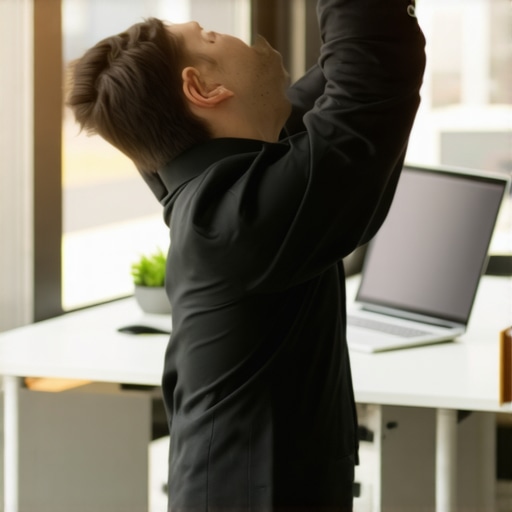
I remember the Tuesday my back finally gave up. I wasn’t doing anything heroic; I was just reaching for a lukewarm cup of coffee when a sharp, electric shock shot from my lower back straight down my leg. I spent the next three days working from a heating pad on the floor, wondering how my body became a stiff prison in my early thirties. My biggest mistake early on was thinking my high-end ergonomic chair was a hall pass to sit like a gargoyle for nine hours a day. I learned the hard way that equipment is no substitute for movement. Today, I am going to show you exactly how a simple five-minute routine can keep you from that same floor-bound fate, even if you feel like you have zero time to spare. Have you ever felt that sudden, terrifying pinch after a long afternoon of typing? [image]
Your Office Chair Won’t Save Your Spine
Let’s be honest with each other. We buy the standing desks and the memory foam cushions, yet we still end up hunched over like we’re trying to merge with our monitors. I used to be the poster child for understanding the link between poor posture and chronic back pain only after the damage was done. The truth is that why sitting up straight might be giving you more back pain is because of the sheer static load on your discs. Research from the Mayo Clinic suggests that sitting for long periods is linked to a cluster of health concerns, including increased blood pressure and high blood sugar, which movement-based breaks can help mitigate. You don’t need a gym membership to fix this; you just need to understand why your body needs micro-breaks every 20 minutes to stay mobile. I spent years ignoring my body’s whispers until they became screams. By incorporating mobility mastery daily tips to keep your spine and joints healthy, I realized that the goal isn’t just to work, but to survive the work day without needing a chiropractor on speed dial.
Can five minutes really undo a whole day of sitting?
It sounds like a marketing gimmick, doesn’t it? I was the biggest skeptic in the room. I thought if I wasn’t sweating for an hour, it didn’t count. But the secret isn’t intensity; it’s consistency. We are basically trying to ‘grease the wheels’ of our joints so they don’t rust shut. If you are ready to stop feeling like a creaky floorboard every time you stand up, we need to talk about the specific movements that actually target the desk-worker’s ‘danger zones.’ If you’ve been struggling with this for a while, it might be time to contact us to get a more personalized plan, but for now, let’s look at the foundational moves you can do right next to your keyboard.
Wake Up Your Glutes Before They Forget Their Job
When you sit for hours, your brain effectively ‘mutes’ the signal to your posterior chain. Think of it like a light switch that’s been taped in the off position. This is precisely why your glutes are falling asleep and how to wake them up is the first hurdle in preventing lower back fatigue. I remember trying to lunge for a falling pen after a four-hour Zoom marathon; my back felt like a brittle twig because my hips were completely offline. To fix this, stop what you’re doing every 30 minutes and perform a simple isometric squeeze. But be careful—you need to stop squeezing your glutes when you stand constantly, as that habit can actually lock your pelvis and create more tension and compression.
Ditch the Knees-to-Chest Stretch
We’ve been told for decades that pulling our knees to our chest is the ultimate back saver. In reality, if you have a bulging disc, this can be like folding a cracked credit card back and forth until it snaps. You must stop pulling your knees to your chest for back relief if you want to avoid aggravating the structural integrity of your spine. Instead, try the 3-second pelvic reset you can do while waiting in line or sitting at your desk. It’s a subtle tilt that realigns the lumbar curve without the aggressive flexion that ruins discs. I switched to this during a particularly nasty flare-up, and the difference in my morning stiffness was night and day.
Floss Your Nerves Like You Floss Your Teeth
If you feel a burning or electric sensation traveling down your leg, that’s not a muscle issue—it’s a nerve signal. You can’t ‘stretch’ a nerve; you have to glide it. Using the nerve glide exercise that calms burning leg pain allows the sciatic nerve to slide through the surrounding tissues without getting snagged like a fishing line on a rock. It’s like pulling a thread through a needle; it needs to move freely to stay healthy. This is one of the most effective swift relief for sciatica quick home remedies that work because it addresses the mechanical irritation directly rather than just masking the symptoms with heat.
Reset Your Posture in Ten Seconds
You don’t need a complicated yoga flow to fix tech neck. The Bruegger position is a fast way to reset your posture at work by opening the chest and reversing the forward-slump we all succumb to. Combine this with the 10-second chin tuck to combat tech neck instantly. If you find yourself constantly looking down, remember why your desk monitor should be higher than you think—your eyes dictate where your head goes. If your screen is too low, no amount of stretching will save your cervical spine from the constant strain of gravity pulling your skull forward. I used to keep my laptop on my desk surface, but once I raised it to eye level, my afternoon headaches virtually vanished within a week.
Keep Your Mid-Back Moving
Mid-back stiffness is often the silent culprit behind lower back pain. When your thoracic spine becomes a solid block of concrete, your lower back has to move extra to compensate. Perform the simple reach and rotate move for mid-back stiffness while seated. It’s like wringing out a wet towel; it encourages the joints to maintain their rotational capacity. When I started doing this, I realized I could finally check my blind spot while driving without having to twist my entire torso.I see this every single day: someone comes in with searing leg pain and tells me they’ve been ‘stretching the heck out of their hamstrings.’ They think they’re helping. In reality, they are playing tug-of-war with a sensitive nerve. This is the biggest ‘oops’ in the world of self-rehab. When you have sciatica, your hamstrings often feel tight because they are trying to protect your back. It’s called a ‘protective guarding’ response. If you force that muscle to lengthen, you’re just yanking on the sciatic nerve. This is why stretching your hamstrings often makes your sciatica worse. Research published in the Journal of Orthopaedic & Sports Physical Therapy (JOSPT) confirms that neural mechanosensitivity requires a completely different approach than muscle flexibility. If you treat a nerve like a rubber band, you’ll lose every time. Instead, you need to understand why hamstring tightness is a defense mechanism for your back and address the root cause rather than the symptom.
Stop Stretching Your Hamstrings if You Have Nerve Pain
It feels counterintuitive, right? Your leg feels tight, so you stretch it. But if that tightness is accompanied by a tingle or a ‘zing,’ you are likely aggravating a disc bulge. I remember one client who spent months doing ‘pigeon pose’ and toe touches, only to find their pain getting more ‘centralized’ and intense. They were falling into the classic trap of ignoring the nerve’s need for space. You must learn how to tell if your leg pain is sciatica or a deep muscle knot before you start any aggressive stretching routine.
Why does ‘core strength’ often fail to stop the pain?
Most of us were told that a strong core is the ultimate armor. So we do sit-ups and planks until we’re blue in the face. But here is the nuance: why your core strength workout is actually destroying your lower back is often due to excessive, repetitive spinal flexion. Traditional sit-ups place a massive amount of compressive load on your lumbar discs, effectively ‘squeezing the jelly out of the donut.’ I’ve seen people with visible abs who can’t bend over to tie their shoes without a wince because their core isn’t stabilizing; it’s just contracting. This is why why your core workout should not include traditional sit-ups if you want longevity. Instead, focus on anti-rotation and anti-extension. The dead bug exercise why it is essential for every back pain sufferer is my gold standard because it teaches your pelvis to stay quiet while your limbs move—this is the ‘true’ core strength that saves your spine. Have you ever fallen into this ‘more is better’ trap with your workouts? Let me know in the comments.
Is Your Leg Pain Actually a Back Issue in Disguise?
Another hidden nuance is the ‘phantom’ hip pain. You think your hip is the problem because that’s where it hurts, but the engine of the problem is in your L4-L5 vertebrae. If you spend all your time foam rolling your IT band or your glutes without addressing the spinal segment, you are just chasing ghosts. It’s vital to recognize when your back pain is a sign of something more serious, especially if you notice any weakness or changes in sensation. If you’re tired of the ‘one step forward, two steps back’ cycle, it might be time to contact us to figure out exactly which ‘switch’ in your body is actually flipped to the off position.I eventually realized that ‘fixing’ my back wasn’t a one-time event like patching a tire; it was more like maintaining a garden. If you stop weeding, the pain creeps back in. Once I got past the initial crisis, I had to find a way to stay mobile without it becoming a full-time job. I stopped looking for the next expensive gadget and started focusing on the small, high-leverage tools that actually made a difference in my daily life.
The Cheap Tool That Replaces My Expensive Massages
People always ask me which $500 massage gun they should buy. My answer? Spend three dollars on a tennis ball first. I use it every single evening while I’m watching TV. By knowing how to use a tennis ball to relieve glute tension, you can pin-point the exact spots where your sitting habit has created ‘trigger points.’ I place the ball under my hip and let gravity do the work. It’s uncomfortable for about thirty seconds, and then you feel the muscle finally let go. This isn’t just about feeling good; it’s about mechanical maintenance. I’ve found that why maintenance care is better than waiting for a spinal crisis is simply because it’s much easier to keep a muscle loose than it is to unlock a full-blown spasm.
How do I keep my spine healthy for the next decade?
The long-term game is won in the moments you aren’t thinking about your back. For me, the biggest shift was realizing why your choice of work shoes matters more than your chair. Your feet are the foundation of your entire kinetic chain. If you’re wearing stiff, narrow shoes, your ankles can’t move, which means your knees have to compensate, which ultimately pulls on your lower back. I started experimenting with barefoot-style movement and discovered how a 5-minute walk barefoot can help your chronic back tension by re-engaging the small muscles in my arches. According to the National Institute for Occupational Safety and Health (NIOSH), even the most advanced ergonomic setups fail if the user remains in a static posture for more than 40 minutes at a time. This is why I focus on ‘movement snacks’ rather than just ‘ergonomic equipment.’
Stop Letting Your Sleep Habits Ruin Your Progress
You can do everything right during the day, but if you spend eight hours in a sub-optimal position at night, you’re starting every morning at a deficit. I used to wake up with a stiff neck that turned into a midday headache until I realized why your pillow height is the key to ending waking migraines. Your neck needs to stay in a neutral ‘goldilocks’ zone—not too high, not too low. If you’re struggling to find that sweet spot, you might need to contact us for a more specific assessment of your sleeping posture. Looking forward, I predict we will see a massive rise in AI-integrated wearable sensors that vibrate when your pelvic tilt shifts into a high-risk zone for more than ten minutes. But until that tech is perfected, you are your own best sensor. If you feel that familiar ‘hollow’ ache in your lower back, don’t ignore it. I want you to try the tennis ball release on your glutes tonight for just two minutes per side. It’s the single most effective way to ‘reset’ your hips after a long day of work. If the pain persists or feels deep and sharp, check if your back pain is a sign of something more serious before pushing through it.
Three Lies That Kept My Spine Stiff
Looking back, I spent way too much money trying to buy my way out of pain. I thought a fancy chair or a specialized desk would be the magic pill. The first lie I believed was that I needed to stay perfectly still and upright. In reality, movement is the only thing that keeps the discs hydrated. The second lie was that ‘tightness’ always meant I needed to stretch. When I was dealing with shooting pain, I didn’t realize why stretching your hamstrings might be making nerve pain worse—it was actually irritating my nerves rather than helping my muscles. Finally, I had to accept that five minutes of focused mobility is worth more than two hours at the gym once a week. It’s the daily ‘maintenance’ that keeps the engine running.
Low-Tech Tools That Outperform Fancy Chairs
If you want to build your own recovery kit without breaking the bank, start simple. I swear by a standard tennis ball for self-massage; learning how to use a tennis ball to relieve glute tension was a complete game-changer for my sciatic flare-ups. Another essential is a simple monitor riser—even a stack of books works—to ensure why your desk monitor should be higher than you think to save your neck. Lastly, don’t underestimate the power of your own feet. I’ve seen incredible results just by incorporating how a 5-minute walk barefoot can help your chronic back tension into my evening routine. These are the small shifts that lead to back pain breakthroughs navigating your path to restored mobility.
#IMAGE_PLACE_HOLDER_E#
Your Journey Out of the Pain Loop
Recovering your mobility isn’t about being a perfect athlete; it’s about reclaiming the ability to reach for a coffee cup or play with your kids without that nagging fear of a ‘snap.’ You’ve already taken the biggest step by educating yourself on the mechanics of your own body. If you feel stuck or unsure if your symptoms are crossing a line, check if your back pain is a sign of something more serious to stay safe. Remember, your body wants to heal; you just need to give it the right environment and the right movements. I’m rooting for you. Have you ever felt like your ‘core exercises’ were actually making your back feel tighter? Let me know your experience in the comments below.