
Why your laptop bag should never go over just one shoulder

I remember the exact moment my body finally gave me the middle finger. I was standing in line for coffee, my trusty leather messenger bag slung over my right shoulder—just like it had been every workday for five years. I went to reach for my wallet, and my neck just… seized. It wasn’t a dull ache. It was a sharp, ‘don’t-you-dare-move’ kind of pinch that left me staring at the floor, sweating, and trying to explain to a barista that I wasn’t having a heart attack. I was just a victim of my own vanity. I’d spent years ignoring the subtle warning signs because I thought a backpack looked too ‘student’ for a professional setting. That was my biggest mistake, and it’s one I see neighbors and friends making every single day. Today, we are going to fix the way you carry your life so you can finally revitalize your neck and stop that slow-motion car crash happening in your spine.
Your Spine is Compensating for Your Favorite Bag
When you throw a heavy laptop over one shoulder, your body doesn’t just sit there and take it. It compensates. To keep that strap from sliding off, you subconsciously hike your shoulder up. To keep from tipping over, your spine curves the opposite way. Over time, this asymmetrical loading creates a ‘functional scoliosis’ that wreaks havoc on your joints. It’s a very similar phenomenon to why your heavy purse is shifting your shoulder alignment, but often worse because our laptops and chargers weigh significantly more than a standard handbag. According to research published in the Journal of Physical Therapy Science, carrying a bag on one shoulder significantly increases the muscle activity in your lower back and neck to an unnatural degree, leading to chronic fatigue and disc compression. This constant tug-of-war is a major factor in understanding the link between poor posture and chronic back pain. If you feel like one side of your body is permanently tighter than the other, you aren’t imagining it—you’ve been training your muscles to be crooked. Have you ever caught your reflection in a shop window and realized one shoulder is a good two inches higher than the other?
Is the Two-Strap Look Actually Worth the Ego Hit?
I know the skepticism. You’re worried that walking into a boardroom with a backpack makes you look like you’re looking for the chemistry lab. But let me ask you this: does chronic sciatica or a stiff neck make you look more professional? Probably not. The reality is that modern ergonomics have caught up with style, and the health trade-off of the single strap is simply too high. If you’re already feeling the twinges, you might even need the 30-second ear-to-shoulder stretch that actually works just to get through your morning commute. We need to stop prioritizing a ‘look’ over the literal framework of our bodies. Transitioning to a balanced load is the first step in reclaiming your mobility and ending the cycle of daily tension.
Start Balancing Your Daily Load Right Now
You wouldn’t drive a car with three flat tires and one fully inflated one; your spine is no different. To stop the structural ‘lean’ that leads to chronic aches, we have to treat your body like a balanced scale. The first step is embracing the two-strap system. When you use both shoulders, you distribute the weight across your thoracic spine rather than dumping it all on one side of your neck. This is a fundamental part of enhance your back mobility because it prevents your muscles from locking into a permanent defensive spasm. Think of your spine as a tent pole; if you only pull the ropes on one side, the pole will eventually snap or bow. By using both straps, you keep the tension even and the pole straight.
Keep the Heaviest Gear Against Your Spine
How you pack is just as important as what you carry. I used to just toss my laptop, charger, and a liter of water into my bag without a second thought. The heavy stuff would sit at the very bottom or, worse, lean away from my body. This created a ‘leverage effect’ where the weight felt ten times heavier because it was pulling me backward. Now, I slide my laptop into the sleeve closest to my back. By keeping the center of gravity tight against your spine, you minimize the shearing force on your lumbar discs. This simple shift is vital for mobility mastery and prevents your body from having to ‘crane’ forward to compensate for the weight.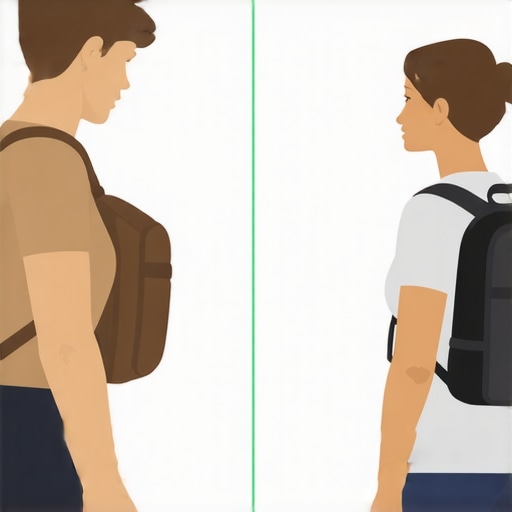
Adjust Your Straps to Stop the Pendulum Effect
Most people wear their bags too low. If the bag is bumping against your butt while you walk, it’s acting like a pendulum, swinging with every step and tugging on your shoulders. This constant micro-trauma is a fast track to needing neck pain solutions later in life. Tighten those straps until the bag is snug against the curve of your mid-back. When the bag moves with you rather than against you, your core can actually stabilize the load. I remember the first day I hiked my bag up—I felt ridiculous, like a middle-schooler on his first day. But by the time I got to my office, that familiar burning sensation in my traps was non-existent. It’s a trade-off I’d make every single time.
Distribute Groceries Like a Human Scale
The ‘One Trip’ grocery rule is a spine-killer. I once tried to carry six bags of groceries in my left hand just so I could keep my right hand free to unlock the door. I felt a pop in my mid-back that sidelined me for a week. Now, I purposefully divide the weight. If I have a gallon of milk, I make sure the other hand has something of equal weight. Learning how to properly carry groceries to balance your spinal load is about making two trips if you have to, or using a cart for the heavy stuff. If you feel a sharp zing while carrying something, stop. That’s your nervous system warning you that you’re about to overtax a disc. To manage the immediate tension, you can try the 30-second neck tuck to stop tension headaches that often follow a heavy lifting session. Balancing the weight isn’t just a suggestion; it’s the only way to ensure your ‘commuter’s hunch’ doesn’t become your permanent posture.
We’ve talked about the weight on your shoulders, but here is where most people get it wrong: they think ‘fixing’ the bag is the end of the story. In my experience, focusing solely on the external load is like putting a band-aid on a broken leg. The hidden nuance that no one tells you is that your body isn’t just reacting to the weight; it’s reacting to how you perceive that weight. Many of us fall into the trap of ‘bracing’—tensing every muscle in anticipation of the pain—which actually creates more restriction than the bag itself. We need to look deeper into the mechanics of why these patterns persist even when the bag is gone.
Stop Trying to Sit Perfectly
You’ve probably been told to sit up straight, shoulders back, chin tucked, like you’re a soldier on parade. But honestly? That advice is making you worse. I’ve seen countless clients whose why your perfect sitting posture is making you stiffer becomes the very reason they can’t find relief. When you hold a rigid position, you’re essentially putting your muscles into an isometric contraction that lasts for hours. This cuts off blood flow and leads to that deep, gnawing ache. A 2019 study published in The Lancet highlights that for chronic low back pain, physical activity and movement are far more effective than bed rest or rigid ergonomic fixes. Your best posture is your next posture; movement is the only way to neck pain solutions innovative strategies for fast recovery.

Why Does the Pain Keep Coming Back After You Get Adjusted?
This is the question that separates the beginners from the experts. You get an adjustment, you feel great for forty-eight hours, and then that familiar ‘zing’ returns. It’s because you haven’t addressed the neurological ‘memory’ of your injury. If you’ve spent a decade carrying a heavy bag on your right side, your brain thinks that ‘crooked’ is ‘straight.’ To break this cycle, you have to understand why maintenance care is better than waiting for a spinal crisis. It’s about retraining the nervous system, not just cracking a joint. Without consistent movement and variety, your body will default to its old, painful settings.
The Stretching Mistake That Actually Aggravates Sciatica
Here is a massive ‘oops’ factor I see every single day: people trying to stretch their way out of nerve pain. When your leg is burning, the instinct is to grab your toes and pull. However, why stretching your hamstrings often makes your sciatica worse is a biological reality. Nerves do not like to be stretched; they like to be ‘glided.’ If you pull a sensitized nerve, you’re just irritating the sheath. Instead of aggressive stretching, you should focus on the nerve glide exercise that calms burning leg pain. This allows the nerve to move through the tissue without being yanked like a rubber band.
Don’t forget the connection between your head and your spine, either. If you’re constantly stressed, the connection between jaw clenching and chronic neck pain can keep your upper traps in a state of permanent fire. You can buy the most expensive backpack in the world, but if you’re clenching your teeth and holding your breath, your neck will never relax. It’s all connected. Have you ever fallen into this trap? Let me know in the comments.
The Tools That Actually Saved My Sanity
I spent thousands of dollars on fancy gadgets before realizing that the simplest tools are often the most effective. For instance, I used to think a $1,200 chair would solve everything. But if you don’t know how to pick a chair that actually supports your lumbar curve, you’re just buying an expensive place to slouch. My ‘secret weapon’ isn’t high-tech; it’s a simple, firm lumbar roll. Knowing how to use a lumbar roll to prevent mid-day back fatigue changed my work life more than any standing desk ever did. It provides that physical ‘stop’ that prevents your low back from rounding into a C-shape while you’re deep in a project.

As Dr. Stuart McGill, author of Back Mechanic and a leading expert in spine biomechanics, famously notes, ‘there is no such thing as a one-size-fits-all chair.’ He emphasizes that spinal hygiene is about the cumulative load. This is why I also swear by a lacrosse ball for my upper traps. It’s a precision tool for back pain breakthroughs that targets specific trigger points a foam roller simply can’t reach. If you’re looking for unlocking sciatica relief expert strategies for lasting comfort, you need to stop thinking about ‘fixing’ your back and start thinking about ‘managing’ your environment.
How do I keep my spine healthy for the next twenty years?
The answer is brutally simple: consistency beats intensity every single time. You don’t go to the gym once for ten hours and expect to be fit; you go for thirty minutes every day. The same applies to mobility mastery daily tips to keep your spine and joints healthy. It’s the micro-breaks and the ‘posture resets’ that add up over decades. I personally use a ‘movement snack’ approach. Every time I finish a task, I stand up and walk for sixty seconds. This is a foundational part of revitalize your neck because it prevents the tissue creep that happens when you’re frozen in one spot. If you want long-term results, you have to build a lifestyle that prioritizes enhance your back mobility through variety, not just better furniture.
The Future of Mobility Is Dynamic Not Static
Looking ahead, I predict a massive shift away from ‘perfect’ sitting toward ‘active’ environments. We are already seeing the rise of wearable tech that vibrates when your core muscles go slack, and I believe the next decade will bring furniture that subtly shifts your weight to prevent blood pooling and disc compression. Until then, we have to be our own advocates. Don’t wait for a crisis to seek why maintenance care is better than waiting for a spinal crisis. The best results come to those who treat their spine like a high-performance machine that requires daily tuning, not a piece of wood that only needs a carpenter when it snaps. **Your challenge today:** Set a timer for 25 minutes. When it goes off, stand up and perform the 3-second pelvic reset. It’s the smallest change with the biggest long-term ROI. Let’s keep this momentum going.
The Truth About Why Your Back Stays Angry
I spent years thinking that if I just rested enough, my spine would magically reset itself. This was my most expensive mistake. The hard truth is that motion is the only real lubricant for your joints. If you are waiting for the pain to disappear completely before you start moving, you are accidentally inviting stiffness to move in permanently. One of my biggest lightbulb moments was realizing that pain is a messenger, not a monster. When you feel that familiar ache, it’s not your body failing; it’s your nervous system asking for a change in position. I also learned that ‘perfect’ posture is often a trap. The most resilient people I know aren’t the ones who sit like statues; they are the ones who move frequently and understand that back pain breakthroughs come from variety, not rigidity.
My Go-To Kit for a Pain-Free Commute
You don’t need a high-tech home gym to reclaim your mobility. My personal toolkit is actually quite humble and fits right in my (two-strap!) backpack. First, I always keep a tennis ball handy; learning how to use a tennis ball to relieve glute tension while sitting on a plane or at a desk is a total game-changer for my lower back health. Second, I recommend the Back Mechanic guide for anyone who wants to understand their specific triggers. Third, I swear by a 5-minute stretching routine for chronic desk workers that I perform every single morning. These tools provide the consistent, small wins that lead to long-term relief without needing a massive lifestyle overhaul.
#IMAGE_PLACEHOLDER_E#
Your Body is Ready to Heal
It’s easy to feel like your back is ‘broken’ or that you’re just ‘getting old,’ but your tissues are remarkably adaptable. Whether you are dealing with a desk-bound hunch or trying to revitalize your neck after years of single-strap bags, the path forward starts with one small, intentional choice today. Don’t let the fear of a flare-up stop you from exploring your range of motion. You have the tools, the knowledge, and the power to change your physical narrative. If you ever feel stuck or need specific guidance, don’t hesitate to reach out for professional support. Your future self—the one who moves without thinking about their spine—is waiting for you to take that first step. Have you ever noticed your pain flares up more during stressful weeks at work? Let me know in the comments below!