
The couch-stretch variation for people who cannot touch their toes
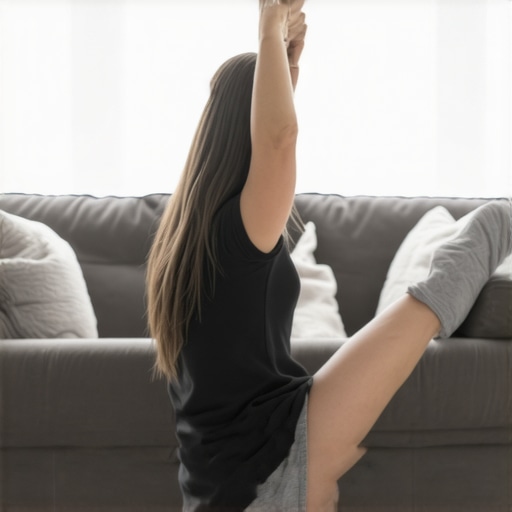
I used to think I was simply built from different materials than the people I saw in yoga classes. While they folded effortlessly in half like high-end stationery, I felt more like a piece of dry, brittle plywood. Every time I tried to reach for the floor, my fingers would stall somewhere around my mid-shins, and my lower back would start screaming for mercy. It was embarrassing, frustrating, and honestly, a bit painful. I spent years convinced that my hamstrings were just naturally short, but I was making a classic mistake that many of us do. I eventually learned that why stretching your hamstrings won’t fix your tight legs often comes down to the fact that the tension isn’t starting in the back of your thighs at all. It is starting in the front of your hips. Today, I want to show you the specific couch-stretch variation that saved my mobility, even when I couldn’t get anywhere near my toes.
Why Your Tight Hips Are Keeping You From Touching Your Toes
The “lightbulb moment” for me happened when I stopped trying to force my spine to bend and started looking at my hip flexors. If you spend most of your day in a chair, those muscles on the front of your pelvis are constantly shortened. This creates a pelvic tilt that pulls your hamstrings taut before you even start to move. I realized that why reaching for your toes is the worst way to stretch your back is because it forces the spine to compensate for hips that won’t budge. According to the Journal of Physical Therapy Science, prolonged sitting significantly shortens the iliopsoas muscle, which is a primary driver of lower back discomfort and restricted range of motion. I used to think resting would help, but I found out the hard way why your back hurts more after a day of resting on the couch—it just keeps those muscles in that same cramped position.
Is This Move Too Advanced for Someone as Stiff as a Board?
You might be looking at the traditional couch stretch—where you put your knee against the back of a sofa and your foot straight up the wall—and thinking, “No way.” I felt the same. When I first tried the standard version, I couldn’t even get my torso upright without feeling a sharp pinch. That is where the modification comes in. We aren’t going for maximum depth on day one. We are going for a position that allows your nervous system to actually relax. If you’ve ever felt like your body is literally “fighting” a stretch, it’s because you’re pushing too hard, too fast. Have you ever felt that sharp, defensive tightening when you try to stretch? Let me know in the comments if your body tends to lock up the moment you try to get flexible. We are going to bypass that reflex entirely. I’ll show you how a slight change in your setup can turn this from a torture session into a move that finally lets your hips breathe. We often forget that why a tight psoas is often actually a weak psoas plays a huge role in how we feel, and this variation addresses that balance perfectly.
Start Your Setup Away From the Wall
To begin, find a padded surface—a yoga mat or a folded towel is perfect because your kneecap will thank you later. Instead of jamming your knee right against the back of the couch like the professionals do, back it away about six to twelve inches. This extra space is the secret sauce for anyone who feels like they are made of steel cables. I remember the first time I tried this; I was so focused on perfect form that I ended up with a literal bruise on my shin. When I finally backed off and gave my joints some breathing room, the relief was instantaneous. You want your back foot resting on the seat of the chair or the couch, while your front leg is in a lunge position. Boost your back mobility with simple exercises like this by focusing on stability first, not depth. 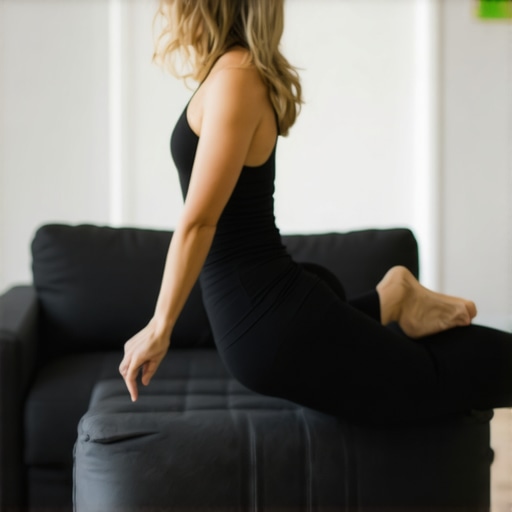
Stop the Water From Spilling Out of Your Pelvis
Think of your pelvis as a bowl full of water. When you have tight hip flexors, that bowl tilts forward, spilling water out the front. This is why you might see a simple way to check your own spine for pelvic tilt as the first step in most rehab programs. In this stretch, your goal is to pull the front of the bowl up. Squeeze your glute on the side where the knee is down. This turns off the muscle on the front of the hip through a process called reciprocal inhibition. It is like how you cannot keep your fist clenched if you are trying to extend your fingers. If you have spent the day working, remember why your glutes turn off when you sit for over an hour—they need this manual wake-up call to protect your lower back.
The Reach and Breathe Method for Deeper Release
Once you are upright and your glute is squeezed, do not just hang out there. Most people make the mistake of arching their lower back to feel a bigger stretch, but that is just cheating. It is also why your couch is the worst place to sit with a herniated disc—it encourages that lazy, rounded or excessively arched posture. Instead, keep your ribs tucked down. I used to think I needed to lean back, but I actually found that how a simple reach and breathe move can decompress your back is the real key. Reach the arm on the same side as your down-knee toward the ceiling. As you inhale, imagine your spine getting longer. As you exhale, let the tension in the front of your hip melt away. This is not a contest of flexibility; it is a conversation with your nervous system. By staying in this modified position for two minutes per side, you are teaching your body that it is safe to let go of that protective guarding. This mechanical shift prevents the sharp tugging that usually happens when you move.For years, I believed the mantra ‘no pain, no gain’ applied to my morning mobility routine. I thought if I didn’t feel a deep, burning ache, I wasn’t actually changing my tissues. This is the biggest mistake I see people make today.
Stop Forcing Your Way Into Flexibility
The common belief is that you can simply ‘bully’ your muscles into lengthening through sheer willpower and force. In reality, your brain is the ultimate gatekeeper of your range of motion. When you push into sharp pain, you trigger the stretch reflex, a protective mechanism that causes the muscle to contract to prevent a tear. This is exactly why some sciatica stretches actually pinch the nerve further instead of providing the relief you crave. If your body perceives a threat, it won’t relax—it will tighten up even more to protect your spine. Have you ever fallen into this trap where you feel looser for five minutes but then stiffer than a board an hour later? Let me know in the comments.
How do you know if your tightness is actually a nerve crying for help?
This is the nuance that separates a beginner from someone who truly understands their body. Muscular tightness usually feels like a dull, broad ache. Neural tension, however, often feels like a ‘zip’ of electricity, a burning sensation, or a sharp line of pull that doesn’t change no matter how much you breathe. If you have sciatica, you need to know the difference between muscular sciatica and a slipped disc before you start any aggressive stretching program. Pushing a nerve that is already compressed is like pulling on both ends of a frayed rope; you aren’t fixing the rope, you’re just making the tear bigger. According to a study in the Journal of Physical Therapy Science, neural mechanosensitivity can be aggravated by standard static stretching, which is why modern rehab often favors ‘nerve glides’ over traditional holds. 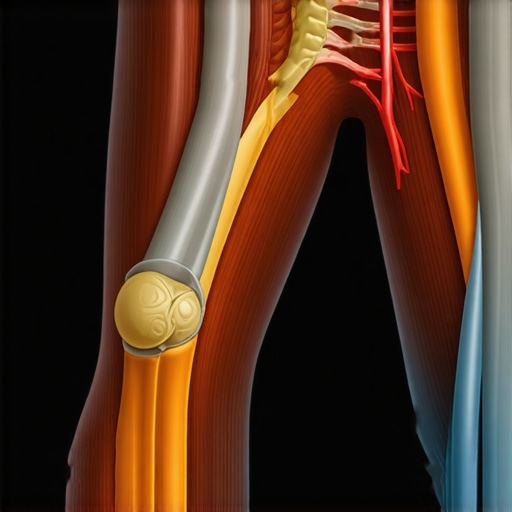
Avoid the Vicious Cycle of Self-Cracking
Another ‘oops’ factor I see constantly is the urge to ‘pop’ your own back or neck when things feel tight. I used to do it every twenty minutes at my desk. While it feels like a release, why cracking your own back is making your joints more unstable is something we rarely talk about. You are likely hitting the segments that are already too mobile, while the stuck ones stay stuck. It is a temporary dopamine hit that masks a deeper issue. Even the way we sit can be a trap; I found that why your perfect upright posture is actually tensing your spine often comes down to over-activating the very muscles that are already exhausted. Instead of forcing a rigid ‘military’ posture, focus on a stacked posture where your ribs sit naturally over your pelvis. This allows the psoas and the deep spinal stabilizers to work as a team rather than as exhausted enemies.Maintaining the progress we have made requires more than just occasional stretching; it requires making your environment do the heavy lifting for you. I used to think I needed an expensive ergonomic chair to fix my issues, but I realized that knowing how to set up your home office for less than fifty dollars was far more effective. The goal is to stop the daily micro-trauma that happens when we are distracted. For instance, I now swear by a simple lumbar roll. It is not just a cushion; it is a tactile reminder for your spine to stay in its natural curve. If you have ever struggled with placement, learning the specific way to use a lumbar roll for maximum relief can prevent the mid-back fatigue that usually sets in by lunchtime. I also keep a lacrosse ball under my desk. While a soft ball is okay, how a simple tennis ball can release your deep glute tension is a game-changer for someone who sits for more than four hours a day.
How can I keep my spine healthy without a gym membership?
Consistency beats intensity every single time. My personal maintenance routine focuses on ‘spine hygiene’—a term coined by Dr. Stuart McGill, a world-renowned spine biomechanist at the University of Waterloo. His research emphasizes that the way we brush our teeth or tie our shoes matters as much as our workouts. For example, I had to relearn the specific way to tie your shoes when you have a herniated disc to avoid that repetitive forward flexion. It sounds small, but these small wins stack up. You can find more of these daily tips to keep your spine and joints healthy in my previous guides, but the main takeaway is to never let your spine stay in one position for too long. 
Why biofeedback is the future of back health
Looking ahead, I predict we are going to see a massive shift toward wearable biofeedback. We are already seeing apps that use your phone’s camera to detect ‘text neck,’ and soon, smart clothing will vibrate the moment your psoas starts to tighten or your ribs flare. We are moving away from ‘fixing’ pain and toward ‘preventing’ it through real-time data. In the meantime, you can create your own low-tech biofeedback. One of my favorite tricks is to adjust your rearview mirror to force better driving posture. If you slouch, you can’t see the cars behind you. It’s a genius way to stay honest with your alignment. Also, make sure you are following the 15-degree rule for your computer monitor to keep your cervical spine in a neutral ‘stacked’ position. If you really want to level up your recovery tonight, I challenge you to try the mirror trick on your drive home. It is the most immediate way to see exactly how often you ‘lapse’ into a slump without realizing it.
Why I Finally Stopped Trying to Force My Progress
The most important thing I learned wasn’t a new stretch; it was that my body wasn’t ‘broken,’ it was just ‘protected.’ When I stopped treating my muscles like stubborn rubber bands and started treating them like sensitive sensors, everything changed. I realized that why stretching your hamstrings won’t fix your tight legs is often because the brain is holding that tension for a reason. Once I gave my nervous system a sense of safety through the modified couch stretch, the ‘steel cables’ in my thighs finally started to soften. It was a lightbulb moment: you can’t bully your way into flexibility; you have to negotiate for it.
The Cheap Tools That Outperform Expensive Chairs
You don’t need a thousand-dollar setup to find relief. My daily maintenance routine relies on simple, low-tech items that actually work. First, if you haven’t yet, look into the specific way to use a lumbar roll for maximum relief—it is the single best way to maintain your lumbar curve while working without thinking about it. I also recommend checking how to set up your home office for less than fifty dollars because smart ergonomic placement beats high-end furniture every time. Finally, keep a constant eye on your alignment by learning the simple way to check your own spine for pelvic tilt throughout the day to ensure your ‘water bowl’ isn’t spilling.
#IMAGE_PLACEHOLDER_E#
Start Your First Two Minutes Today
Improving your back mobility doesn’t require hours in the gym or a complete lifestyle overhaul. It requires these small, consistent shifts in how you sit, stand, and move. You now have the tools to stop the cycle of ‘stretch, tighten, repeat’ and actually move toward lasting change. For more guidance on staying limber and avoiding the common traps of modern life, explore these daily tips to keep your spine and joints healthy. Your body is capable of incredible change, no matter how ‘stiff’ you feel right now. Have you noticed that your body feels tighter after a long day of trying to maintain ‘perfect’ upright posture? Let me know in the comments below!