
How a simple tennis ball can release your deep glute tension
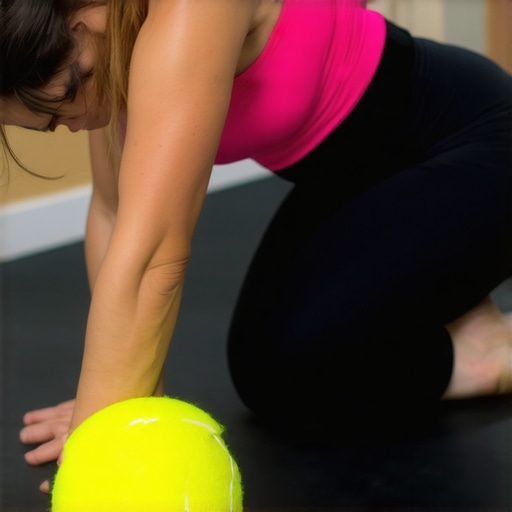
I remember the exact moment I realized my body was winning the war against my productivity. I was trying to stand up after a long session at my desk, and a sensation like a hot soldering iron seared through my right glute. I couldn’t even reach for my phone without a wincing grunt. In my early days of trying to fix this, I made the classic mistake of stretching my hamstrings for hours, thinking the tightness was the problem. It wasn’t. I was actually making it worse. It turns out, I was dealing with a locked-up piriformis muscle that was effectively strangling my sciatic nerve. I tried the fancy foam rollers and the expensive vibrating massage guns, but the real breakthrough came from a dusty, neon-yellow tennis ball I found under my couch. Today, I am going to show you how that $2 dog toy can do more for your mobility than a hundred-dollar massage, specifically by targeting the trigger points that keep you in a cycle of pain.
Stop Treating Your Glutes Like a Spare Tire
We often ignore our hips and glutes until they scream at us, usually after we’ve spent too much time in a car or an office chair. I used to be the person who would reach into the back seat from the driver’s seat, oblivious to how those tiny, repetitive strains were adding up. This deep tension isn’t just about feeling ‘sore’; it’s about how your entire lower kinetic chain is functioning. When your deep glute muscles—like the piriformis or the obturators—clamp down, they can create a literal bottleneck for blood flow and nerve signals. This is often why you feel that sharp pinch when standing up from a chair or why your leg feels heavy after a long day. If you’ve ever wondered why your wallet in your back pocket causes so much trouble, it’s because it creates an uneven platform that forces these deep muscles to work overtime just to keep you upright. By using a tennis ball, we can provide a specific, pin-point pressure that a foam roller simply cannot reach, allowing those stubborn fibers to finally let go. Have you ever felt a knot in your hip that felt like you were sitting on a literal golf ball?
Can a Cheap Dog Toy Really Outperform a Professional Massage?
It sounds almost too simple to be true, and I was the biggest skeptic at first. I thought I needed ‘medical grade’ equipment to fix what felt like a medical-grade problem. However, the science of self-myofascial release supports this low-tech approach. According to a study published by the International Journal of Sports Physical Therapy, self-myofascial release using small, dense objects can significantly improve joint range of motion without negatively impacting muscle performance. The tennis ball works because its slight ‘give’ prevents you from bruising the bone while still being firm enough to sink into the thick layers of the gluteus maximus. This helps you find the sciatica relief secrets that professionals use without the professional price tag. Before we get into the exact movements, you need to understand the difference between muscular sciatica and a slipped disc, because while the tennis ball is a miracle for muscles, you have to be gentle with your spine. I’ve spent years figuring out how a tennis ball can relieve deep glute and sciatic pain through trial and error, and the biggest lesson I learned was that more pressure isn’t always better—precision is what matters.
[image_placeholder]
Find the Sweet Spot Without Bruising Your Bone
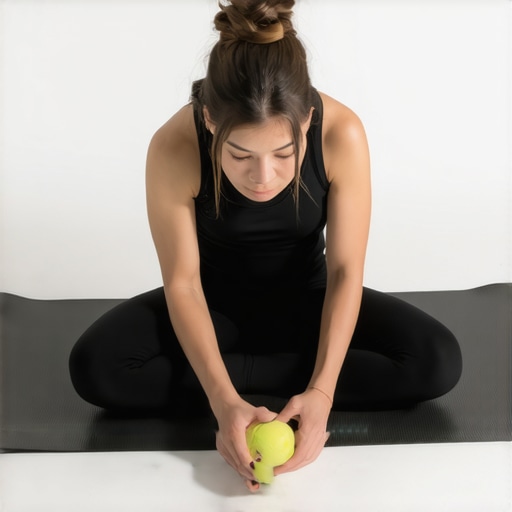
To start, you need to ditch the soft cushions. I once tried doing this on my sofa while watching a movie, but the ball just disappeared into the upholstery, and I ended up with zero relief and a very confused dog. This is why your couch is the secret cause of your morning back stiffness; it lacks the resistance needed for actual change. Sit on a firm floor or a yoga mat. Bend your knees and place the tennis ball under the fleshy part of one glute. Do not put it directly under your sit-bone (the hard bone you feel when sitting on a chair). Instead, shift your weight slightly until you find a point that feels tender or ‘tight.’ This isn’t about crushing the muscle; it’s about signaling the nervous system that it’s okay to let go.
The Sink and Breathe Method
The biggest mistake people make is rolling back and forth like they are kneading dough. That aggressive friction can actually inflame the area further. Instead, I want you to practice the ‘sink.’ Once you find a trigger point, stay there. Use your hands behind you for support to control how much weight you drop onto the ball. Take a deep breath in through your nose and, as you exhale, imagine your hip melting over the ball. This is where the 10-second breathing trick for instant lower back relief becomes your best friend. In my early days, I was so impatient that I’d press down as hard as I could, thinking I could force the knot to pop. I ended up with a massive bruise and couldn’t sit comfortably for three days. I learned the hard way that why gentle is the most important word applies to self-care just as much as it does to professional adjustments.
Move Your Leg to Pin and Stretch
Once you’ve mastered the sink, you can add a dynamic element to effectively ‘floss’ the muscle. While keeping the pressure on that specific spot, slowly drop your knee out to the side toward the floor, then bring it back to the center. This movement forces the piriformis to slide under the pressure of the ball, breaking up adhesions that a static stretch would miss. If you’ve been looking for ways to boost your back mobility, this active release is far more effective than reaching for your toes. You’ll feel a ‘good hurt’—that deep, dull ache that signals the muscle is finally yielding. If the pain becomes sharp or electric, move the ball immediately. You never want to compress the sciatic nerve itself; we are targeting the ‘meat’ around it.
Avoid the Nerves and Focus on the Meat
If you feel a zing down your leg that feels like a lightning bolt, you are likely sitting directly on the nerve. Back off. The goal is to hit the trigger points in the muscle belly, not the nerve itself. If you aren’t sure where your pain is coming from, you might want to try the simple test to see if your leg pain is actually sciatica before you continue. By keeping the ball in the upper-outer quadrant of your glute, you stay in the safe zone. I remember one specific session where I finally hit the exact spot where my glute meets my hip. It felt like a dam breaking; suddenly, the warmth returned to my foot and the constant humming in my calf just stopped. It wasn’t magic—it was just the first time in months that my piriformis wasn’t acting like a tourniquet. Learning how a tennis ball can relieve deep glute and sciatic pain is about this kind of precision, not power.
While that tennis ball trick is a game-changer, I need to address the elephant in the room: our obsession with stretching. Most people think that if a muscle feels tight, they need to pull on it harder. This is a massive mistake when dealing with the sciatic nerve. Nerves are not like muscles; they do not have the same elasticity. When you yank on a sensitized nerve, you aren’t ‘loosening’ it—you are irritating it. This is exactly why stretching your hamstrings can actually flare up sciatica rather than fixing it. If your pain is coming from a disc or a truly inflamed nerve, that long, slow hold is just cutting off the nerve’s blood supply. I’ve seen so many people try to ‘power through’ the discomfort, only to end up with a leg that feels like it is on fire for three days. Have you ever fallen into this trap of thinking more pain equals more gain? Let me know in the comments because I certainly did for years.
Why Does Your Hamstring Feel Tight Even After an Hour of Yoga?
The hidden nuance here is neural tension. Your brain will often make your muscles feel tight as a protective mechanism to keep you from overstretching a vulnerable nerve. If you keep stretching the muscle without addressing the nerve’s sensitivity, the brain just clamps down harder. This is a core concept in back pain breakthroughs that shift the focus from simple flexibility to neural mobility. A study published in the Journal of Orthopaedic & Sports Physical Therapy (JOSPT) highlights that neural mobilization—think gentle ‘sliding’ or ‘flossing’ rather than ‘stretching’—is significantly more effective for reducing symptoms than traditional static stretching. This is also why you should avoid the cobra stretch during a back spasm; for many, that extension pinches the nerve roots even further and escalates the protective response.
#IMAGE_PLACE_HOLDER_C#
Stop Aiming for That Perfect Military Stance
Another trap I fell into was the ‘perfect posture’ myth. I used to walk around with my chest puffed out and shoulders pinned back, thinking I was doing my spine a favor. In reality, why your straight posture is actually straining your muscles becomes obvious when you realize how much constant isometric tension you are creating. You are not a statue; your spine needs to move and breathe. When you force a rigid position, you are just exhausting the small stabilizer muscles until they eventually give up and spasm. Instead of chasing a ‘straight’ back, focus on a ‘supple’ back. When you start conquering sciatica, you learn that movement variability is your best friend. Look for the one sign that your sciatica is finally starting to heal, which is usually ‘centralization’—the pain moving from your foot or calf back up toward your lower back. If your stretching makes the pain travel further down your leg, stop immediately; you are heading in the wrong direction.
Once you’ve calmed the fire in your glutes, the real work begins. I spent years in a ‘pain-relief-pain’ cycle because I treated my recovery like a destination rather than a lifestyle. Now, I view my body like a high-performance machine that requires a specific toolkit for long-term maintenance. Beyond the tennis ball, I’ve integrated a few non-negotiables into my environment. For instance, I realized that my desk setup was a constant source of micro-trauma. I adopted the 15-degree rule for your computer monitor to save your neck, and the difference in my end-of-day tension was immediate. I also swapped my standard chair for one with a lumbar roll that actually matches my spine’s curve, because I learned that enhance your back mobility ergonomic tips for everyday comfort aren’t just suggestions—they are the blueprints for a pain-free life.
Your Toolkit Needs More Than Just a Tennis Ball
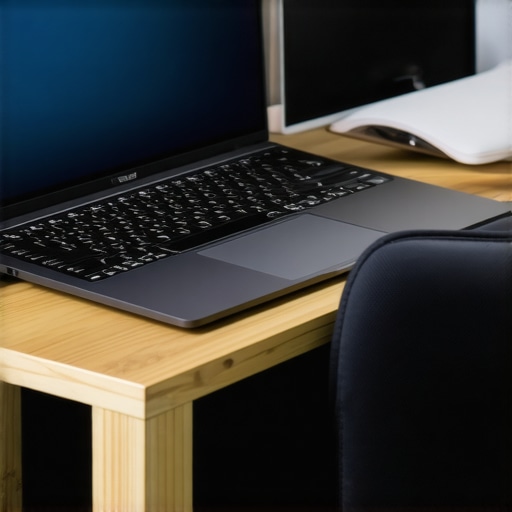
While the tennis ball is my ’emergency’ tool, my daily maintenance relies on understanding how my environment shapes my posture. If you’re still working from a laptop on your kitchen counter, you are fighting a losing battle. I’ve found that using a dedicated laptop stand and an external keyboard is the only way to keep my shoulders from creeping toward my ears. These small overcoming sciatica top lifestyle changes for better quality of life seem trivial until you realize that they prevent thousands of hours of accumulated strain. I also swear by a firm lumbar support, even when I’m driving. In fact, learning how to sit in a car for hours without triggering sciatica changed my perspective on road trips entirely. It’s about creating an environment where your spine can rest in its natural neutral position without you having to think about it constantly.
How do I stop the pain from coming back next month?
Maintenance is about what you do in the ‘in-between’ moments. I no longer spend an hour at the gym trying to ‘fix’ my back; instead, I sprinkle movement snacks throughout my day. I’ve incorporated the 5-second glute squeeze that prevents sciatica flares while standing into my morning coffee routine. When I’m doing chores, I’m hyper-aware of my mechanics—learning how to carry a heavy laundry basket without a back spasm has saved me more times than I can count. This approach is backed by experts like Dr. Stuart McGill, author of Back Mechanic, who argues that ‘spine hygiene’—the way we move during common daily tasks—is the single most important factor in long-term recovery. He emphasizes that we have a ‘load tallies’ for our discs, and by moving efficiently, we keep that tally low. By focusing on mobility mastery daily tips to keep your spine and joints healthy, you turn your mundane movements into a form of rehabilitation.
The Future of Mobility is Micro-Movement
Looking ahead, I believe we are moving away from the ‘big stretch’ era and into the era of neural hygiene and micro-adjustments. As we head into 2025, the focus is shifting toward how our nervous system perceives safety. In my own journey, I’ve seen unlocking mobility expert tips on managing back pain in 2025 emphasize eccentric loading and gentle nerve gliding over aggressive static stretching. We are learning that a resilient spine isn’t necessarily a ‘flexible’ one; it’s one that can stabilize under load and adapt to different positions. This is why I focus on back pain breakthroughs that prioritize strength in the deep core stabilizers rather than just chasing a deeper toe-touch. I want you to try one specific thing today: the next time you are standing in line or at your sink, perform that five-second glute squeeze. It sounds silly, but it resets your pelvis and takes the immediate pressure off your sciatic nerve. It’s the smallest habit that often yields the biggest results.
The Painful Lessons That Finally Taught Me to Listen
I spent years thinking I could outrun my pain with more intensity. I was wrong. One of the biggest ‘lightbulb moments’ I had was realizing that intensity is actually the enemy of healing when your nerves are involved. If you push too hard, your nervous system interprets that pressure as a threat and clamps the muscle down even tighter. I also learned that the brain controls the tension; if you don’t feel safe, you won’t get loose. This is exactly why your favorite yoga pose might be hurting your spine—if it’s triggering a defensive reflex, it’s doing more harm than good. Finally, I discovered that ‘movement snacks’—short, ten-second adjustments like the 5-second glute squeeze that prevents sciatica flares while standing—are infinitely more effective than a once-a-week hour-long stretching marathon.
The Simple Gear That Saved My Sanity
You don’t need a gym full of equipment to regain your life, but you do need a few high-value tools. My essential toolkit starts with the humble tennis ball for pin-point pressure, but it doesn’t end there. I trust a dedicated laptop stand to keep my cervical spine neutral because I’ve seen why your laptop stand might be making your neck knots worse when it’s at the wrong height. I also never drive without a small lumbar roll now that I know how to sit in a car for hours without triggering sciatica. For deeper reading, I always recommend Dr. Stuart McGill’s Back Mechanic; his work on spinal hygiene is the gold standard for anyone serious about sciatica relief secrets that actually stick.
[IMAGE_PLACEHOLDER_E]
Your Path to Living Without That Constant Hum of Pain
Recovery isn’t a straight line, and there will be days when your body feels like it’s taking two steps back. But remember, you now have the tools to talk back to that pain. By prioritizing mobility mastery daily tips to keep your spine and joints healthy and focusing on gentle, neural-focused movements, you are rewriting your body’s story. You aren’t just ‘fixing a back’; you are unlocking sciatica relief expert strategies for lasting comfort that will serve you for decades. Don’t wait for the next flare-up to start these habits. Start today, be patient with your progress, and trust that your body wants to heal just as much as you want it to. Have you ever tried the tennis ball trick only to find it made things feel tighter the next day? Let me know in the comments so we can troubleshoot together.