
Why Your Shoulder Blades Should Move When You Reach Upward

I reached for the coffee beans on the top shelf of my pantry. High shelf. Left side. Snap. That familiar, sharp pinch shot through my collarbone. I’d spent months trying to maintain perfect posture by pinning my shoulder blades down and back, thinking I was doing my body a favor. Boy, was I wrong. I thought I was protecting my joints, but I was actually suffocating them. If you’ve felt that same snag when reaching for a coffee mug or putting on a jacket, I’m here to tell you that your shoulder blades aren’t meant to be statues. They are meant to dance. Today, we are going to fix that stuck feeling and get your arms moving freely again.
Stop pinning your shoulders back like a statue
For the longest time, I believed the lie that shoulders down and back was the ultimate fix for slouching. I forced my scapulae—those flat wing bones on your back—to stay low every time I lifted my arm. It felt stable, sure, but it also felt like my joints were grinding against each other. The truth is, your shoulder blade needs to rotate upward to make room for your arm bone. When you trap it down, you create a collision. I eventually learned that why your shoulder blade pain might actually be a neck issue stems often from this very lack of movement. My early mistake was prioritizing a rigid look over functional mechanics, and it cost me months of discomfort. It turns out that mobility mastery isn’t about being still; it’s about being fluid. When you reach up, those blades should slide and pivot like a well-oiled machine. If they don’t, your neck and lower back start picking up the slack, and that’s when the real trouble begins.
Won’t moving my shoulders ruin my posture?
I know what you’re thinking because I thought it too. If I let my shoulders move up, won’t I look like I’m shrugging all day? Won’t that make my neck even tighter? It’s a valid fear. We’ve been conditioned to think that any upward movement of the shoulders is stress or tension. But there is a massive difference between a stressed-out shrug and a healthy scapular rotation. When your shoulder blade moves correctly, it actually offloads the tension from your upper traps. Research published in the Journal of Orthopaedic & Sports Physical Therapy (JOSPT) confirms that healthy overhead reaching requires a 2:1 ratio—for every two degrees your arm lifts, your shoulder blade must rotate one degree upward. Without that movement, you’re essentially hitting a biological wall. I found that incorporating the 30-second wall slide into my morning routine changed everything. It taught my brain that it was safe to let go of that rigid, down and back grip. Have you ever felt that annoying click or bone-on-bone sensation when you reach for something overhead? I’d love to hear if you’ve been told to keep your shoulders pinned down like I was.
Understanding why your rib cage position determines your shoulder health is the next piece of this puzzle. If your ribs are flared out, your shoulder blades can’t glide smoothly. It’s all connected. Now that we’ve debunked the statue myth, let’s look at how we can actually retrain these muscles to work together without the pinch.
Reclaim your overhead reach without the crunch
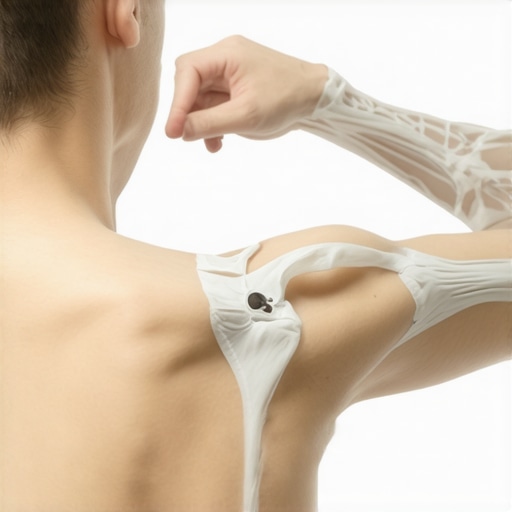
To break the statue habit, we have to wake up a specific muscle you’ve probably ignored: the serratus anterior. Think of this muscle like the engine of a sliding glass door. If the engine is dead, you’re forced to yank the door off its tracks just to get it open. When you reach up, your serratus should pull your shoulder blade forward and around your rib cage. I remember the first time I actually felt this happen. I was reaching for a heavy cast-iron skillet on a high hook. Instead of pinning my shoulder down, I focused on pushing my armpit toward the ceiling. For the first time in years, there was no ‘clunk.’ The skillet felt lighter because I was finally using a functional lever rather than a jammed hinge. This is the essence of the 30-second wall slide—it’s not a stretch; it’s a recalibration of your brain’s movement map.
Turn on the muscle that moves the wing
If you feel a sharp catch when you reach for your seatbelt, your serratus anterior has likely clocked out for the day. You can wake it up with a simple ‘scapular punch.’ Stand facing a wall, arms straight out at shoulder height. Without bending your elbows, try to push the wall away from you. You’ll feel your shoulder blades spread apart. Now, keep that tension and slowly slide your hands up the wall. If you feel your neck muscles jumping in to help, stop. You’ve hit your current limit. This is often why your shoulder blade pain might actually be a neck issue; the small muscles in your neck are trying to do the heavy lifting that your big back muscles should be handling.
Keep the track smooth by leveling your ribs
Your shoulder blade sits on your rib cage like a train on a track. If the track is warped, the train derails. Many of us stand with our lower ribs flared out, which tilts the shoulder blade into a position where it’s guaranteed to pinch. To fix this, think about gently ‘knitting’ your front ribs together as if you’re wearing a slightly snug vest. This creates a flat surface for the scapula to glide over. I used this trick to solve why your head feels heavy by 3 pm every afternoon. By fixing the rib position, my shoulders naturally sat back without me having to force them, which instantly took the strain off my neck. You might also find that addressing how to fix the rounded shoulders you get from scrolling your phone starts with this rib-cage reset rather than just pulling your shoulders back.
Breathe into the space between your blades
Believe it or not, your breath is a mobility tool. When you take shallow chest breaths, you tighten the very muscles that jam your shoulders. Instead, try to send your breath into the space between your shoulder blades. Imagine your lungs expanding like a balloon toward your back. This internal pressure gently pushes the ribs and shoulder blades apart from the inside out. It’s an incredible way to supplement how to use a foam roller on your mid-back without causing pain because it addresses tension that a roller can’t reach. If you master how your breathing pattern affects your core stability, you’ll find that your shoulders stay loose even when you’re stressed or stuck at a desk for hours.
Stop trying to stretch your way out of tension
I used to spend twenty minutes every morning pulling my head from side to side, trying to ‘release’ my upper traps. I thought if I could just stretch them enough, the knots would disappear. This is the biggest trap in the world of mobility: assuming that a ‘tight’ feeling always means a muscle needs to be lengthened. Often, that tightness is actually protective tension. Your brain is tightening those muscles because it doesn’t trust your shoulder joints to stay stable. If you keep stretching a muscle that is already over-lengthened and weak, you’re essentially pulling on a frayed rope. A study published in the British Journal of Sports Medicine (BJSM) highlights that addressing scapular dyskinesis—the improper movement of the shoulder blade—requires strengthening and motor control rather than just passive stretching. When you aggressively stretch, you might be ignoring why your shoulder blade pain might actually be a neck issue or an instability problem. Have you ever fallen into this trap of stretching a ‘tight’ muscle only to have it feel tighter an hour later? Let me know in the comments.
Why does my shoulder still click even when I stand up straight?
This is the question that plagued me for years. I had ‘perfect’ posture, yet my joints sounded like a bowl of cereal. The ‘oops’ factor here is confusing static posture with dynamic health. Standing like a soldier doesn’t mean your joints are functioning well. In fact, forcing yourself into a rigid upright position can lead to why you feel a burning sensation between your shoulder blades because you’re overworking the rhomboids while the serratus anterior stays dormant. If your ribs are locked, your shoulder blade is essentially trying to glide over a speed bump. This is where mobility mastery shifts from being about ‘positions’ to being about ‘patterns.’ You need to ensure your rib cage can move and expand to provide a smooth track for the scapula. #IMAGE_PLACE_HOLDER_C#
The hidden nuance of joint centration
True shoulder health comes from ‘joint centration’—keeping the ball of your arm bone perfectly centered in the socket throughout the entire movement. When we pin our shoulders back, we often nudge that ball forward in the socket, which irritates the tendons. Instead of forcing a position, we should be looking for revitalize your neck effective techniques for lasting pain relief that focus on the relationship between the breath and the upper back. By mastering unlocking mobility expert tips on managing back pain in 2025, you realize that the shoulder is merely the end of a long chain that starts at your feet and moves through your core. If you are struggling with persistent ‘knots,’ stop reaching for the foam roller and start reaching for better mechanics. It’s not about how far you can stretch; it’s about how well you can control the range you already have.
The simple band trick that keeps my ribs in check
I found that the most expensive equipment usually gathers the most dust in the corner of the gym. For my own recovery, the real breakthrough wasn’t a thousand-dollar machine, but a simple $10 long-loop resistance band. I use it for what I call the ‘rib cage hug.’ By wrapping the band around my lower rib cage and holding the ends in front of me, I create a tactile boundary. This is my secret weapon for mobility mastery. Every time I take a breath, the band tells me if I’m flaring my ribs out—which kills shoulder movement—or if I’m successfully breathing into my back. I personally use this during my morning coffee because it anchors my brain to my body before the chaos of the day starts. It’s far more effective than just guessing if your posture is right.

How do I maintain these mobility gains over time?
The hardest part of fixing a ‘stuck’ shoulder isn’t the initial release; it’s making sure you don’t wake up tomorrow feeling just as tight. Maintenance isn’t about doing a 60-minute routine every day. It’s about micro-doses of movement. I’ve integrated enhance your back mobility ergonomic tips for everyday comfort into my work block. Every time I hit ‘send’ on an email, I do one slow scapular rotation. This keeps the neural pathways open. You have to remember that back pain breakthroughs often happen in the small, boring moments of consistency. As Dr. Karel Lewit, a pioneer in manual medicine and author of ‘Manipulative Therapy in Rehabilitation of the Locomotor System,’ once noted, ‘He who treats the site of pain is often lost.’ This perfectly sums up why we look at the ribs to fix the shoulder. If you don’t change the habit of how you reach for your mouse, no amount of therapy will stick.
Real-time feedback is the future of joint health
I predict that in the next few years, we will move away from passive stretching entirely. We are already seeing a shift toward wearable technology that provides haptic feedback—small vibrations on your skin when your shoulder blade stops rotating correctly. Imagine a shirt that gently buzzes when you start to pin your shoulders back like a statue. Until that’s affordable, we have to be our own sensors. This is why I focus so heavily on revitalize your neck effective techniques for lasting pain relief that prioritize feeling over forcing. When you stop trying to ‘fix’ a position and start trying to ‘feel’ a movement, the results become permanent. It’s the difference between a temporary patch and a total system upgrade. If you’re still relying on how to use a foam roller on your mid-back without causing pain to get through the day, you’re missing the bigger picture of why your rib cage position determines your shoulder health. My challenge to you today: the next time you reach for something on a high shelf, don’t pull your shoulder down. Reach up and out, and feel your shoulder blade wrap around your ribs like a supportive hand. Give that ‘rib-knit’ a try during your next walk and see if your neck doesn’t feel instantly lighter.
The Hardest Lessons I Learned While Chasing Perfect Posture
For years, I treated my body like a blueprint that needed to be straightened rather than a living system that needed to move. I realized that stiffness is often a cry for stability, not a request for more stretching. When I finally stopped forcing my shoulders into a military stance, I saw that mobility mastery comes from trust, not tension. I learned that understanding the link between poor posture and chronic back pain isn’t about being perfectly upright—it’s about having the freedom to move through every degree of your range without fear. My biggest ‘lightbulb moment’ was discovering that why your shoulder blade pain might actually be a neck issue often points back to the rib cage being locked in place. If your ribs can’t move, your shoulder blades can’t dance.
My Shoulder Health Survival Kit
You don’t need a gym full of equipment to fix a stuck shoulder. My personal toolkit is remarkably simple. First, a long-loop resistance band is essential for the rib-knit feedback I mentioned earlier. Second, I swear by how a simple tennis ball can release your deep glute tension, which surprisingly helps your shoulders by leveling your pelvis and spine. Third, I always recommend the works of Dr. Karel Lewit for anyone who wants to dive deep into the ‘why’ behind their movement. Finally, never underestimate the simple morning move to prime your spine for the day; it’s the consistency of these small habits that creates lasting change. #IMAGE_PLACEHOLDER_E#
The Future of Your Movement
Your shoulders were designed to carry you through a lifetime of reaching, lifting, and hugging—not to be pinned down like a butterfly in a display case. Start small today. Try one ‘scapular punch’ while you wait for your coffee to brew. Feel your ribs soften and your breath expand. As you move toward mobility mastery, remember that every small adjustment is a step toward a lighter, more capable version of yourself. Your body wants to move efficiently; you just have to give it the right map. Have you ever noticed your shoulders creeping up toward your ears during a stressful workday, or do you find yourself constantly trying to pin them down? Let me know in the comments below.