
Why your thin shoes are impacting your lower back shock absorption
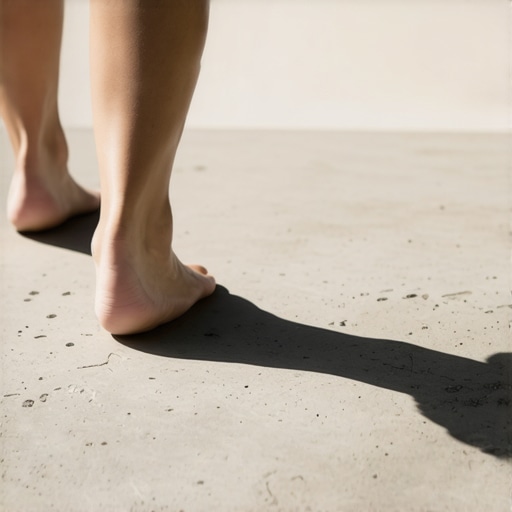
I’ll never forget the week I decided to “go natural” with my footwear. I’d read all the blogs about how humans were meant to walk barefoot, so I bought the thinnest, flimsiest pair of minimalist shoes I could find. I wore them for a three-mile walk on the pavement, feeling very superior—until I got home. My lower back wasn’t just sore; it felt like a stack of bricks that had been jolted out of place. It was a visceral realization that while my feet were free, my spine was paying the price. If you’ve ever felt that sharp, nagging ache after a day in flats or thin sneakers, you aren’t alone. Today, I want to help you understand why your favorite thin shoes are essentially turning off your body’s built-in shock absorbers and what you can do to protect your spine.
Why Your Spine Feels Every Single Step
When you walk, your body deals with something called ground reaction force. Basically, for every action, there’s an equal and opposite reaction. According to research published in the Journal of Applied Biomechanics, walking on hard surfaces can generate forces up to 1.5 times your body weight through your heel. In a cushioned shoe, the foam eats that impact. In thin shoes, that energy has to go somewhere. Since your feet aren’t providing the buffer, that vibration travels up your legs and slams right into your lumbar spine. I made the classic mistake of thinking my body would just figure it out without any transition period. I ignored the fact that the real reason your hamstrings feel tight after a long walk often starts with the lack of support under your heels. It turns out, how a stiff ankle is actually causing your recurrent lower back aches is closely tied to how much impact your footwear allows through. We’re going to look at how to protect your back while still enjoying your favorite shoes, because nobody wants to be stuck wondering is your back pain a sign of something more serious.
Are these thin soles actually worth the risk?
It is a fair question. You hear people swear by the ground feel and improved balance. But for many of us living on concrete and hardwood rather than soft forest floors, the lack of shock absorption is a recipe for disaster. Have you noticed your back stiffness flare up specifically after wearing certain shoes? I’d love to hear if you’ve had that same aha moment I did—or if you’re currently stuck in the ouch phase. Before we move on, let’s look at how you can boost your back mobility to compensate for the hard surfaces we navigate every day.
Rebuild Your Foundation from the Ground Up
Transitioning to thin shoes isn’t just about changing your wardrobe; it is about retraining your entire kinetic chain. Think of your body like a high-performance car. If you suddenly swap out your thick, bouncy tires for thin, racing slicks, you better make sure your suspension is top-notch. If it isn’t, the frame is going to rattle apart. In your body, your suspension consists of your ankles, knees, and hips. Most of us have “sleepy” feet from years of wearing shoes that act like casts, which effectively numbs the proprioceptors that tell your brain how to stabilize your spine. To avoid the pain I felt that first week, you need to wake up the nerves in your soles and prepare your joints for the reality of the pavement.
Wake Up Your Feet Before You Step Outside
Before you even put on those thin shoes, you need to stimulate the tissues. I started using a small tool to roll out my arches every morning. It sounds simple, but how a simple tennis ball can fix deep glute tension actually applies to the feet as well. By breaking up the tight fascia on the bottom of your foot, you allow the bones of the feet to spread out and actually absorb some of that ground force. I remember trying to walk three miles in brand new minimalist flats without any prep. Halfway through, my lower back went into a full-blown guarding response. I actually had to sit on a park bench and perform the 10-second breathing trick for instant lower back relief just to make it back to my car. It was a messy, painful lesson that you can’t just skip the “waking up” phase for your feet if you expect your spine to stay quiet.
Stop Hitting the Pavement Like a Hammer
The biggest mistake people make with thin shoes is keeping their “cushioned shoe gait.” When you have two inches of foam under your heel, you can strike the ground hard without immediate pain. In thin shoes, that same strike is like hitting a nail with a hammer—and your spine is the wood. You must shift your strike toward the mid-foot or forefoot. This allows the arch and the Achilles tendon to act as natural springs. You can practice this by walking softly around your house on a hard surface. If you can hear your footsteps, you’re hitting too hard and sending a shockwave directly into your lumbar discs. This adjustment is essential to how to fix your gait to reduce chronic hip clicking and preventing that jarring energy from traveling up to your neck.
Free Your Ankles to Spare Your Spine
If your ankles are stiff, your body will find mobility somewhere else—usually your lower back. When you wear thin shoes, your ankles have to move through a larger range of motion than they do in heels or thick sneakers because they are no longer being propped up. If they can’t flex properly, your pelvis tilts forward, and your back muscles overwork to keep you from falling. This is why the hidden link between tight calves and neck stiffness is so relevant; tension doesn’t stay in one place. I recommend spending two minutes a day on the simple ankle drill that improves your walking balance. This creates the slack your system needs to handle the lack of artificial support. You should also focus on how to enhance your back mobility to ensure your spine remains resilient as you adapt to this new way of moving. Without this ankle freedom, every step in thin shoes is just another minute spent grinding down your back’s natural defenses.
Common wisdom suggests that if your back hurts after wearing thin shoes, you just need to strengthen your core. I’ve seen countless people spend months doing planks and deadbugs, yet their lumbar spine still feels like it’s in a vice. Here is the contrarian truth: your six-pack doesn’t matter if your hips are locked. In my experience, focusing solely on the ‘core’ is a surface-level fix for a structural problem. If your ankles and hips cannot move, your lower back is forced to become a mobile joint instead of a stable one. This is exactly why your core strength won’t fix your back if your hips are locked. When you wear thin shoes, you are essentially exposing every restriction in your lower body directly to the pavement.
Stop Stretching Your Hamstrings to Fix Back Pain
One of the biggest ‘traps’ people fall into is the ‘oops’ factor of aggressive stretching. When your back feels tight from thin shoes, the natural instinct is to reach for your toes. But here is the danger: if your pain is actually neural—meaning it involves the sciatic nerve—stretching your hamstrings like a piece of rubber can actually make things worse. I learned this the hard way when I tried to ‘stretch out’ a flare-up and ended up unable to sit comfortably for a week. You need to understand that why stretching your hamstrings can actually flare up sciatica is a real risk when your spine is already sensitized. Instead of mindless stretching, you should focus on mobility mastery that respects your nerve tension.
Does Your Spine Really Need More Stability?
We are often told that stability is the cure-all, but many people are actually *too* stable—meaning they are stiff and guarded. A study published in the Journal of Manual & Manipulative Therapy highlights the concept of regional interdependence, showing that dysfunction in the hips or ankles can directly cause compensatory patterns in the lumbar spine that no amount of ‘core bracing’ can overcome. In fact, why your perfect upright posture is actually tensing your spine is a common issue for those trying too hard to protect their backs. If you are constantly bracing, you are just adding more pressure to your discs. Have you ever fallen into this trap of trying to ‘hold’ yourself perfectly still, only to feel more exhausted and stiff? Let me know in the comments.
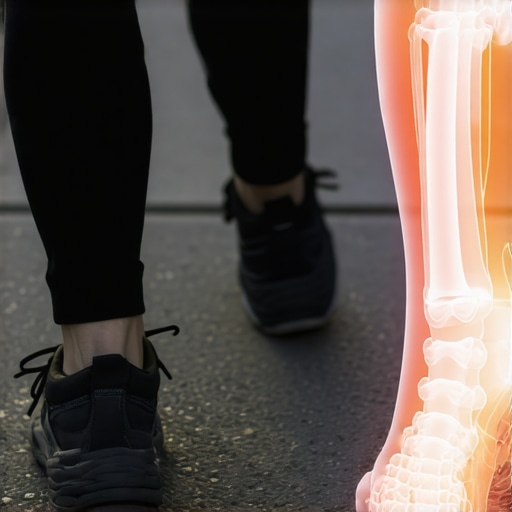
The nuance that most beginners miss is the relationship between ground feel and hip internal rotation. If you can’t rotate your hips, every step in a minimalist shoe forces your lower back to twist instead. To see where you stand, I recommend taking the toe-touch test that reveals your actual back injury risk. It’s not just about reaching the floor; it’s about how your pelvis shifts in space. You can also how to check your own hip mobility in under a minute to find the true culprit of your discomfort. Once you identify these hidden blocks, you can stop blaming your shoes and start addressing the link between poor posture and chronic back pain from the inside out.
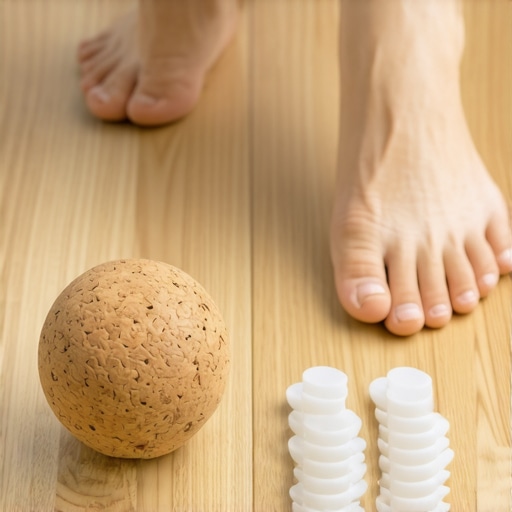
I eventually realized that simply ‘trying’ to walk differently wasn’t enough. If I wanted to stick with my minimalist lifestyle without ending up back in a chiropractor’s office every two weeks, I needed a maintenance toolkit that actually worked. I threw away those cheap generic foam rollers that felt like pillows and invested in a high-density cork ball. Why? Because the plantar fascia on the bottom of your foot is incredibly dense tissue. A soft ball just squishes, but a firm cork ball allows you to pin and stretch the tissue, which is vital for preventing the tension that leads to the real reason your hamstrings feel tight after a long walk. If you can’t release the bottom of the ‘kinetic chain,’ your lower back will always be the one screaming for help.
The Gear That Kept Me on the Pavement
Beyond the cork ball, the most specific tool I recommend is a set of silicone toe spacers. I wear them for thirty minutes every evening. Most people think their back pain is a ‘spine’ problem, but often it’s a ‘stability’ problem because your big toe can’t engage with the ground. When your big toe is shoved into a narrow shoe box, your arch collapses, your knee caves in, and your pelvis tilts, sending a shockwave into your sciatic nerve. Using these spacers was the turning point in finding swift relief for sciatica that actually lasted. I also keep a simple slant board under my desk. Spending just three minutes a day on a slant board ensures that the hidden link between tight calves and neck stiffness is broken before I even leave the house.
How do I maintain my spinal health over time?
Consistency beats intensity every single time. I used to spend an hour on mobility once a week, and it did nothing. Now, I spend five minutes a day doing the simple ankle drill that improves your walking balance. This small habit keeps my ankles from locking up, which means my lumbar spine doesn’t have to compensate. I also make sure to check in with my body whenever I’m doing chores. For instance, knowing the one-foot-up rule for pain-free dishwashing and chores has been a game-changer for my evening routine. Maintenance is about these small, tactical adjustments that prevent the ‘stack of bricks’ feeling from ever returning.
Looking ahead, I predict the ‘barefoot’ trend is going to pivot. We are already seeing a shift toward ‘functional footwear’ that maintains a wide toe box but adds a bit more anatomical cushioning for those of us living in urban environments. The future isn’t about being as close to the ground as possible; it’s about giving our feet the space to function while acknowledging that concrete is not our natural habitat. In the meantime, you need to stay proactive. A study published in the British Journal of Sports Medicine found that increasing foot intrinsic muscle strength directly correlates with better postural control and reduced lower back load. This is why I advocate for foot ‘gymnastics’ as much as I do for mobility mastery. If you want to scale your results, you have to stop looking at your back as an isolated part and start seeing it as the end-of-the-line for every movement your feet make.
If you’re currently struggling, don’t just buy more shoes. Start by using the 30-second neck tuck to reset your upper body while you work on your foundation. I challenge you to try the cork ball rollout for just two minutes tonight—pay close attention to the area right in front of your heel. You might be surprised at how much ‘back pain’ is actually hiding in your arches.
What I Finally Realized About the ‘Natural’ Footwear Trap
One of the biggest lightbulb moments I had was realizing that ‘natural’ walking doesn’t happen on unnatural surfaces like asphalt. I used to think my body was broken, but it was just mismatched for the environment. I also learned that back pain breakthroughs often come from looking at the joints furthest from the pain site. If you ignore your feet, you’re basically trying to fix a skyscraper by painting the top floor while the foundation is sinking.
Another revelation? Mobility isn’t a destination; it’s a daily hygiene. Just like you brush your teeth, you have to ‘brush’ your joints to stay supple. Following expert tips on managing back pain in 2025 means moving beyond the old-school rest-and-ice mentality and embracing active restoration.
#IMAGE_PLACEHOLDER_E#
The Practical Gear That Saved My Lumbar Spine
I’ve tested dozens of gadgets, but three things remain in my daily rotation. First, high-density cork balls provide the necessary pressure to release deep plantar tension. Second, silicone toe spacers are essential for restoring the natural splay of your foot, which is the secret to sciatica relief secrets and better balance. Finally, a simple slant board helps me tackle tight calves and neck stiffness by ensuring my posterior chain isn’t pulling my pelvis into a tilt.
Building a Spine That Lasts on Concrete Jungles
It is easy to get discouraged when a new pair of shoes causes a flare-up, but don’t let it stop your progress. Your body is incredibly adaptable if you give it the right inputs and enough time to adjust. By mastering your foundation, you can turn every walk into a strengthening session rather than a source of chronic back pain. Start small, be consistent, and listen to the signals your body is sending you. If you need immediate help, check out these quick home remedies that work for a sudden flare-up.
Have you tried transitioning to minimalist shoes only to have your back protest? Let me know your experience in the comments below!