
The secret to sitting through a 2-hour flight without back pain
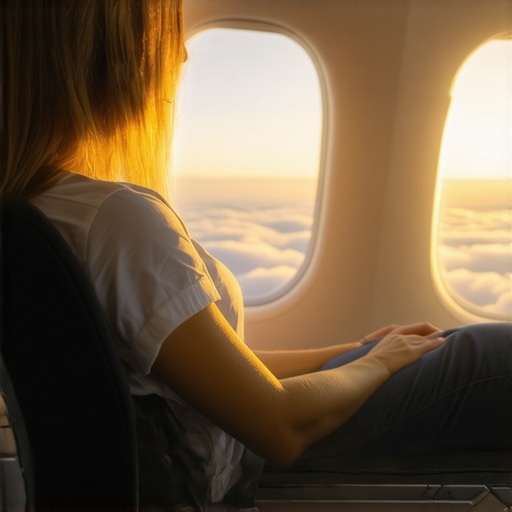
I remember a flight from Omaha last spring where I thought my spine might actually fuse into the shape of seat 14B. It was only a two-hour trip, but by the time the wheels hit the tarmac, I was gripping the armrests just to stand up. My lower back felt like it had been through a slow-motion car wreck. I had made the classic rookie mistake of thinking I could just tough it out for a short duration. I sat there, static and stiff, while my lumbar discs took the brunt of every bit of turbulence. It was miserable. If you have ever felt that sharp, radiating zing down your leg mid-flight, you know exactly the panic I am talking about. It makes you wonder if your back pain is a sign of something more serious or just a temporary annoyance. Today, I am going to share the exact routine I use now to walk off any flight feeling refreshed, not wrecked. We are going to fix your seated posture, stop the numbness, and ensure you actually enjoy your trip.
Stop the Slinky Spine Effect Before You Take Off
Most of us board a plane and immediately slump. We let the bucket-style seats swallow our shoulders and round our lower backs. This creates a massive amount of pressure. According to research frequently cited by major health institutions like the Mayo Clinic, sitting puts significantly more pressure on your spinal discs than standing or walking. On a plane, where you are vibrating at 30,000 feet, that pressure is compounded. Early in my journey, I made the mistake of using a massive, rolled-up hoodie as a lumbar support. It was too thick and ended up making my poor posture and chronic back pain even worse by over-arching my spine. I’ve since learned that it’s the subtle, consistent movements that matter more than fancy gear. You need to know how to sit on a plane without your legs going numb by focusing on hip alignment rather than just lumbar padding.
Will these tiny movements really make a difference on a short trip?
People often ask if it is worth the effort for a flight that is less than three hours. My answer is always a resounding yes. Your nervous system doesn’t have a stopwatch; it just knows when it’s being pinched. By staying proactive, you are unlocking mobility that will serve you the rest of the week. Have you ever had to do that awkward, stiff-legged shuffle down the jetway because your back seized up? It is a total vacation-killer. I want to hear about your worst travel-related back flare-up—did it happen during the flight or the next morning? Let’s get into the specific mechanics of the ‘Active Sit’ so you never have to feel that way again.
Master the Active Sit to Save Your Spine
Most travelers think ‘comfortable’ means ‘soft,’ but on a plane, soft is your enemy. Those bucket seats are designed for safety in a crash, not for the long-term health of your lumbar discs. To survive a long haul, you have to adopt what I call the Active Sit. Think of your spine as a stack of coins; if one tilts, the whole pile gets wobbly. I once tried to combat this by shoving a thick airplane pillow behind my lower back during a flight to Newark. Within forty minutes, my back felt like it was being pried open with a crowbar because I had forced my spine into an unnatural arch. This is a common trap—it is actually why your lumbar support might be making your back stiffer if it is too aggressive. The goal isn’t to create a massive curve, but to maintain the natural one. 
Ditch the Slump and Level Your Pelvis
Your pelvis is the foundation of your entire torso. If it tilts backward—a position called posterior tilt—it stretches the sciatic nerve like a tight guitar string. This tension is exactly why you feel that deep, toothache-like throb in your glutes. I used to suffer through this constantly until I started using the ‘wallet trick.’ Never sit with a wallet in your back pocket; it’s like putting a shim under one side of a table and wondering why the legs are vibrating. Instead, focus on sitting directly on your sit-bones. If you feel your legs starting to tingle, you need to know how to sit on a plane without your legs going numb by slightly rocking your pelvis forward to restore blood flow. This small adjustment is often the first step in unlocking sciatica relief before the pain becomes unbearable.
Reset Your Shoulders to Save Your Neck
When your lower back rounds, your head naturally drifts forward to keep your eyes on your book or screen. This ‘tech neck’ at 30,000 feet is a recipe for a tension headache. The weight of your head increases by ten pounds for every inch it moves forward. To fix this, use the seated shoulder blade squeeze to kill midday tension headaches. It’s a simple move: pull your shoulder blades down and back as if you are trying to tuck them into your back pockets. I do this every time the ‘fasten seatbelt’ light dinging occurs. It acts as a physical reset button for my posture. If you find your neck is already screaming, remember that the 15-degree rule for your computer monitor to save your neck also applies to your tablet or phone. Hold the device higher so your gaze stays level with the horizon, rather than dropped toward your lap.
Micro-Movements to Prevent Fluid Stagnation
Gravity is a relentless force, especially when you are stationary. Without movement, fluid pools in your lower extremities and your spinal discs lose their ‘bounce.’ I make it a rule to perform ankle circles and calf pumps every thirty minutes. It sounds trivial, but these micro-movements act as a pump for your circulatory system. When I skipped this during a red-eye to London, my ankles were so swollen I could barely tie my shoes the next morning. Now, I incorporate a version of the simple ankle drill that improves your walking balance right in my seat. It keeps the joints lubricated and prevents that dreaded ‘stuck’ feeling when you finally stand up to deplane.
Let’s dig deeper into the mechanics of why your back actually hurts when you travel, because most of the advice you’ve heard is either incomplete or flat-out wrong. In my years of studying movement and helping others recover, I’ve seen one mistake more than any other: the belief that ‘good posture’ is a static, rigid position. You’ve likely tried to sit like a soldier for hours, chest out and shoulders pinned, only to find that your mid-back feels like it’s on fire by the time you reach cruising altitude. This is the great posture paradox. Rigidly forcing a straight spine leads to muscle exhaustion and ischemia—a lack of blood flow to the tissues. A study published in the Journal of Electromyography and Kinesiology confirms that postural variability, or the ability to shift through various ‘good’ positions, is far more important for pain prevention than holding one ‘correct’ shape. This is precisely why your straight posture is actually straining your muscles rather than helping them.
Stop Stretching Your Way into More Sciatica Pain
The biggest ‘oops’ factor I see during long-haul travel involves the hamstrings. When your legs feel tight and heavy, the instinct is to stand up in the aisle and reach for your toes. If you are dealing with nerve irritation, this is the worst thing you can do. Sciatic nerves do not like to be stretched; they like to be glided. When you pull on a sensitized nerve, you are essentially increasing the internal pressure within the nerve sheath. I’ve seen travelers turn a minor annoyance into a week-long flare-up because they didn’t realize why stretching your hamstrings can actually flare up sciatica. Instead of aggressive stretching, focus on gentle hip hinges or simply walking the length of the plane to encourage blood flow without high-tension nerve pulling. If you’re unsure if your pain is muscular or neural, you should try the toe touch test that reveals your actual back injury risk before you attempt any deep stretches in the terminal.
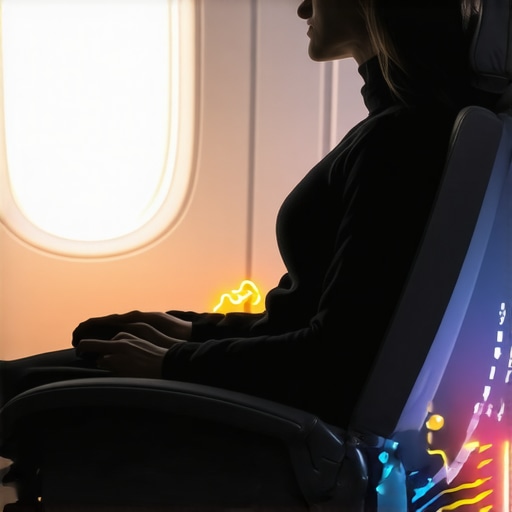
Does your constant self-cracking actually lead to long-term instability?
Another nuance that many frequent flyers miss is the danger of the ‘airplane self-adjustment.’ When you’re stuck in a cramped seat, it’s tempting to grab the armrests and twist your torso until you hear a loud pop. While that release of gas from the joint provides a temporary hit of dopamine and a few minutes of relief, you are often ‘cracking’ the joints that are already moving too much (hypermobile) to compensate for the ones that are truly stuck. Over time, this habit creates a cycle of instability. You might find why cracking your own back is making your joints more unstable as the surrounding muscles have to work twice as hard to protect those loose segments. If you find yourself needing to ‘pop’ your back every thirty minutes just to stay comfortable, it’s a major red flag that your spinal support system is failing. Have you ever fallen into this trap of constant self-adjusting during a trip? Let me know in the comments. If the pain doesn’t subside within 48 hours of landing, it is vital to understand how to know if your back pain needs a chiropractor or a doctor. True mobility isn’t about the sound of a joint popping; it’s about the quality of the movement you maintain throughout the journey.
Once I’ve deplaned and claimed my luggage, my first stop isn’t the hotel bar—it’s the hotel floor. I’ve realized over years of travel that the ‘travel hangover’ isn’t just about jet lag; it’s about the metabolic waste and fluid stagnation that builds up in your tissues when you are forced into a cramped seat for hours. To combat this, I swear by a firm lacrosse ball tucked into my carry-on. Unlike a standard tennis ball, which has too much give, a lacrosse ball provides the dense, targeted pressure needed to reach the deep stabilizers of the hip like the piriformis. If you’ve been searching for sciatica relief secrets how to banish pain quickly today, this is my top recommendation. I spend five minutes on each glute, finding those ‘hot spots’ and breathing through the tension to signal my nervous system to downregulate. This prevents the temporary stiffness of travel from turning into a week of debilitating misery. It’s also the perfect moment to reflect on your footwear, as I’ve seen countless travelers suffer because they didn’t realize why your thin shoes are impacting your lower back shock absorption while trekking through massive airports.
How do I maintain my mobility after a long travel day?
Maintaining your progress is a marathon, not a sprint. I often tell my clients that consistency always beats intensity. You don’t need a sixty-minute gym session after landing; you just need three minutes of the one stretch you should do after every flight to reset your hip-to-spine relationship. My personal ritual involves the ‘Couch Stretch’—placing one knee on the floor (or hotel bed) and the foot of that same leg up against the wall behind me. This aggressively opens up the hip flexors that have been shortened and tightened during the flight. Incorporating this into your routine is the key to mobility mastery daily tips to keep your spine and joints healthy. If you find yourself having to work from your hotel room, don’t just hunch over the desk. Take a moment to learn how to set up your laptop for better spine protection using a few hotel pillows or books to elevate your screen. The science of recovery is evolving rapidly. A study published in the Journal of Bodywork and Movement Therapies highlights that self-myofascial release can significantly increase joint range of motion without the loss of muscle force typically seen with long-duration static stretching. This is a game-changer for people who need to remain active immediately after a trip. 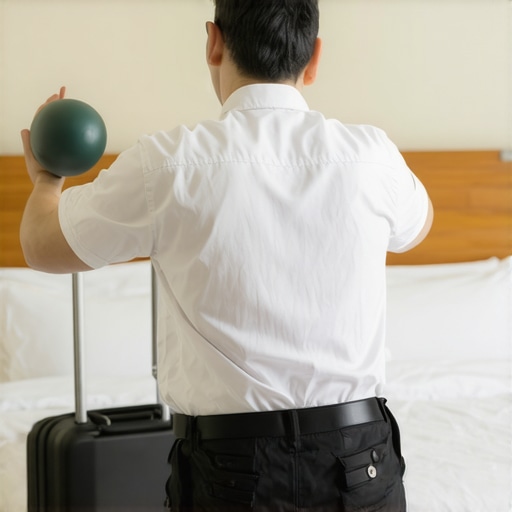 Looking into the future, I predict we will soon see a surge in ‘smart apparel’—clothing with embedded haptic sensors that gently vibrate when your pelvis tilts into a high-risk range during long-haul flights. Until that technology becomes mainstream, we have to be our own bio-feedback loops. If you feel a flare-up starting, reach for swift relief for sciatica quick home remedies that work before the inflammation peaks. My challenge to you is simple: the next time you land, perform the 30-second wall stretch that releases shoulder blade knots before you even unpack your suitcase. Your neck and upper back will feel the difference by the time you wake up the next morning.
The Brutal Lessons My Spine Taught Me Over 100,000 Miles
Looking back at my years of traveling, I realized that my biggest mistakes weren’t about missing flights, but about ignoring my body’s early whispers. First, I learned that ‘toughing it out’ is a recipe for a three-day recovery period once you arrive. If you feel a twinge, move immediately. Second, I discovered that my back pain breakthroughs navigating your path to restored mobility often happened when I stopped looking for a magic pillow and started focusing on my pelvic alignment. Lastly, your body is incredibly resilient if you give it frequent, small signals that it is safe to move, rather than one giant stretch at the end of the day.
The Essential Toolkit That Keeps Me Out of the Doctor’s Office
I never leave home without a few non-negotiables that have saved my sanity on long-haul flights. I trust a dense lacrosse ball because it is small enough for a carry-on but firm enough to mimic a therapist’s thumb; learning how a tennis ball can relieve deep glute and sciatic pain is a great starting point, though the lacrosse ball is my professional upgrade. #IMAGE_PLACEHOLDER_E# I also highly recommend wearing supportive, wide-toe-box shoes to ensure your foundation is solid the moment you hit the airport floor. Finally, I always carry a thin, inflatable lumbar cushion that I can adjust on the fly; it is much more versatile than a bulky foam one.
Reclaim Your Adventures Without the Fear of a Flare-Up
Travel is supposed to be about discovery and joy, not about counting the minutes until you can lie down on a flat surface. By taking these small, proactive steps, you are doing more than just preventing stiffness; you are conquering sciatica proven approaches to end discomfort now and ensuring that you arrive at your destination ready to explore. Don’t let the fear of a back pain episode dictate your itinerary. You have the tools, the knowledge, and the routine to stay mobile and pain-free. Have you ever had a trip ruined by a back spasm on the very first day? Let me know your story in the comments below.