
Why your glutes ‘turn off’ when you sit for over an hour
I remember the exact moment I realized my body was staging a silent protest. I’d been cranking away at my desk for nearly two hours, lost in a spreadsheet, when the doorbell rang. I stood up fast—or tried to. My legs felt like lead weights, and my lower back let out a sharp twinge that made me gasp. It wasn’t just stiffness; it felt like the connection between my brain and my backside had been severed. For a few terrifying seconds, my legs just didn’t want to carry me.
Stop Your Glutes From Taking a Permanent Vacation
This isn’t just about being “out of shape.” I’ve spent years obsessing over why perfectly active people suddenly feel like they’re walking on stilts. We’re dealing with what experts call Gluteal Amnesia. Essentially, when you park yourself in a chair for over sixty minutes, your hip flexors tighten up so much they actually signal your glutes to stop firing. It’s a biological shutdown. I used to think the answer was just to stretch my hamstrings until I was blue in the face, but I eventually learned that stretching those tight legs wasn’t the fix I needed. In fact, my big mistake early on was trying to “relax” a muscle that was already weak and overstretched. Today, we’re going to fix that. I’m going to show you how to wake those muscles up so you don’t end up with that heavy-legged feeling during your evening walk. We’ll look at why your chair is effectively “muting” your power muscles and how a few simple shifts can save your spine.
Is Dead Butt Syndrome Just a Buzzword for the Lazy?
It sounds like a joke, right? But the science is surprisingly solid. Researchers at the Ohio State University Wexner Medical Center have highlighted that when the gluteus medius stops doing its job, the pressure shifts directly to your lower back and knees. This isn’t just a trend; it’s a structural failure caused by our modern furniture. Have you ever stood up and felt that sharp pinch in your hip? That’s your body screaming for help because your glutes are fast asleep. If you’ve ever felt like your lower body is “turning off” by mid-afternoon, you aren’t alone. Have you noticed your posture crumbling after lunch, or do you feel like you’re dragging your feet? Drop a comment or just think about that last time you stood up—did it feel effortless, or did you have to brace yourself? Understanding this link is crucial because poor posture and chronic back pain are often just the final symptoms of glutes that have checked out for the day. We need to stop the cycle before the sleepy muscle becomes a permanent injury.
Force Your Glutes to Do Their Job
Think of your glutes as a master light switch for your entire lower body. When you sit for too long, that switch gets stuck in the ‘off’ position. You can’t just stand up and expect the light to shine brightly; you have to manually flip the breaker. I learned this the hard way after a four-hour drive to a hiking trail. I jumped out of the car, threw on a heavy pack, and started climbing. Within twenty minutes, my lower back felt like it was being crushed by a hydraulic press. My glutes were still ‘asleep’ from the drive, forcing my small lower back muscles to do the heavy lifting of a mountain ascent. I spent the next three days hobbling because I didn’t take two minutes to wake up my posterior chain. To avoid this, you need to master the 5-second glute squeeze that prevents sciatica flares while standing. It’s the simplest way to re-establish the brain-muscle connection before you even take your first step.
Stop Stretching Your Hamstrings and Start Stretching Your Hips
One of the biggest mistakes I see is people frantically touching their toes when their legs feel stiff. If your glutes aren’t firing, your hamstrings will tighten up as a secondary defense mechanism to stabilize your pelvis. Stretching them is like pulling on a knot that’s already under tension—it just makes things worse. This is why your hamstrings feel tight but never get better with stretching. Instead, focus on the front of your body. Your hip flexors are the real villains here. When they are short and tight from sitting, they physically prevent your glutes from contracting. You need to open the front gate to let the back muscles work. Before you start your day, you should how to check your own hip mobility in under a minute to see if your desk chair has won the battle for your posture. 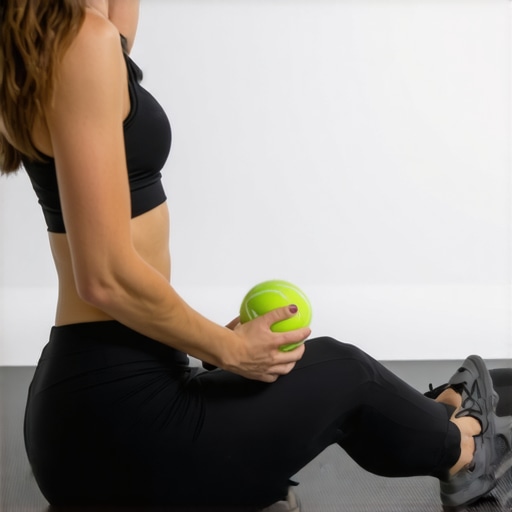
Use a Tennis Ball to Find the Off Switch for Pain
Sometimes the muscle isn’t just ‘sleepy’; it’s knotted up from hours of compression. When I was dealing with a nagging pinch in my right hip, I found that static stretching did nothing. I had to go deeper. I started using a simple tool from my garage to break up the adhesions. Learning how a simple tennis ball can release your deep glute tension changed everything. By placing the ball under the meaty part of the glute and gently moving until you find a ‘hot spot,’ you can force the muscle to finally let go. This isn’t just about comfort; it’s about restoring the mechanics of your spine. When those deep muscles relax, your pelvis can sit level again, which is why these boost your back mobility simple exercises that make a difference work so much better after you’ve cleared the internal roadblocks. If you feel a ‘stuck’ sensation, it’s often why your hip feels stuck when you try to sit cross-legged, and direct pressure is the only way to melt that tension away.
Your “Perfect” Posture is Probably Part of the Problem
I’ve seen it a thousand times: someone sits down and immediately pulls their shoulders back and arches their lower spine into what they think is “good form.” But here is the contrarian truth—holding yourself in a rigid, “perfect” upright position is often more exhausting for your nervous system than slouching. When you force that military-style alignment, you’re creating constant isometric tension in your paraspinal muscles. Research, including insights from biomechanics experts like Dr. Stuart McGill, suggests that static loading is the ultimate enemy of spinal health. Your discs need movement to stay hydrated; they don’t have a direct blood supply and rely on a “pump” mechanism created by gentle shifts. By staying perfectly still, you’re essentially starving your spine of nutrients. This is exactly why your straight posture is actually straining your muscles instead of helping them. Have you ever fallen into this trap of trying to look “correct” only to end up with a burning ache by 3 PM? Let me know in the comments.
Can Your Expensive Lumbar Support Actually Make Your Back Stiffer?
We are told to buy ergonomic chairs with aggressive lumbar curves, but for many, this is a specific trap to avoid. If the support is positioned too high or is too firm for your unique spinal curvature, it can actually act as a fulcrum, pushing your vertebrae into an exaggerated arch that pinches the facet joints. This is a common nuance people miss: support should be a gentle suggestion, not a forceful shove. I’ve found that why your lumbar support might be making your back stiffer is often due to the fact that it’s doing the work your deep stabilizers should be doing. Eventually, those muscles stop firing altogether because the chair is doing the heavy lifting. 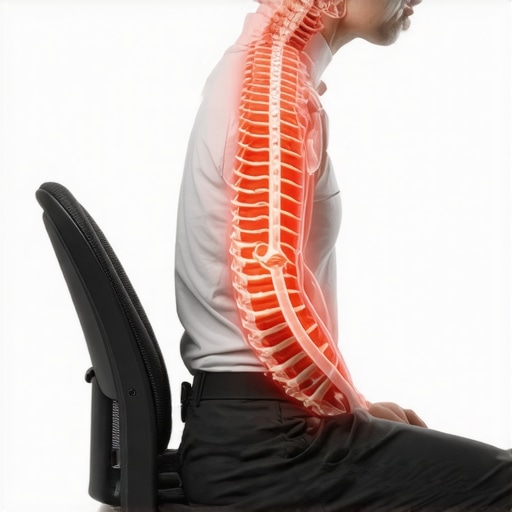
The Mistake of Mislabeling Every Leg Twinge as Sciatica
The most dangerous “oops” factor I see in my practice is the self-diagnosis of sciatica. Everyone assumes a shooting pain in the leg is a disc issue, but a study published in the Journal of Orthopaedic & Sports Physical Therapy notes that many patients with “sciatica-like” symptoms actually have Piriformis Syndrome or simple referred pain from the SI joint. If you treat a muscular knot with the same aggressive protocols used for a herniated disc, you might actually make the inflammation worse. You need to understand the difference between muscular sciatica and a slipped disc before you start any heavy rehabilitation. If you’re feeling a deep ache, it’s also worth checking is your back pain a sign of something more serious to ensure you aren’t ignoring a red flag. Mobility isn’t just about moving more; it’s about moving with precision, and that starts with an accurate map of what’s actually causing the restriction. Stop assuming your body is a machine with fixed parts—it’s a biological system that craves variety over “perfection.”Maintaining a pain-free life isn’t about doing an hour of yoga every night; it’s about the invisible habits you bake into your workday. I used to think I needed a complete lifestyle overhaul, but I realized that a few targeted resets are far more effective than a weekend recovery session. For me, it starts before I even check my email. I’ve found that the simple morning move to prime your spine for the day creates a protective buffer that lasts until lunch. It’s not about strength; it’s about lubrication.
Stop fixing and start priming
The real secret to longevity is preventing the ‘stiffening’ before it locks your joints. I’m a huge advocate for what I call ‘movement snacks.’ Instead of sitting for four hours and then wondering why your hip is screaming, you need to clear the cobwebs every thirty minutes. I personally use the 30 second ankle drill that reduces your risk of back injury because I’ve seen how how a stiff ankle is actually causing your recurrent lower back aches by forcing your spine to overcompensate during every step you take.
How do I maintain this mobility over time?
Consistency beats intensity every single time. To keep the progress you’ve made, you have to look at your environment with a critical eye. I constantly refer back to mobility mastery daily tips to keep your spine and joints healthy to ensure I haven’t let bad habits creep back in. For example, I’ve stopped using a standard mouse and switched to a vertical one, which sounds like a small change, but it prevents the spiral of tension that travels all the way up to my neck. I also make sure my workspace follows enhance your back mobility ergonomic tips for everyday comfort so I’m not fighting my furniture all day.
Your monitor is a neck-saver in disguise
One of the most effective tools in my arsenal isn’t a fancy gym machine; it’s a simple stack of books or a monitor arm. Dr. Alan Hedge at the Cornell University Ergonomics Research Laboratory (CUEW) emphasizes that the top of your monitor screen should be at eye level so that your gaze is slightly downward. This prevents the ‘turtle neck’ effect that ruins your cervical alignment. This is why mastering the 15 degree rule for your computer monitor to save your neck is non-negotiable if you work on a laptop. 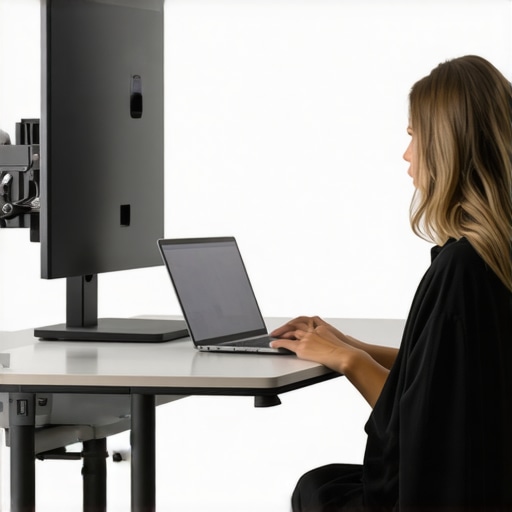 Looking forward, I predict we’re going to see a massive shift toward ‘active furniture’—desks and chairs that use haptic feedback to nudge us when our posture begins to fail. Until then, you have to be your own feedback loop. My challenge for you today: move your monitor up by just two inches and see if that midday headache disappears. It’s the small, specific adjustments that create the biggest long-term wins.
What My Most Stubborn Injuries Taught Me
After years of trial and error, I’ve realized that the ‘perfect’ setup doesn’t exist. My biggest lightbulb moment was discovering that movement variety is more important than static ergonomic perfection. Even in the most expensive chair, your body will eventually rebel if you don’t change positions. I also learned that understanding the link between poor posture and chronic back pain isn’t about being stiff and upright; it’s about being fluid. Finally, stop waiting for the ‘perfect time’ to exercise. A 30-second reset in your kitchen is worth more than a 60-minute gym session once a week.
Three Tools That Actually Live Up to the Hype
I don’t believe in buying every gadget on the market, but these three have saved my sanity. First, the humble tennis ball. It is the most effective way to address the knots that lead to sciatica relief secrets how to banish pain quickly today without spending a fortune on therapy. Second, a dedicated monitor arm. It allows you to follow the 15-degree rule and keeps your neck from collapsing. Lastly, a simple kitchen timer. Setting it for 30 minutes is the best way to ensure you never let your glutes go on vacation again. #IMAGE_PLACEHOLDER_E#
The Simple Path to Reclaiming Your Range of Motion
Reclaiming your mobility doesn’t have to be a daunting task. It starts with the realization that your body is incredibly resilient and capable of change, no matter how many years you’ve spent at a desk. By incorporating small, strategic movements into your day, you can begin unlocking mobility expert tips on managing back pain in 2025 and finally stop the cycle of stiffness. These boost your back mobility simple exercises that make a difference aren’t just for athletes; they are for anyone who wants to stand up without a groan. You aren’t stuck with ‘Dead Butt Syndrome’ forever; you’re just one movement snack away from a more comfortable life. Every time you stand up and engage those glutes, you’re investing in your future back mobility.
Have you tried the 30-minute timer trick yet, or do you have another favorite way to stay moving during the workday? Let me know below!