
The 5-second glute squeeze that prevents sciatica flares while standing

I was standing in line at the post office, just minding my own business, when it happened. That familiar, white-hot sizzle of electricity shot from my lower back right down into my heel. I tried to play it cool, shifting my weight to the left, then the right, desperately trying to find a neutral zone that didn’t feel like a live wire was touching my spine. I looked like a nervous penguin. For years, I thought the answer was more stretching or maybe buying those expensive gel inserts. I even tried those hamstring stretches that actually flare up sciatica mid-aisle, which—let me tell you—was a huge mistake that left me limping to my car. The real fix wasn’t a fancy gadget or a yoga pose; it was a simple five-second engagement that I had been completely ignoring because I was too busy overcomplicating my recovery. Have you ever found yourself doing that ‘sciatica dance’ in the middle of a store, just hoping the cashier would hurry up before your leg gave out?
How This One Tiny Twitch Saves My Sanity at the Grocery Store
Listen, I know how it feels to dread standing still. Whether you are at a backyard BBQ or trying to transition to a standing desk without leg pain, that static position is often the enemy. When we stand, we tend to ‘hang’ on our ligaments and let our pelvis dump forward. This puts an incredible amount of pressure on the sciatic nerve. I made the classic mistake of thinking my core was the only thing that mattered, but your glutes are actually the primary protectors of your lower back. By performing a subtle, five-second glute squeeze, you essentially create a ‘muscular corset’ that tucks your tailbone and opens up the space where that nerve is getting pinched. It is the fastest way to get sciatica relief secrets into your daily routine without needing to lie down on a dirty floor to stretch.
Is This Short Squeeze Really Better Than an Expensive Ergonomic Chair?
You might be skeptical that something so simple could rival a thousand-dollar setup. I was too. But the reality is that movement and muscle activation trump passive support every single time. According to research published in the Journal of Physical Therapy Science, gluteal muscle weakness is directly correlated with chronic lower back pain and instability (https://www.ncbi.nlm.nih.gov/pmc/articles/PMC4433989/). If those muscles are ‘asleep,’ your spine takes the hit. This is often why your standing desk is giving you lower back pain even if the monitor height is perfect. You can’t buy your way out of a muscle that isn’t firing. I’m going to show you exactly how to time this squeeze so you can stop the flare before it starts, but first, we need to talk about why your current ‘standing posture’ is actually a trap.
Stop the Pelvic Dump Before It Ruins Your Day
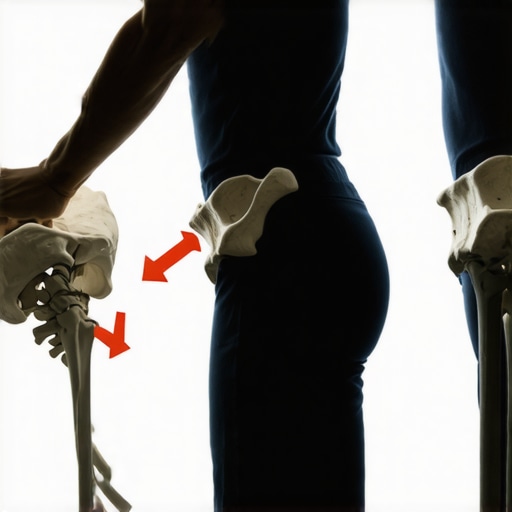
The first thing you need to realize is that most of us stand like we are trying to balance a heavy bucket on our belt buckles. We let our hips spill forward—a phenomenon called anterior pelvic tilt—which stretches the sciatic nerve like a rubber band over a sharp edge. To fix this, imagine your pelvis is a bowl of water. When you stand mindlessly, you are spilling water out the front. To keep the water level, you have to engage your lower abdominals and glutes just enough to pull the front of the bowl up. This is a crucial part of understanding the link between poor posture and chronic back pain. If you can not keep that ‘water bowl’ level, your lower back muscles will stay in a state of constant, painful contraction, eventually leading to that dreaded zip of nerve pain.
The Glute Squeeze That Reboots Your Spine
Here is exactly how I do it when I am stuck in a long line. First, I shift my weight so it is evenly distributed between my heels and the balls of my feet. I am not leaning back, and I am not on my toes. Then, I give my glutes a 50% squeeze. You are not trying to crush a walnut; you just want enough tension to feel your tailbone drop slightly toward the floor. Hold this for five seconds while taking a deep breath into your belly. This simple reset helps you learn how to fix your gait to reduce chronic hip clicking because it realigns the femur in the hip socket. I remember standing at my sister’s outdoor wedding three years ago. The ceremony was beautiful, but it was forty minutes of standing on uneven grass. About ten minutes in, the heat-sink sensation started in my lower back. Usually, that is my cue to start the ‘sciatica dance,’ but I committed to this 5-second reset every two minutes. I did not just survive the ceremony; I was actually able to dance later that night without feeling like my leg was on fire.
Why Timing Is More Important Than Effort
The trick is not squeezing as hard as you can; it is squeezing before the pain spikes. If you wait until you feel that lightning bolt, your nervous system is already in ‘red alert’ mode, and your muscles will be too guarded to move properly. You need to use this as a proactive tool. If you are learning how to transition to a standing desk without leg pain, you should be doing this reset every time you change tasks or reach for your phone. It is about building a new ‘default’ setting for your brain. When you master this, you are actually implementing some of the most effective unlocking sciatica relief expert strategies for lasting comfort without ever needing a doctor’s appointment. You are essentially teaching your body that it does not need to use the sciatic nerve as a kickstand for your upper body weight.
Most of us were taught that when our back feels tight, we should reach for our toes or pull our knees to our chests. It feels good for about thirty seconds, right? But here is the hard truth: you are often just pulling on a nerve that is already screaming for slack. In my experience, chasing that ‘stretching’ feeling is exactly why you should stop stretching your back into a c-shape during a flare-up. You are essentially trying to win a tug-of-war with your own nervous system, and I can tell you from years of trial and error, the nerve always wins. When you round your spine, you increase the pressure on the front of your discs, potentially pushing them further toward the sciatic nerve. Have you ever fallen into this trap? Let me know in the comments.
Why Your Favorite Stretch Is Actually a Trap
The biggest mistake I see is people confusing ‘tension’ with ‘tightness.’ Your hamstrings might feel tight not because they are short, but because they are protecting your spine. If you keep stretching them, your brain will only tighten them more to keep you safe. This is a primary reason why your core strength wont fix your back if your hips are locked. If the hip joint cannot rotate properly, the lower back has to pick up the slack, leading to micro-tears and inflammation. I spent years doing planks and sit-ups, wondering why my back still hurt, until I realized my hips were about as mobile as a rusted gate. You have to learn how to check your own hip mobility in under a minute to see where the real blockage is hiding.
Does More Core Strength Always Equal Less Pain?
Actually, no. One of the most common myths in the fitness world is that a ‘weak core’ is the sole cause of back pain. In reality, an overactive, rigid core can be just as damaging. If you are constantly bracing your abs like you are about to get punched, you are creating intra-abdominal pressure that can actually irritate a disc. Advanced recovery involves unlocking mobility expert tips on managing back pain in 2025 that focus on coordination rather than just raw strength. A study published in the Journal of Biomechanics (https://pubmed.ncbi.nlm.nih.gov/22137119/) highlights that people with chronic back pain often have ‘stiffer’ movement patterns, meaning they’ve lost the ability to move their spine and hips independently. You don’t need a stronger ‘shield’; you need a more adaptable one.
The Missing Link Between Your Ankles and Your Back
If you have tried everything and your sciatica still lingers, look at your feet. It sounds crazy, but the hidden link between tight calves and neck stiffness also applies to your lower back. If your ankles are stiff, your gait changes, your knees cave in, and your pelvis tilts, putting that familiar stress back on the nerve. True mobility is a chain reaction. When I finally stopped obsessing over just my ‘sore spot’ and started looking at the whole system, that’s when the permanent changes happened. Are you ready to stop the endless cycle of stretching and start addressing the root cause?
Once you get that first taste of relief from the five-second glute squeeze, the next question is always: ‘How do I make this last?’ Maintenance isn’t about doing two hours of yoga every morning; it is about those high-leverage lifestyle changes for better quality of life that happen while you are actually living. For me, that meant looking at the tools I used every day. I stopped buying generic lumbar rolls and started using a simple tennis ball. I use it to target the piriformis muscle specifically because it provides a pinpoint pressure that a foam roller just can’t reach. If you have ever wondered how a simple tennis ball can fix deep glute tension, it is all about the ischemic pressure—basically, you are ‘restarting’ the blood flow to a muscle that has been stuck in a protective spasm.
How do I maintain my mobility without spending hours in the gym?
The secret to long-term success is what I call ‘Passive Correction.’ This involves setting up your environment so it is harder to slouch than it is to sit correctly. For example, I used to struggle with ‘tech neck’ until I learned neck pain solutions proven techniques to regain your range of motion by simply raising my monitor. But the real game-changer was the rearview mirror trick. I adjusted my car’s mirror while sitting perfectly upright. The second I started to slouch or my pelvis tilted, I couldn’t see the traffic behind me. This forced me to improve your driving posture without having to constantly remind myself. It’s an external cue that acts as a guardian for your spine.
As we look toward the future, I predict we are going to see a massive shift toward ‘Bio-Feedback Wearables.’ We are already seeing prototypes of smart shirts that provide haptic feedback—a tiny vibration—the moment your shoulders round or your core goes slack. While the tech is cool, you can achieve the same result today by training your proprioception. According to a study published in the Journal of Orthopaedic & Sports Physical Therapy (2011), patients who engaged in proprioceptive training—teaching the brain to ‘feel’ the spine’s position—showed significantly higher long-term recovery rates than those who only did strength exercises. You are essentially upgrading your internal GPS so you can find back pain breakthroughs through better body awareness.
To truly scale these results, you have to look at the ‘dead time’ in your day. When you are waiting for the microwave or brushing your teeth, that is the time to implement mobility mastery daily tips to keep your spine and joints healthy. I’ve found that even the 2-minute hip reset for better sleep tonight is more effective when done consistently than a 90-minute massage once a month. This proactive approach is the core of unlocking mobility expert tips on managing back pain in 2025. If you want to see an immediate difference, I want you to try the rearview mirror trick tomorrow morning. Set it while you are at your tallest, and see how long you can go before you lose your ‘view.’ It’s the ultimate reality check for your posture.
The Hard Truth About My Sciatica Recovery
Reflecting on my journey, the most humbling lesson was realizing that the ‘big fixes’—expensive injections or hours on the massage table—were never as effective as the small, boring habits. I spent years conquering sciatica through proven approaches only to find that my body responded best when I stopped treating it like a broken machine and started listening to its signals. Another lightbulb moment? Realizing that overcoming sciatica requires lifestyle changes that happen in the gaps of your day, not just during a physical therapy session. If I could go back, I would tell my younger self to stop chasing the ‘perfect stretch’ and start focusing on how I actually move through the world.
The Tools That Actually Live In My Gym Bag
I am often asked what gear I recommend for someone struggling to stay mobile. Honestly? My toolkit is remarkably low-tech. First, I never travel without a tennis ball; knowing how a tennis ball can relieve deep glute and sciatic pain has saved me during many long flights and car rides. It is the ultimate portable therapist. I also became incredibly picky about footwear. I learned the hard way why flip flops cause morning heel and back pain, so I switched to shoes with actual structural support. Finally, I swear by the ‘mirror reset’ we discussed earlier. It is the only ‘tool’ that costs nothing but provides constant, real-time feedback on my spinal alignment.
#IMAGE_PLACE_HOLDER_E#
You Don’t Have to Live in the Sciatica Dance
It is easy to feel like your body has betrayed you when you are stuck in that cycle of white-hot nerve pain. But remember, the goal is not to never feel a twinge again; it is to have the tools to handle it when you do. By integrating these sciatica relief secrets to banish pain quickly, you are taking back control. You are no longer a victim of a bad back; you are the active manager of your own mobility. Start with the five-second squeeze tomorrow morning. Then, try the mirror trick. These tiny wins stack up until, one day, you realize you haven’t thought about your sciatic nerve all afternoon. Have you ever tried a ‘proactive’ move like the glute squeeze before the pain starts, or do you usually wait until the lightning strikes? Let me know below.