
How to use a doorway to release chest tension and improve posture
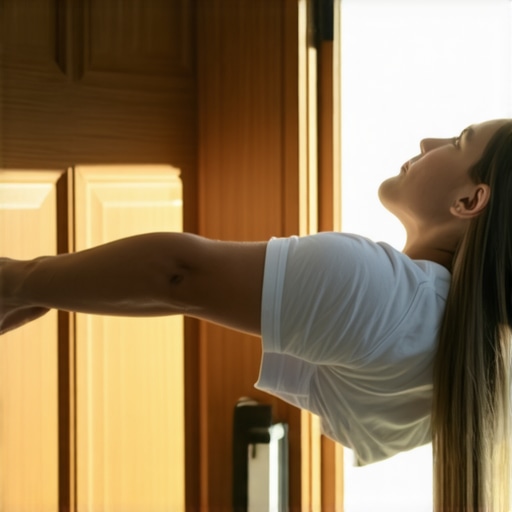
I remember one Tuesday afternoon when I caught my reflection in the microwave door and didn’t recognize the person looking back. My shoulders were rolled so far forward I looked like I was carrying the weight of the world on my neck. I felt that familiar, nagging burning sensation between my shoulder blades. I tried to ‘pull my shoulders back’ like my mom used to tell me, but it felt forced, painful, and lasted about thirty seconds before I slumped right back down. My chest felt tight, like a drum skin stretched too thin, and no amount of fidgeting in my chair helped. For the longest time, I thought why my perfect sitting posture was making me stiffer, but the reality was I was ignoring the front of my body entirely. My ribs felt locked, and my breath felt shallow.
The Best Posture Tool You Already Own
We spend most of our lives ‘closing’ our bodies. We drive, we type, we eat—all with our arms in front of us. This constant forward motion makes our pectoral muscles short and stubborn. I made the mistake of thinking I could just ‘strengthen’ my way out of it by hitting the gym and doing more rows. I was wrong. You can’t build a new house on a crooked foundation. I had to learn that understanding the link between poor posture and chronic back pain starts with opening up the front of the ribcage. Today, I’m going to show you how a standard door frame—the one you walk through fifty times a day—is actually the most effective piece of rehab equipment in your house. It’s more effective than those $50 posture braces that just make your armpits sore. Have you ever felt like your chest was literally too tight to take a full, deep breath after a long day at the office?
Does a simple door frame really offer lasting relief?
I get it. You’ve probably seen a dozen ‘hacks’ online that promised to fix your posture in five minutes. You might be skeptical that something as low-tech as a doorway can compete with expensive therapy or specialized equipment. But the science is actually on our side here. According to research published in the Journal of Physical Therapy Science, prolonged forward head posture and chest tightness are directly linked to decreased respiratory function because your lungs literally don’t have room to expand. By using a doorway to create leverage, we’re not just stretching skin; we’re signaling the nervous system to let go of that ‘survival’ hunch. I personally spent years trying a 5-minute stretching routine that ignored the pecs, and I never got anywhere until I started using the walls around me. When we open the chest, we take the pressure off the lower neck and shoulder blades, allowing the spine to find its natural curve again. Let’s get into the specific way to lean into this move so you don’t accidentally pinch a nerve.
The doorway stretch is like a reset button for your skeletal system. Imagine your chest muscles are like tight elastic bands that have been sitting in the cold for too long; if you yank them, they snap. But if you warm them up and slowly lengthen them, the whole structure changes. First, you need to find a door. Stand inside it and bring your arms up to a 90-degree angle, like you’re surrendering. This is where most people mess up. They just lean. Instead, think about your shoulder blades sliding down into your back pockets. I remember the first time I did this correctly at my old office. I was in the middle of a brutal shift, my neck was killing me, and I stood in the breakroom doorway. My boss walked in while I was leaning forward with my chest open and my eyes closed. He asked if I was okay or if I’d finally lost it. I told him I was just trying to revitalize your neck because my head felt like a bowling ball. Within thirty seconds, that sharp pinch between my blades softened. He ended up joining me, and for a week, the breakroom looked like a weird stretching cult.
Get Your Alignment Right Before You Lean
When your pecs are tight, they act like a drawstring, pulling your shoulders forward and creating that link between poor posture and chronic back pain. If you just lean forward without setting your shoulders, you’re actually just straining the front of the joint. You aren’t fixing the problem; you’re just stressing the ligaments.
Find the Sweet Spot for Your Elbows
Place your forearms on the door frame. Your elbows should be slightly lower than your shoulders. If they are too high, you’ll feel a pinch in the joint; too low, and you won’t get deep enough into the minor pectoral muscle. Think of your arms as the anchors and your torso as the ship trying to sail through the door. This is one of those neck pain solutions proven techniques that relies entirely on geometry to work.
The Step That Changes Everything
Instead of leaning with your whole body like a falling tree, take one small step forward with one foot. This allows you to control the depth of the stretch with your legs rather than your lower back. If you arch your back to get ‘deeper,’ you’re just trading one problem for another. You want to feel the pull across the front of your chest, not a crunch in your spine. This is how you boost your back mobility without overextending your lumbar region.
Breathe Into the Tension
This isn’t a ‘no pain, no gain’ situation. When you feel that tension, stop. Take three deep, slow breaths into your belly. On each exhale, visualize the muscles on the front of your ribs melting like butter. Most people treat a 5-minute stretching routine like a chore to rush through, but this doorway move requires you to actually ‘be’ there. If you rush it, your nervous system stays in ‘clench’ mode. When you finally allow that release, you’ll see how these daily tips to keep your spine and joints healthy change your entire baseline of comfort.Despite how good that doorway stretch feels, there is a dangerous trap I see people fall into once they start focusing on opening up. They assume if a little stretching is good, then aggressive, painful stretching must be better. This is where most people go wrong with lower body issues. In my experience, if you have a shooting pain down your leg, why stretching your hamstrings often makes your sciatica worse is because you aren’t actually stretching a muscle—you’re yanking on an inflamed nerve.
Is your ‘tightness’ actually a nerve in disguise?
When a nerve is irritated, the brain sends a signal to the surrounding muscles to tighten up and protect it. You feel this as tight hamstrings. If you ignore this warning and go for a deep reach, you’re just agitating the fire. This is why the truth about yoga for sciatica sufferers can be so polarizing; certain poses like the downward dog or pigeon can actually compress the sciatic nerve further if you don’t know how to tell if your sciatica is a disc or muscle issue. A study published in the Journal of Manual & Manipulative Therapy highlights that neural mobilization—think of it as gently sliding the nerve through its natural pathway—is far superior to static stretching for reducing mechanosensitivity in patients with radiating pain. Instead of a hard pull, you often need the nerve flossing technique that silences burning thigh pain to find relief.
The ‘Perfect Posture’ Trap That Makes You Stiffer
Another nuance I had to learn the hard way is that there is no such thing as a perfect static position. I spent months trying to sit with a perfectly straight back, only to find that why your perfect sitting posture is making you stiffer was because I was essentially holding a low-grade isometric contraction all day. Your body craves variability. Even the best ergonomic setup becomes a prison if you don’t move. I’ve found that expert tips on managing back pain in 2025 focus less on sitting straight and more on sitting frequently in different ways. Most experts tell you to ‘strengthen your core’ as the ultimate fix, but this is often the wrong place to start if your hips are locked solid. You end up arching your back and using your lumbar spine to compensate for the lack of hip mobility, leading to those sharp zings when you move. This is exactly why your core strength won’t fix your back if your hips are locked. The ‘oops’ factor here is over-bracing; if you walk around with your abs sucked in all day, you lose the ability to breathe into your lower back, creating more tension. Have you ever fallen into the trap of trying to force your body into a position it wasn’t ready for? Let me know in the comments; I’d love to hear how you handled that first realization that stretching isn’t always the answer.
Stop Chasing Gadgets and Use What Works
I’ve spent a small fortune on ergonomic gadgets that promised to ‘solve’ my aches overnight. Most of them ended up in a dusty box under the bed. The reality I discovered is that you don’t need a high-tech exoskeleton; you need tools that respect your body’s natural mechanics. My absolute favorite is the humble lumbar roll. I use it every single time I’m in the car or sitting at my desk because it prevents that ‘slump’ from happening without me having to think about it. If you’ve ever wondered how to use a lumbar roll to prevent mid-day back fatigue, the secret is placing it slightly higher than you think—right in the small of your back. This simple firm cushion fights off what the Journal of Clinical Biomechanics calls ‘viscoelastic creep.’ This is the phenomenon where your spinal ligaments literally stretch out and lose their stability after just 20 minutes of sitting, leaving you vulnerable to injury when you finally stand up. By maintaining that curve, you’re keeping the tissues resilient.
How do I keep my spine mobile for the long haul?
The biggest mistake I see is people waiting for a ‘flare-up’ to take action. They treat their back like an emergency room rather than a garden that needs daily watering. You have to realize that why maintenance care is better than waiting for a spinal crisis is all about baseline management. For me, that means keeping a tennis ball in my gym bag. It’s the best $2 physical therapist you’ll ever buy. I use it for a deep-tissue release on my hips and shoulders. Learning how a simple tennis ball can fix deep glute tension was a game-changer for my sciatica. I also use it to hit those stubborn spots in my upper back—knowing how to use a tennis ball to release tension in your upper traps can stop a tension headache in its tracks before it ruins your afternoon. The goal isn’t to be ‘fixed’ forever; it’s to have the tools to reset yourself every day.
Wearable Tech and the Future of Your Back
As we look toward the future, I predict we are going to see a massive shift toward bio-individual feedback. We are already seeing expert tips on managing back pain in 2025 focusing on wearable sensors that give a gentle haptic vibration when your shoulders start to round. Instead of a brace that does the work for you (and makes your muscles weak), these tools will train your brain to stay aware. This is the ultimate ‘bio-hack’—using technology to rebuild the mind-body connection we lost to our smartphone screens. Until that tech is mainstream, I highly recommend adopting the 20-20-20 rule for neck and eye strain relief. Every 20 minutes, look 20 feet away for 20 seconds, and while you’re at it, do two shoulder rolls. It sounds too simple to work, but it’s the consistency that saves your discs. My challenge for you today: The next time you find yourself staring at a screen for more than thirty minutes, stand up and do one doorway stretch or use that tennis ball on your traps. Don’t wait for the pain to tell you it’s time to move.
The Subtle Shift That Finally Stopped My Daily Aches
Looking back at my journey from chronic stiffness to fluid movement, I’ve realized that the biggest hurdles weren’t physical—they were mental. I had to unlearn the idea that I could ‘fix’ my spine with a single intense session once a week. Here are a few lightbulb moments that changed everything for me: Intensity is the enemy of healing. When I tried to force a stretch, my nervous system fought back, making me tighter. Movement is the only true posture. I finally understood why my perfect sitting posture was making me stiffer—it wasn’t about the position, but the lack of variety. Maintenance isn’t a chore; it’s a gift. Realizing why maintenance care is better than waiting for a spinal crisis shifted my focus from ‘putting out fires’ to ‘tending the garden’ of my own mobility.
My Non-Negotiable Kit for a Resilient Spine
You don’t need a gym membership to reclaim your range of motion. I’ve narrowed my daily essentials down to three things that actually move the needle. First, the lumbar roll; it’s the only way I can survive long commutes. Knowing how to use a lumbar roll to prevent mid-day back fatigue has saved my lower back from that deep, dull ache. Second, the tennis ball. It’s my go-to for localized release, especially when I need to know how a simple tennis ball can fix deep glute tension after a day at the desk. Finally, the 20-20-20 rule for neck and eye strain relief. It’s a free, low-tech way to ensure my brain and neck get the breaks they deserve before the tension turns into a headache.
#IMAGE_PLACEHOLDER_E#
Choose One Move and Start Today
The path to back pain breakthroughs and navigating your path to restored mobility isn’t built on 60-minute workouts; it’s built on 30-second resets. You don’t have to be an expert to start feeling better; you just have to be consistent. Whether it’s the doorway stretch or a quick neck release, these daily tips to keep your spine and joints healthy only work if you actually use them. Your body wants to move well—you just have to give it the space and the permission to do so. You have the power to revitalize your neck and back starting right now. Which of these simple tools do you already have lying around the house? Share your go-to stretch in the comments below!