
Why your wrist position at your desk affects your neck health

I spent three years blaming my pillow. Every morning, I’d wake up with a neck so stiff it felt like it was made of dry wood. I bought the fancy memory foam versions, the cooling gels, and even tried sleeping on the floor once—don’t do that, by the way. It wasn’t until I was mid-deadline, rubbing a knot in my shoulder for the tenth time that day, that I noticed my right wrist. It was cocked back at a sharp angle like a broken wing while I scrolled through spreadsheets. That’s when the lightbulb finally flickered on: my neck pain wasn’t a “sleeping” problem; it was a “typing” problem.
Your Wrists Are Secretly Pulling the Strings on Your Neck
My biggest mistake early on was thinking that ergonomics just meant buying an expensive chair. I sat there like a statue, wondering why your perfect upright posture is actually tensing your spine while my neck continued to throb. What I didn’t see was the kinetic chain. When your wrists are extended—meaning your fingers are higher than your wrist joint—it creates a ripple effect. The muscles in your forearm tighten, which tugs on the elbow, which rotates the humerus, and eventually, your upper trapezius has to work overtime just to keep your arm from falling off. According to researchers at Harvard Health, repetitive strain in the hands and wrists is a primary contributor to referred pain in the upper back and cervical spine. It’s a sneaky cycle. You might be focusing on how your monitor height is causing those recurring headaches, but if your hands are struggling, your neck will never truly relax.
Is this tiny adjustment really worth the hype?
I know what you’re thinking. It sounds like a reach. Can a two-degree shift in your keyboard really stop that stabbing pain behind your shoulder blade? I was a skeptic too until I realized understanding the link between poor posture and chronic back pain isn’t just about your spine—it’s about every limb attached to it. Today, we are going to fix that. I’m going to show you how to realign your workspace so your neck stops paying the price for your mouse habits. Have you ever noticed your shoulder climbing toward your ear while you’re deep in a project? If you’re already feeling the burn, you might want to try the 10-second jaw release that softens your neck muscles before we dive into the setup. Let’s get your desk working for you, not against you.
Stop fighting your keyboard and win back your neck
The first thing I did—and the hardest habit to break—was getting rid of those little plastic ‘feet’ on the back of my keyboard. Most people think propping up the back makes it easier to see the keys, but in reality, it is a recipe for chronic inflammation. When you tilt the keyboard up, your wrists have to ‘cock’ back to reach the keys. Imagine trying to drive a car with your hands bent backward at a 45-degree angle; you wouldn’t last ten minutes before your forearms screamed. By flattening the keyboard, or better yet, giving it a slight ‘negative tilt’ where the front is higher than the back, your wrists stay in a neutral, straight line. This alignment prevents the kinetic chain of tension from traveling up to your cervical spine.
Bring the work to you instead of reaching for it
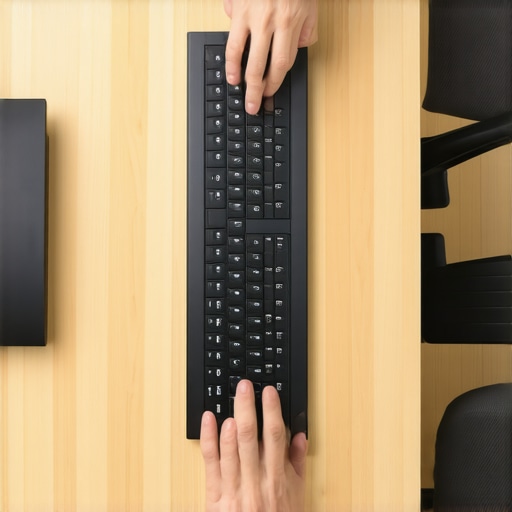
I used to push my keyboard halfway across the desk because I thought I needed ‘space’ to think. All I was doing was forcing my shoulders to protract and my neck to crane forward. Think of your arms like heavy weights hanging off a crane; the further away from the base (your spine) the weight is, the more strain the crane (your neck muscles) has to handle. I finally moved my keyboard so my elbows were bent at exactly 90 degrees, tucked right against my ribs. It felt cramped for about an hour, then it felt like pure relief. If you are a laptop user, this is even more critical. You absolutely must learn how to set up your laptop for better spine protection or you will be chasing this pain forever.
The mouse is a secret shoulder-wrecker
My ‘messy’ moment came when I tried a split keyboard for the first time. I looked like I was playing a futuristic organ and my typing speed dropped to about ten words per minute. I almost threw it in the trash. But I noticed something: my right shoulder, which usually felt like it was being poked by a hot needle, was suddenly quiet. The split allowed my chest to open up and stopped my shoulder from rotating inward. If you cannot get a split keyboard, at least move your mouse closer to the center of your desk. Reaching out to the right for hours is essentially a slow-motion shoulder injury. While you are at it, if you find yourself tensing up during a long email chain, try the seated shoulder blade squeeze to kill midday tension headaches to reset your system.
Ditch the perfect posture myth for better movement
We have been told to sit up straight like soldiers, but why your standing desk is giving you lower back pain often comes down to that same rigidity. The best posture is actually your next posture. I started using a timer-based reset. Every 20 minutes, I would perform the 30-second wall stretch that releases shoulder blade knots. This isn’t just about the physical stretch; it is about breaking the static load. When you stay in one position, even a ‘good’ one, your muscles eventually starve for oxygen and start sending pain signals to your brain. You might even find that the hidden link between tight calves and neck stiffness plays a role if you are standing all day without moving your ankles. Movement is the only real cure for a desk-bound life.
But even movement can be a double-edged sword if you are moving the wrong parts. The biggest ‘expert’ myth I see is the obsession with core strength as a universal fix for back pain. We’ve been conditioned to think that a strong midsection is a bulletproof vest for the spine, but the reality is more nuanced. In my experience, why your core strength won’t fix your back if your hips are locked is a conversation many people miss. If your hip joints cannot rotate properly, your lumbar spine is forced to become a mobile joint to compensate, which it isn’t designed to do. This leads to a persistent ache that no amount of planks or crunches will ever solve.
Why your expensive lumbar support might be making you stiffer
Most people run out and buy a chair with a massive lumbar bulge, thinking more support is always better. However, why your lumbar support might be making your back stiffer often comes down to the loss of natural ‘micro-movements.’ When you are pinned against a rigid support, your multifidus muscles—the tiny stabilizers of your spine—can actually start to switch off. It is essentially an ‘ergonomic cast.’ You want support that encourages your spine to maintain its natural curve while allowing for subtle shifts, rather than one that forces you into a frozen, exaggerated arch.
Can your eyes actually dictate how much your neck hurts?
This is where we get into the advanced levels of the kinetic chain. There is a deep neurological link called the Vestibulo-Ocular Reflex. A study published in the Journal of Physical Therapy Science demonstrated that when we experience ocular fatigue from staring at screens, our suboccipital muscles at the base of the skull tighten up to provide a ‘stable’ platform for our vision. You could have the perfect desk setup, but if you aren’t managing screen glare, your neck will stay in a state of high alert.  This tension is often how a stiff upper back is forcing your neck to move too much, as the body tries to find mobility somewhere else in the chain.
Avoid the ‘stretch it out’ reflex when things feel tight
The most common ‘oops’ factor I see is stretching when you should actually be stabilizing. If you feel a sharp pull in your leg, why stretching your hamstrings can actually flare up sciatica is something you need to understand before you hit the yoga mat. If that ‘tightness’ is actually a nerve being compressed, pulling on it is like yanking on a snagged thread in a sweater—it only makes the knot tighter. Before you dive into a deep stretch, you need to check if is your back pain a sign of something more serious to ensure you aren’t aggravating a disc issue. Instead of aggressive pulling, look for back pain breakthroughs through gentle nerve glides or positional releases. Have you ever fallen into this trap of stretching a pain that only got worse? Let me know in the comments.
Stop the ‘relapse’ cycle before it starts
The hardest part of fixing your neck and back isn’t the initial relief; it is the two-month mark when the pain is gone and you start getting lazy again. I call this the ‘comfort trap.’ You feel great, so you slowly migrate back into a slouch, or you start typing with your wrists cocked again. To stay ahead of it, you need a system for mobility mastery: daily tips to keep your spine and joints healthy that don’t feel like a chore. For me, that meant anchoring my movement breaks to things I already do. Every time I hit ‘send’ on a long email, I do one neck rotation. Every time I finish a meeting, I stand up. It is about building a lifestyle, not just a list of exercises.
How do I maintain these spinal gains for the long haul?
Consistency over intensity is the secret. You don’t need a 90-minute yoga session to stay mobile; you need five minutes of intentional movement spread throughout your workday. I’ve found that focusing on revitalize your neck: effective techniques for lasting pain relief works best when integrated into your environment. If you find yourself slipping into old habits because of work pressure, remember that neck pain and stress: how to break the cycle for good are deeply intertwined. If your mind is tight, your traps will be too. I now use a simple haptic feedback app on my watch that vibrates every 30 minutes just to remind me to check my shoulder position. It’s annoying for the first week, then it becomes second nature.
The tools that actually earned a spot on my desk
I’ve spent a small fortune on ergonomic gadgets, and 90% of them are currently gathering dust in my closet. The 10% I kept? A vertical mouse, a split mechanical keyboard, and a simple foam lumbar roll. Learning how to use a lumbar roll to prevent mid-day back fatigue was a game-changer because it provides a tactile cue to keep my pelvis from tucking under. Dr. Stuart McGill, a world-renowned biomechanics expert at the University of Waterloo, emphasizes ‘spinal hygiene’ in his technical documentation—the idea that it’s the small, cumulative movements throughout the day that determine the health of your discs. By using these tools, I’m essentially creating a ‘safety net’ for my spine when my focus is on my work rather than my posture.
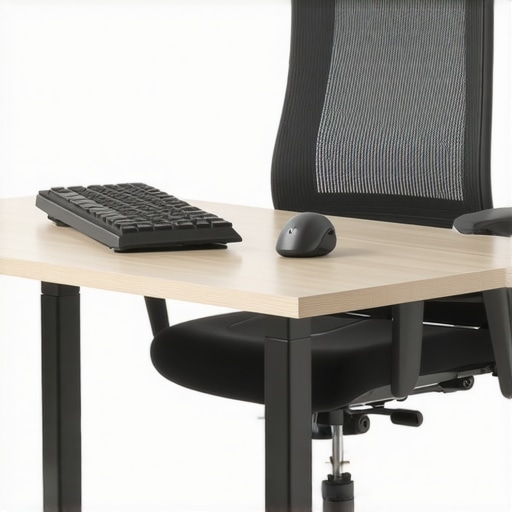
Beyond the hardware, I’ve started looking at my environment as a whole to enhance your back mobility: ergonomic tips for everyday comfort. For instance, I moved my printer to the other side of the room. Now, I have to stand up and walk to get my documents. I also swear by a high-refresh-rate monitor; as strange as it sounds, reducing screen flicker lowers eye strain, which prevents that forward-head tilt we talked about earlier. I predict we are moving toward ‘smart’ workstations where haptic sensors in our chairs will subtly vibrate to tell us which specific muscle is over-firing. Until that tech arrives, we are the sensors.
Take the first step toward a permanent fix
If you are tired of the ‘up and down’ cycle of feeling better then crashing, I want you to try one specific thing today. Instead of a standing desk, which can often lead to new problems, try the ‘one-foot-up rule.’ While standing or even washing dishes, place one foot on a small step stool. It’s a trick I learned from the one-foot-up rule for pain-free dishwashing and chores that instantly tilts your pelvis and takes the pressure off your L5-S1 disc. It’s a tiny shift that yields massive long-term results. If you’re dealing with more intense nerve issues, don’t wait—look into sciatica relief secrets: how to banish pain quickly today to get the inflammation down before you start your maintenance routine.
The Brutal Truth About Ergonomics That I Had to Learn the Hard Way
Looking back at my years of struggle, I realized that I was chasing a ‘gadget’ solution for a ‘behavioral’ problem. I spent over five hundred dollars on a top-tier lumbar pillow only to realize that my tight hip flexors were the real culprit behind my discomfort. The most profound shift happened when I stopped trying to find the one perfect posture and started treating my body like a living system that demands variety. I finally understood that pain isn’t a sign that my back is ‘broken,’ but rather a loud notification that I’ve been static for too long. If you find yourself constantly adjusting your seat, it might be time to ask is your back pain a sign of something more serious or if it’s simply your body begging for a new position. Also, never underestimate the power of the mind-body connection; I’ve found that neck pain and stress: how to break the cycle for good are two sides of the same coin. When the inbox gets full, my shoulders shouldn’t have to pay the price.
My Minimalist Toolkit for a Resilient Spine
You don’t need a thousand-dollar setup to find relief. Here is what I actually use every single day to stay mobile. First, a vertical mouse—it’s the only way to stop that forearm torque that eventually radiates into the neck. Second, I rely on boost your back mobility: simple exercises that make a difference during my lunch hour to undo the morning’s compression. Third, I keep a simple foam roller under my desk to wake up my feet and calves, which sounds weird until you realize how lower-body stiffness affects your whole chain. Lastly, I highly recommend checking out neck pain solutions: proven techniques to regain your range of motion for those days when the stiffness feels particularly stubborn and refuses to budge with simple movements.
Reclaiming Your Body One Desk Shift at a Time
The journey toward a pain-free life isn’t about a single ‘aha’ moment; it’s about the small, quiet wins you stack up every hour. Every time you choose to move instead of pushing through the burn, you are rewriting your body’s relationship with your workspace. These back pain breakthroughs are within your reach if you stay curious and listen to what your nerves are telling you. You aren’t destined to be stiff just because you work at a computer for forty hours a week. You are a biological masterpiece designed for movement—even in an increasingly digital world. Which one of these desk adjustments are you going to try first this afternoon? Let me know in the comments below.