
The single movement that resets your posture after a flight
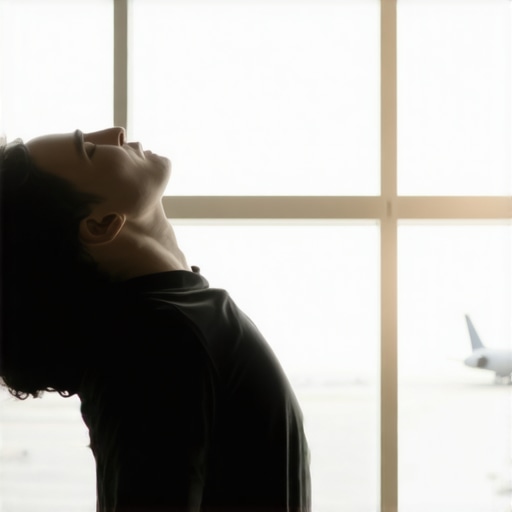
I stepped off the plane at O’Hare last November feeling like my spine had been replaced by a rusty accordion. My lower back was screaming, my neck felt like it was stuck in a permanent forward tilt, and I walked as if I’d aged thirty years in a four-hour flight. We’ve all been there, right? You spend hours folded into a seat designed for someone half your size, and when you finally stand up, your body has quite literally molded itself to the plastic shell of the aircraft. I used to make a massive mistake here—I’d immediately try to touch my toes or twist my spine violently in the baggage claim area to ‘loosen up.’ But I learned the hard way that reaching for your toes is the worst way to stretch your back when your discs are already compressed from travel. It’s like trying to stretch a cold rubber band that’s been under a heavy weight. Today, I’m going to show you the one movement that actually works to decompress your spine and reset your posture before you even reach the rental car counter. This isn’t some complex routine; it’s a physiological reset that tells your muscles it’s safe to let go.
Stop Letting Coach Seats Wreck Your Spine
Flying is a nightmare for your biomechanics. Between the constant vibration of the plane and the pressurized cabin, your intervertebral discs actually lose hydration and compress. According to research published in the journal Spine, prolonged sitting in a slouched position increases intradiscal pressure by up to 40% compared to standing. It’s no wonder we feel so ‘stuck.’ For years, I struggled with understanding the link between poor posture and chronic back pain, often blaming my mattress or my shoes when the real culprit was how I handled travel recovery. I once tried to ‘power through’ the stiffness by hitting the gym right after a red-eye, which led to a week-long flare-up that made me look like I was walking on eggshells. Now, I know better. There’s a secret to sitting through a 2-hour flight without back pain, but what you do the moment you walk off that jet bridge is even more critical for your long-term mobility. Have you ever felt that terrifying ‘catch’ in your back the moment you reached for your carry-on in the overhead bin? That’s your body sounding the alarm.
Does one single move really fix hours of cramped sitting?
It sounds like one of those ‘too good to be true’ internet hacks, doesn’t it? I was skeptical too. I thought I needed a full hour of yoga to undo the damage of a middle seat between two linebackers. But the reality is that your nervous system is just looking for a signal of safety and space. By performing a specific decompression move—what I call the ‘Baggage Claim Reach’—you create the necessary gap in your vertebrae to allow for rehydration. It’s not about intensity; it’s about alignment. If you’ve been dealing with neck pain and loss of motion after traveling, you know that traditional stretches often just pull on already irritated nerves. We need to focus on how a simple reach and breathe move can decompress your back and let your joints settle back into their natural grooves.
To start the ‘Baggage Claim Reach,’ find a sturdy vertical surface—a pillar near the luggage carousel or even the side of a rental car shuttle works perfectly. Stand about a foot away, facing the surface. Instead of bending down (which we already know is a disaster), reach one arm as high as you can while keeping your feet planted. The goal isn’t just to stretch the shoulder; it’s to use the reach to pull your rib cage away from your pelvis. When your ribs lift, you naturally create a vacuum effect in the lumbar spine. I remember doing this at Heathrow after a brutal ten-hour flight. I looked like a crazy person reaching for a sign on a pillar, but for the first time in three countries, I felt the ‘catch’ in my SI joint simply vanish. It wasn’t a violent crack; it was like a locked door finally clicking open. This is why how a simple reach and breathe move can decompress your back is so much more effective than aggressive floor stretches.

Create Space Between Your Vertebrae Right Now
Once you are in that reaching position, don’t just hang there. You need to actively engage your breathing to ‘push’ the vertebrae apart from the inside out. Think of your spine like a collapsed garden hose; you need internal pressure to straighten it out. While reaching high, take a slow, deep breath, but don’t let your chest puff out. Instead, try to direct the air into your back ribs and your waistline. This technique is essential for anyone looking to boost your back mobility with simple exercises that make a difference. I used to breathe entirely into my upper chest when I was stressed from travel, which only tightened my neck further. When I finally learned how to breathe into your lower back to release deep muscle tension, the chronic ‘tightness’ that usually followed me to the hotel began to dissipate within minutes.
Breathe Into Your Lower Back to Force Decompression
The mechanics are simple: as you inhale into the lower back, the diaphragm moves down and the pressure within your abdomen increases slightly, pushing against the spine. This creates a gentle ‘expansion’ from the inside. Hold that breath for three seconds while maintaining your reach, then exhale slowly. Repeat this five times on each side. It’s a literal reset for your nervous system. If you ignore this, your muscles will stay in ‘protection mode’ for the rest of the day, leading to that heavy, leaden feeling in your legs. By the time you get to the rental car, your spine should feel an inch longer. To keep this alignment intact as you transition to driving, you can how to adjust your rearview mirror to force better posture so you don’t immediately slump back into the same position that caused the trouble in the first place. I’ve found that if I don’t set this visual cue immediately, I’m back to a C-curve spine before I’ve even left the airport parking lot.
Let’s dig deeper into why these techniques feel so counterintuitive at first. Most of us were raised on the advice to ‘stand up straight’ or ‘shoulders back,’ but I’ve found that this rigid, military-style positioning is a one-way ticket to a flare-up. In my experience, why your straight posture is actually straining your muscles is because you’re essentially asking your back to act like a structural steel beam rather than a shock absorber. When you force a ‘perfect’ curve, you’re creating isometric tension that never shuts off, which is exactly why your back feels like it’s made of concrete by mid-afternoon.
Why does your sciatica flare up even when you are doing everything right?
This is the question that haunts most of my clients. You’re doing the stretches, you’ve bought the expensive chair, and yet the burning sensation remains. The hidden nuance here is movement variability. According to a landmark study published in the Journal of Orthopaedic & Sports Physical Therapy (JOSPT), there is no single ‘ideal’ posture that prevents pain; rather, the most significant risk factor for chronic issues is a lack of posture changes. If you are holding yourself ‘correctly’ for four hours, you are still starving your tissues of blood flow. This is where people often fail to see the difference between muscular sciatica and a slipped disc. They treat every tingle as a structural failure when it’s often just a lack of movement variety.
Stop stretching your hamstrings until you check this one thing
Here is the most common ‘oops’ factor I see: the hamstring trap. If you have leg pain, your instinct is to pull on that tight muscle. However, why your hamstrings feel tight but never get better with stretching is usually because they aren’t actually short—they are being pulled taut by your pelvis or, worse, you’re actually tugging on an irritated sciatic nerve. If you feel a sharp, ‘electric’ pull behind your knee when you stretch, stop immediately. You are likely experiencing nerve tension, and why some sciatica stretches actually pinch the nerve further is a nuance that even seasoned gym-goers miss. Instead of pulling harder, you need to address the root, which often requires conquering sciatica through proven approaches to end discomfort now rather than relying on the same old floor stretches that keep you in a cycle of irritation.
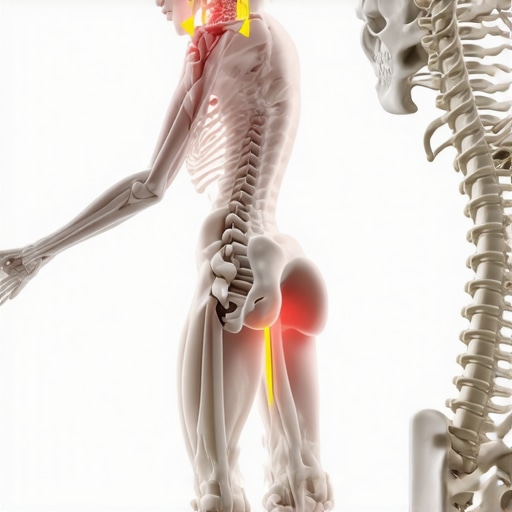
If you’ve been struggling with this, you might also want to check is your back pain a sign of something more serious by looking for key symptoms that go beyond simple travel stiffness. We often ignore the warning signs because we think we just ‘slept wrong’ or ‘sat too long.’ Have you ever fallen into this trap of over-stretching a nerve thinking it was a muscle? Let me know in the comments, and we can troubleshoot your specific routine. If you need more direct guidance on your specific situation, feel free to contact us to discuss a personalized plan for your recovery.
I’ve spent way too much money on high-tech massage guns and vibrating foam rollers that usually just sit in my closet gathering dust. What I’ve found over a decade of trial and error is that the most effective tools for back health are often the most basic. For example, I never travel without a standard tennis ball in my carry-on. This isn’t for a quick game of catch; it’s because knowing how a simple tennis ball can release your deep glute tension is a game-changer when you’re dealing with that deep, gnawing ache in your hip after a flight. I place it against a hotel wall and lean into those ‘hot spots’ in my piriformis. It’s targeted, it’s cheap, and it works better than any $400 device I’ve tried.
Your travel kit needs a simple tennis ball
Many people think they need complex equipment to maintain their progress, but most of my back pain breakthroughs navigating your path to restored mobility have come from mastering the fundamentals. When I’m at my desk, I don’t rely on a fancy lumbar support built into the chair—they are almost never in the right spot for my height. Instead, I use a small rolled-up towel, and learning the specific way to use a lumbar roll for maximum relief has saved me more pain than any ergonomic certification ever could. #IMAGE_PLACE_HOLDER_D#
The hidden screen habits that undo your work
Even if you do your stretches, your environment might be sabotaging you. I recently started looking into how your phones font size is impacting your neck tension. If you are squinting and leaning forward just to read an email, you are creating ‘text neck’ without even realizing it. I’ve increased the font size on all my devices by 20%, which naturally allows me to sit further back. Combine this with following the 15 degree rule for your computer monitor to save your neck, and you’ve eliminated about 80% of the mechanical stress that causes mid-afternoon headaches. Dr. Stuart McGill, a world-renowned expert on spine mechanics and author of Back Mechanic, often discusses the concept of ‘spinal hygiene’—it’s the small, repetitive movements we do all day that matter more than the 30 minutes we spend in the gym.
How do I maintain my spinal mobility for years?
Consistency is the only secret that actually exists. You can’t just do a ‘reach and breathe’ once and expect to be fixed forever. You need to integrate mobility mastery daily tips to keep your spine and joints healthy into your actual life, not just your workout routine. Looking ahead, I suspect we’ll see more AI-driven wearables that vibrate the moment your rib cage drops out of alignment, but for now, you have to be your own biofeedback loop. If you really want to stay ahead of the curve, focus on overcoming sciatica top lifestyle changes for better quality of life like changing your sitting position every 20 minutes. My challenge for you today is this: go into your phone settings right now and bump up your font size one notch. It feels weird for five minutes, but your neck will thank you by 5 PM.
The Hardest Lessons Travel Taught My Lower Back
After years of hobbling off planes, I realized that the “no pain, no gain” mentality is a recipe for disaster. My biggest lightbulb moment was realizing my body isn’t a machine; it’s a living ecosystem that reacts to the stress of travel. If I’m dehydrated and cramped, my spine is twice as vulnerable. I also discovered that consistency beats intensity every single time—doing five minutes of decompression at the gate is worth more than an hour-long yoga class two days later. Finally, I had to accept that why standing up straight is actually making your back pain worse when you’re forcing it; true mobility comes from relaxation and creating internal space, not rigid posturing.
The Minimalist Toolkit for Pain-Free Flights
I used to pack every high-tech gadget under the sun, but now I stick to these three essentials. First, a standard tennis ball—nothing releases deep glute tension faster after a middle seat. Second, Dr. Stuart McGill’s book Back Mechanic; it fundamentally changed how I view spinal hygiene and helped me with unlocking sciatica relief with expert strategies. Third, a simple high-quality lumbar roll because most airplane seats are shaped like a ‘C’ and actively push your discs out of alignment. If you’re on a budget, the simple towel roll trick works wonders for both your neck and your lower back while you’re resting in a hotel room.
Start Reclaiming Your Freedom of Movement
Don’t let the fear of a flare-up keep you from exploring the world. Your spine is incredibly resilient when you give it the space and the nervous system signals it needs to thrive. By implementing these small shifts—from font sizes to decompression breaths—you are taking proactive steps toward back pain breakthroughs and navigating your path to restored mobility. Travel should be about the destination, not the discomfort you feel when you arrive. If you feel stuck or your symptoms are lingering, don’t hesitate to contact us to find a personalized path forward. You deserve to move without restriction. Have you ever tried a specific stretch after a long flight that actually made your pain worse? Let me know your experience in the comments below!