
Why crossing your legs at the office leads to uneven hips

I remember the day I realized my favorite pair of jeans was suddenly fitting… wrong. The right hem was dragging on the floor, while the left one sat perfectly above my heel. At first, I blamed the dryer. Then I blamed the manufacturer. But then I stood in front of a full-length mirror and saw the truth: my right hip was hiked up significantly higher than my left. I looked like I was permanently mid-step. My years of the “executive cross”—sitting with one leg thrown over the other for hours on end—had finally caught up with me. It wasn’t a fashion disaster; it was a physical one.
That One Habit You Think is Harmless
We all do it. You sit down, open your laptop, and your leg naturally swings over the other. It feels cozy. It feels stable. But in reality, you are putting your pelvis into a vice grip. When you cross your legs, you force your hip bones to rotate and your lower back to compensate for the shift in weight. This is why crossing your legs is the fastest way to tilt your pelvis and create a structural imbalance that stays with you long after you leave the office. I made the massive mistake of assuming that if it didn’t hurt while I was doing it, it wasn’t causing a problem. I couldn’t have been more wrong. The subtle tugging on your ligaments starts a chain reaction. Eventually, that tilted pelvis starts pulling on your spine, leading to a clear link between poor posture and chronic back pain. If you’ve ever wondered why one side of your back feels perpetually tighter than the other, your sitting habit is likely the culprit.
Can a simple sitting habit actually cause real damage?
It is easy to dismiss this as “just a posture thing,” but the impact is physiological. Research published in the Journal of Physical Therapy Science indicates that prolonged leg-crossing can lead to significant lateral pelvic tilt and even changes in the length of your leg muscles over time. It is not just a “tight muscle”—it is a change in how your skeleton sits. Today, I am going to show you exactly how to stop this cycle. We are going to look at a simple way to check your own spine for pelvic tilt right now in your office chair. We also need to address the “sleepy muscle” syndrome, specifically why your glutes turn off when you sit for over an hour, leaving your lower back to do all the heavy lifting. My goal is to get you back to a place of total mobility mastery where your hips are level and your back is quiet. Do you find yourself always crossing the same leg, or do you switch it up to “even things out”? (Spoiler: switching doesn’t actually fix the tilt!). Let me know your go-to sitting position in the comments below.
Find Your Neutral Ground Right Now
Think of your pelvis like a bowl of water. When you habitually cross one leg over the other, you are effectively tipping that bowl to the side, causing the water to spill and forcing your spine to act as a frantic mop. To stop the cycle, you must first find your center. Sit on a firm chair and slide your hands under your butt until you feel those two hard bones—your ‘sit bones.’ If you are tilted, one bone will feel like it is digging into your palm while the other barely makes contact. Leveling these out is the first step in mobility mastery. I remember the first time I tried this; I realized I was putting about 80% of my weight on my left hip. It felt completely alien to sit ‘evenly,’ but that discomfort was actually the feeling of my muscles finally being asked to do their real jobs.
The Footstool Trick That Saved My Hips
One of the most effective ways to kill the urge to cross your legs is to change the geometry of your seat. When your knees are slightly higher than your hips, your pelvis naturally tucks into a more stable, neutral position. This is the simple footstool trick to stop lower back pain while sitting that I now swear by. Last month, I spent four hours finishing a project and usually, my right hip would be screaming by hour two. By placing a small, six-inch stool under my feet, I created a ‘cradle’ for my hips. The urge to swing my leg over vanished because the mechanical tension that usually makes crossing feel ‘comfortable’ was gone. If you don’t have a stool, a stack of old textbooks or a firm yoga block works just as well.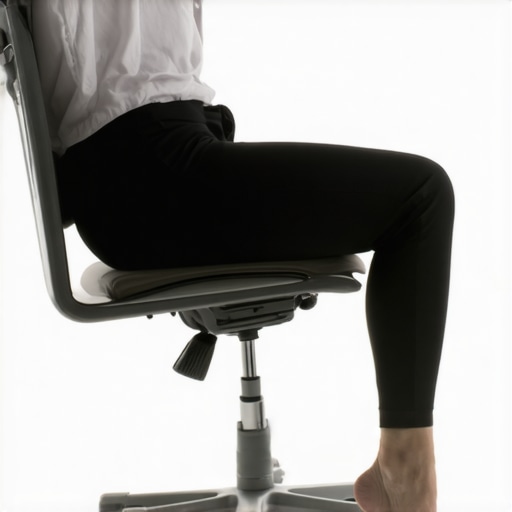
Reactivate Your Foundation Before It Shuts Down
The longer you sit, the more your nervous system begins to ‘mute’ the signals to your glutes. This isn’t just a metaphor; it is a physiological process where the front of your hips (the hip flexors) become so tight they actually inhibit the muscles on the back. This is exactly why your glutes turn off when you sit for over an hour, leaving your lower back to stabilize your entire torso. To fight this, you need a ‘reset’ movement. Every sixty minutes, stand up and perform ten repetitions of a glute squeeze while standing straight. It sounds silly, but it re-establishes the brain-body connection that sitting destroys.
Adjust Your Sitting Angle to Save Your Nerves
If you already feel a tingling or ‘heavy’ sensation in your legs, your current chair setup might be pinching the sciatic nerve or local blood vessels. You can often find instant relief by learning how a slight change in your sitting angle stops leg numbness. Try wedging a small rolled-up towel under the very back of your sit bones. This creates a slight forward tilt that preserves the natural curve of your lower back, preventing the ‘slump’ that leads to nerve compression. When I first implemented this during my morning commute, I noticed that the weird buzzing in my calf disappeared before I even reached the office. It’s also worth noting that you should adjust your rearview mirror to force better posture; if you start to slouch, you won’t be able to see the traffic behind you, serving as a constant, passive reminder to sit tall.It is tempting to think that if a muscle feels tight, the solution is to pull on it until it lets go. But here is the contrarian truth: most ‘tightness’ is actually a protective tension, not a length issue. I spent years aggressively stretching my hamstrings, only to find they felt even tighter the next morning. It turns out that why stretching your hamstrings won’t fix your tight legs is because your brain is keeping them taut to protect a vulnerable lower back or a tilted pelvis. If you force a stretch on a muscle that is ‘guarding’ a joint, you are not gaining mobility; you are inviting a tear or a disc flare-up.
How can you tell if your leg pain is a muscle pull or a nerve root?
This is the advanced question every desk warrior needs to answer. If you feel a ‘stretch’ that is sharp, electric, or travels down toward your foot, you aren’t stretching a muscle—you are yanking on a nerve. This is a massive ‘oops’ factor. I have seen people try to ‘power through’ a hamstring stretch, only to aggravate their sciatic nerve further. In fact, why some sciatica stretches actually pinch the nerve further is often due to increased ‘neural tension.’ According to a study published in the Journal of Orthopaedic & Sports Physical Therapy, nerves do not respond well to traditional stretching; they require ‘gliding’ or ‘flossing’ to regain mobility without irritation. If you treat a nerve like a rubber band, it will revolt with inflammation. One of the most overlooked nuances in back pain breakthroughs is looking at the ground floor: your feet. You might be focused on your lumbar spine, but how a stiff big toe forces your lower back to overwork is a classic example of the ‘kinetic chain’ in action. If your big toe cannot extend properly when you walk, your body compensates by over-rotating your hip, which then yanks on your SI joint. You end up treating the back when the real culprit is your footwear or a stiff joint three feet away. Have you ever fallen into the trap of stretching a ‘tight’ muscle for weeks with no relief? Let me know in the comments below.Maintaining a level pelvis and a happy back isn’t about one giant workout; it’s about the gear you use when you aren’t thinking about your posture. I personally never sit in a car or an office chair without a McKenzie D-Section lumbar roll. Most people buy the round ones, but the ‘D’ shape sits flush against the chair, providing a stable shelf for your lumbar spine. I’ve found that the specific way to use a lumbar roll for maximum relief is to place it slightly higher than you think—right at the belt line—to prevent the ‘tailbone tuck’ that ruins your alignment. If you are on a budget, you don’t need a thousand-dollar Herman Miller; I have coached many readers on how to set up your home office for less than fifty dollars using just a few key supports and a stack of books.
The Two Cheap Tools That Keep My Spine Happy
Beyond the lumbar roll, my second ‘must-have’ is a simple lacrosse ball. While foam rollers are great for large surfaces, a lacrosse ball allows you to pin down the specific trigger points in your glutes that fire up when you’ve been sitting too long. If you’ve been dealing with a persistent ache, it’s worth checking if your back pain is a sign of something more serious, but often, it is just localized muscle adhesion that needs targeted pressure. I spend five minutes every evening leaning against a wall with that ball tucked into my hip. It’s my daily ‘insurance policy’ against a flare-up.
How do I keep these results for the next decade?
Long-term success is built on the concept of ‘micro-dosing’ movement. According to Robin McKenzie, the developer of the McKenzie Method of Mechanical Diagnosis and Therapy (MDT), the key to spinal health is the regular interruption of sitting. You cannot undo eight hours of slouching with one hour at the gym. This is why I advocate for mobility mastery through small, hourly resets. I also swear by the morning routine that prevents lower back stiffness, which focuses on gentle extension before you ever sit down for breakfast. If you are still dealing with lingering nerve issues, integrating the nerve flossing routine for stubborn leg numbness and tingling into your daily wind-down can prevent scar tissue from binding the nerve to the surrounding muscle.
Why Your Smartwatch Is About to Become Your Personal Coach
Looking ahead, I predict a massive shift toward bio-interactive wearables. We are moving away from simple step counters and toward sensors that can detect the exact moment your pelvis tilts or your head drifts forward. Future haptic-feedback devices will likely give you a tiny pulse on your wrist the second you cross your legs, training your nervous system in real-time rather than forcing you to remember to sit straight. Until that tech is perfected, we have to rely on our own internal ‘software.’ Try this today: Take your lumbar support and move it exactly two inches higher than your usual spot for one hour. Observe how it changes the tension in your neck. If it feels better, your ‘default’ setting was likely too low.I remember the day I realized my favorite pair of jeans was suddenly fitting… wrong. The right hem was dragging on the floor, while the left one sat perfectly above my heel. At first, I blamed the dryer. Then I blamed the manufacturer. But then I stood in front of a full-length mirror and saw the truth: my right hip was hiked up significantly higher than my left. I looked like I was permanently mid-step. My years of the “executive cross”—sitting with one leg thrown over the other for hours on end—had finally caught up with me. It wasn’t a fashion disaster; it was a physical one.
That One Habit You Think is Harmless
We all do it. You sit down, open your laptop, and your leg naturally swings over the other. It feels cozy. It feels stable. But in reality, you are putting your pelvis into a vice grip. When you cross your legs, you force your hip bones to rotate and your lower back to compensate for the shift in weight. This is why crossing your legs is the fastest way to tilt your pelvis and create a structural imbalance that stays with you long after you leave the office. I made the massive mistake of assuming that if it didn’t hurt while I was doing it, it wasn’t causing a problem. I couldn’t have been more wrong. The subtle tugging on your ligaments starts a chain reaction. Eventually, that tilted pelvis starts pulling on your spine, leading to a clear link between poor posture and chronic back pain. If you’ve ever wondered why one side of your back feels perpetually tighter than the other, your sitting habit is likely the culprit.
Can a simple sitting habit actually cause real damage?
It is easy to dismiss this as “just a posture thing,” but the impact is physiological. Research published in the Journal of Physical Therapy Science indicates that prolonged leg-crossing can lead to significant lateral pelvic tilt and even changes in the length of your leg muscles over time. It is not just a “tight muscle”—it is a change in how your skeleton sits. Today, I am going to show you exactly how to stop this cycle. We are going to look at a simple way to check your own spine for pelvic tilt right now in your office chair. We also need to address the “sleepy muscle” syndrome, specifically why your glutes turn off when you sit for over an hour, leaving your lower back to do all the heavy lifting. My goal is to get you back to a place of total mobility mastery where your hips are level and your back is quiet. Do you find yourself always crossing the same leg, or do you switch it up to “even things out”? (Spoiler: switching doesn’t actually fix the tilt!). Let me know your go-to sitting position in the comments below.
Find Your Neutral Ground Right Now
Think of your pelvis like a bowl of water. When you habitually cross one leg over the other, you are effectively tipping that bowl to the side, causing the water to spill and forcing your spine to act as a frantic mop. To stop the cycle, you must first find your center. Sit on a firm chair and slide your hands under your butt until you feel those two hard bones—your ‘sit bones.’ If you are tilted, one bone will feel like it is digging into your palm while the other barely makes contact. Leveling these out is the first step in mobility mastery. I remember the first time I tried this; I realized I was putting about 80% of my weight on my left hip. It felt completely alien to sit ‘evenly,’ but that discomfort was actually the feeling of my muscles finally being asked to do their real jobs.
The Footstool Trick That Saved My Hips
One of the most effective ways to kill the urge to cross your legs is to change the geometry of your seat. When your knees are slightly higher than your hips, your pelvis naturally tucks into a more stable, neutral position. This is the simple footstool trick to stop lower back pain while sitting that I now swear by. Last month, I spent four hours finishing a project and usually, my right hip would be screaming by hour two. By placing a small, six-inch stool under my feet, I created a ‘cradle’ for my hips. The urge to swing my leg over vanished because the mechanical tension that usually makes crossing feel ‘comfortable’ was gone. If you don’t have a stool, a stack of old textbooks or a firm yoga block works just as well.
Reactivate Your Foundation Before It Shuts Down
The longer you sit, the more your nervous system begins to ‘mute’ the signals to your glutes. This isn’t just a metaphor; it is a physiological process where the front of your hips (the hip flexors) become so tight they actually inhibit the muscles on the back. This is exactly why your glutes turn off when you sit for over an hour, leaving your lower back to stabilize your entire torso. To fight this, you need a ‘reset’ movement. Every sixty minutes, stand up and perform ten repetitions of a glute squeeze while standing straight. It sounds silly, but it re-establishes the brain-body connection that sitting destroys.
Adjust Your Sitting Angle to Save Your Nerves
If you already feel a tingling or ‘heavy’ sensation in your legs, your current chair setup might be pinching the sciatic nerve or local blood vessels. You can often find instant relief by learning how a slight change in your sitting angle stops leg numbness. Try wedging a small rolled-up towel under the very back of your sit bones. This creates a slight forward tilt that preserves the natural curve of your lower back, preventing the ‘slump’ that leads to nerve compression. When I first implemented this during my morning commute, I noticed that the weird buzzing in my calf disappeared before I even reached the office. It’s also worth noting that you should adjust your rearview mirror to force better posture; if you start to slouch, you won’t be able to see the traffic behind you, serving as a constant, passive reminder to sit tall.It is tempting to think that if a muscle feels tight, the solution is to pull on it until it lets go. But here is the contrarian truth: most ‘tightness’ is actually a protective tension, not a length issue. I spent years aggressively stretching my hamstrings, only to find they felt even tighter the next morning. It turns out that why stretching your hamstrings won’t fix your tight legs is because your brain is keeping them taut to protect a vulnerable lower back or a tilted pelvis. If you force a stretch on a muscle that is ‘guarding’ a joint, you are not gaining mobility; you are inviting a tear or a disc flare-up.
How can you tell if your leg pain is a muscle pull or a nerve root?
This is the advanced question every desk warrior needs to answer. If you feel a ‘stretch’ that is sharp, electric, or travels down toward your foot, you aren’t stretching a muscle—you are yanking on a nerve. This is a massive ‘oops’ factor. I have seen people try to ‘power through’ a hamstring stretch, only to aggravate their sciatic nerve further. In fact, why some sciatica stretches actually pinch the nerve further is often due to increased ‘neural tension.’ According to a study published in the Journal of Orthopaedic & Sports Physical Therapy, nerves do not respond well to traditional stretching; they require ‘gliding’ or ‘flossing’ to regain mobility without irritation. If you treat a nerve like a rubber band, it will revolt with inflammation. One of the most overlooked nuances in back pain breakthroughs is looking at the ground floor: your feet. You might be focused on your lumbar spine, but how a stiff big toe forces your lower back to overwork is a classic example of the ‘kinetic chain’ in action. If your big toe cannot extend properly when you walk, your body compensates by over-rotating your hip, which then yanks on your SI joint. You end up treating the back when the real culprit is your footwear or a stiff joint three feet away. Have you ever fallen into the trap of stretching a ‘tight’ muscle for weeks with no relief? Let me know in the comments below.Maintaining a level pelvis and a happy back isn’t about one giant workout; it’s about the gear you use when you aren’t thinking about your posture. I personally never sit in a car or an office chair without a McKenzie D-Section lumbar roll. Most people buy the round ones, but the ‘D’ shape sits flush against the chair, providing a stable shelf for your lumbar spine. I’ve found that the specific way to use a lumbar roll for maximum relief is to place it slightly higher than you think—right at the belt line—to prevent the ‘tailbone tuck’ that ruins your alignment. If you are on a budget, you don’t need a thousand-dollar Herman Miller; I have coached many readers on how to set up your home office for less than fifty dollars using just a few key supports and a stack of books.
The Two Cheap Tools That Keep My Spine Happy
Beyond the lumbar roll, my second ‘must-have’ is a simple lacrosse ball. While foam rollers are great for large surfaces, a lacrosse ball allows you to pin down the specific trigger points in your glutes that fire up when you’ve been sitting too long. If you’ve been dealing with a persistent ache, it’s worth checking if your back pain is a sign of something more serious, but often, it is just localized muscle adhesion that needs targeted pressure. I spend five minutes every evening leaning against a wall with that ball tucked into my hip. It’s my daily ‘insurance policy’ against a flare-up.
How do I keep these results for the next decade?
Long-term success is built on the concept of ‘micro-dosing’ movement. According to Robin McKenzie, the developer of the McKenzie Method of Mechanical Diagnosis and Therapy (MDT), the key to spinal health is the regular interruption of sitting. You cannot undo eight hours of slouching with one hour at the gym. This is why I advocate for mobility mastery through small, hourly resets. I also swear by the morning routine that prevents lower back stiffness, which focuses on gentle extension before you ever sit down for breakfast. If you are still dealing with lingering nerve issues, integrating the nerve flossing routine for stubborn leg numbness and tingling into your daily wind-down can prevent scar tissue from binding the nerve to the surrounding muscle.
Why Your Smartwatch Is About to Become Your Personal Coach
Looking ahead, I predict a massive shift toward bio-interactive wearables. We are moving away from simple step counters and toward sensors that can detect the exact moment your pelvis tilts or your head drifts forward. Future haptic-feedback devices will likely give you a tiny pulse on your wrist the second you cross your legs, training your nervous system in real-time rather than forcing you to remember to sit straight. Until that tech is perfected, we have to rely on our own internal ‘software.’ Try this today: Take your lumbar support and move it exactly two inches higher than your usual spot for one hour. Observe how it changes the tension in your neck. If it feels better, your ‘default’ setting was likely too low.
Hard Truths About Your Daily Desk Habit
After years of navigating my own recovery from a tilted pelvis, I’ve realized that long-term relief isn’t about doing more; it’s about doing less of the wrong thing. One major lightbulb moment was realizing that passive stretching often backfires when you don’t know how to tell if your leg pain is a muscle strain or a nerve root. If you are yanking on a nerve that is already compressed by a tilted hip, you are essentially pouring gas on a fire. I also learned that you can’t out-exercise a bad habit. You can do all the squats in the world, but if you spend the other 23 hours in a crooked chair, your brain will prioritize the slouch over the strength. Finally, consistency beats intensity every time. A 30-second glute reset every hour is infinitely more valuable than a grueling two-hour mobility session once a week.
The Minimalist Toolkit I Use Every Day
I’ve tested dozens of gadgets, but these are the only ones that actually made a difference in my journey toward mobility mastery. First, the D-section lumbar roll—it’s the only support that stays put and actually supports the lumbar curve rather than just pushing your whole body forward. Second, a simple lacrosse ball. It is the most effective way to address deep glute adhesions that lead to sciatica relief secrets that actually work. Lastly, I swear by a firm yoga block under my feet when I’m forced to sit in a chair that is too high. It provides the mechanical leverage to keep my pelvis neutral and is a core part of my ergonomic tips for everyday comfort.
Building a Body That Moves with Ease
Fixing your posture and leveling your pelvis isn’t a destination; it’s a practice. It’s about building a foundation where your spine and joints can thrive without constant intervention. By making these small adjustments—swapping the leg cross for a footstool or resetting your glutes hourly—you are choosing a future free from chronic back pain and sciatica. You have the knowledge and the tools to take control of your alignment starting right now. Stay consistent, stay curious, and listen to what your body is trying to tell you through those small aches. Have you ever noticed your clothes fitting differently because of a hip hike or pelvic tilt? Let me know your experience in the comments below.