
The simple footstool trick to stop lower back pain while sitting

I’ll never forget the Tuesday I almost quit my job just because of a chair. My lower back wasn’t just aching—it felt like someone had driven a hot spike into my L5-S1 disc. I had the “best” lumbar support money could buy, and I was sitting as straight as a board, yet the pain was blinding. I was failing at the simple act of sitting. It turns out, I was falling for the biggest lie in ergonomics. I spent years thinking my chair was the enemy when, really, it was the floor. Or rather, how far away my feet were from it. Today, I am going to show you how a simple footstool can change your life, because frankly, your spine is tired of waiting for a miracle chair to save it.
Stop fighting your chair and start using your feet
Most of us are told that the secret to a happy back is a $1,000 mesh chair. I bought into that. I also tried the simple morning move to prime my spine, but nothing stuck because the moment I sat back down, the pressure returned. I realized that understanding the link between poor posture and chronic back pain isn’t about sitting straighter. The real issue is that when your feet sit flat on the floor, your hip flexors often stay tight, pulling your pelvis into a tilt that crushes your lower back. This is why your favorite armchair is secretly causing your lower back stiffness; it just doesn’t support the right angle. By simply propping my feet up on a small stool, I felt an instant release. [IMAGE_PLACEHOLDER]
Is a cheap plastic stool really better than a fancy chair?
You’re probably skeptical. I was too. I thought, “There’s no way a twelve-dollar piece of plastic does more than my ergonomic setup.” But the science of intradiscal pressure supports it. According to research cited by the Cleveland Clinic, sitting can increase the pressure on your spinal discs by 40% to 90% more than standing, depending on your slouch. When you elevate your knees slightly above your hips, you flatten the lumbar curve just enough to offload those overworked joints. I made the massive mistake early on of thinking my upright posture was helping, but I was just creating a rigid, painful cage for my nerves. Have you ever found yourself fidgeting every five minutes just to find a sweet spot that never stays sweet for long? Even the simplest chair height trick won’t work if your pelvic angle is fundamentally wrong. By the end of this, you will know exactly how to set this up to finally sit without that nagging throb.
Build your own ergonomic cockpit for under twenty dollars
To start, you need to ignore the 90-90-90 rule your HR department probably emailed you. Setting your hips, knees, and ankles all at perfect right angles is actually a recipe for hip flexor tension. Instead, you want your knees to be roughly two to three inches higher than your hip joints. This small adjustment acts like a release valve for your psoas muscle, which is the primary culprit when you feel like your spine is being pulled forward from the inside. I remember one afternoon in a cramped library where I was desperate for relief; I ended up stacking three massive hardcover encyclopedias under my desk. It looked ridiculous, and the books kept sliding around, but the relief was so immediate that I didn’t care about the noise or the stares. By the time I left, the familiar ‘grinding’ sensation in my sacrum was gone. If you aren’t ready to buy a dedicated stool, you can use the simple chair height trick to find your baseline, but nothing replaces the mechanical advantage of a solid footrest. 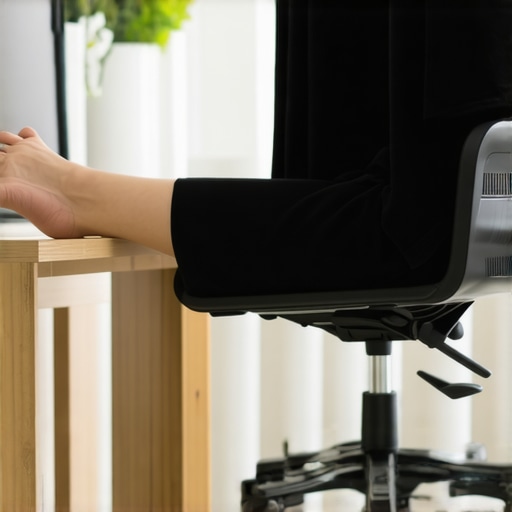
Stop your pelvis from dragging your spine down
Think of your pelvis as a bucket filled with water. When your feet are dangling or even just flat on the floor in a standard chair, that bucket tends to tilt forward, ‘spilling’ water out the front. This ‘anterior tilt’ forces your lower back to arch excessively, crushing the facets of your vertebrae together. By elevating your feet, you effectively tilt the bucket back into a neutral position. This is why your lumbar support might be making your back stiffer; it’s trying to push into a curve that is already under too much tension. When you use a stool, the chair’s support actually starts to feel like a cushion rather than a rock. This subtle shift is essential for enhancing your back mobility because it allows the muscles to finally let go of their ‘protective guarding’ reflex.
Hack your kitchen time with the one-foot-up rule
This principle isn’t just for your desk. Most people suffer the most during stationary tasks like washing dishes or prepping dinner because standing still is actually harder on the spine than walking. When you stand, your center of gravity is constantly fighting to stay upright, often at the expense of your L4 and L5 discs. I started keeping a small step stool under my kitchen sink. By placing just one foot up on the stool while I scrubbed pans, I could feel my entire lumbar spine decompress. This one foot up rule for pain-free chores works because it breaks the symmetrical tension in your hips. If you’ve ever felt a sharp pinch when standing up from a chair, it’s likely because your joints have been locked in a static, high-pressure state for too long. You can also pair this with a 30-second ankle drill to ensure your lower body stays fluid.
Choose the right height for your height
Not all stools are created equal. If the stool is too high, you’ll round your mid-back and start feeling a burning sensation between your shoulder blades. If it’s too low, you won’t get enough pelvic tilt to matter. Look for an angled footrest that allows your ankles to stay relaxed. When I first started experimenting, I made the mistake of using a stool that was nearly ten inches high; I ended up with a sore neck because I was hunching forward to compensate. I quickly learned that your straight posture is actually straining your muscles if it isn’t supported by the correct foundation. Aim for that ‘sweet spot’ where your lower back feels like it’s melting into the backrest of your chair without you having to ‘force’ a single muscle to stay in place.Let’s dig deeper into the nuances that most people—and even some professionals—completely miss.
Stop stretching your hamstrings if you want your back to heal
One of the biggest mistakes I see, and one I fell for myself for years, is the obsession with ‘stretching it out.’ When your back or leg feels tight, the instinct is to reach for your toes. But here is a hard truth: why reaching for your toes is the worst way to stretch your back. If you have any underlying nerve irritation, that aggressive stretch acts like a cheese grater on an already inflamed nerve. This is specifically why stretching your hamstrings can actually flare up sciatica. You think you’re loosening a muscle, but you’re actually tensioning the sciatic nerve until it screams. 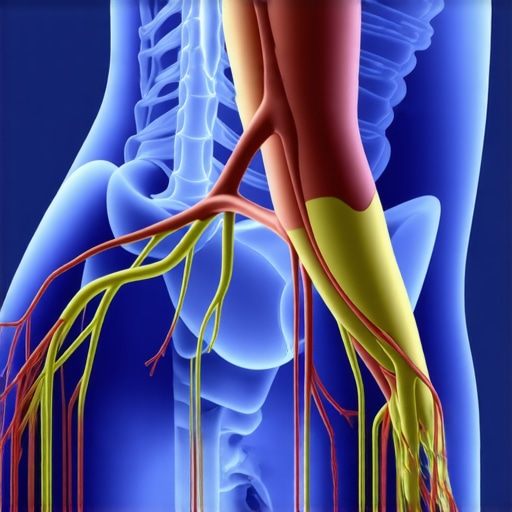
The nerve versus muscle trap that keeps you in pain
A study published in the Journal of Orthopaedic & Sports Physical Therapy highlighted that ‘neural mobilization,’ which involves gentle gliding of the nerve, is far superior to static stretching for radiating pain. If you feel a sharp, electrical, or ‘zingy’ sensation during a stretch, stop immediately. You aren’t stretching a rubber band; you are pulling on a sensitive electrical cord. This is the difference between muscular sciatica and a slipped disc. If you continue to push through that ‘good’ pain, you’re likely making the inflammation worse. Have you ever fallen into this trap? Let me know in the comments.
Why does the pain return immediately after you finish your stretches?
Most people focus on the symptoms rather than the mechanical ‘upstream’ cause. For instance, how a stiff ankle is actually causing your recurrent lower back aches is a nuance most ignore. Your body is a kinetic chain. If your ankle doesn’t move, your knee wobbles, your hip compensates, and your lower back takes the hit. If you only treat the back, you’re just bailing water out of a sinking boat without plugging the hole. This is also why your workout might be feeding your chronic inflammation if your form is off. Another hidden trap is the ‘perfect’ posture myth. Why your perfect upright posture is actually tensing your spine comes down to muscle fatigue. If you are ‘holding’ yourself straight, you are creating a static load that cuts off blood flow. You need movement, not just a better position. For those dealing with neck issues, how a stiff upper back is forcing your neck to move too much is often the real secret to lasting relief. Stop looking only at where it hurts and start looking at what isn’t moving.
I stopped looking for a miracle cure and started looking at my everyday environment. I realized that maintenance isn’t about a weekly massage; it’s about the hours spent between those appointments. I personally swear by a physical lumbar roll rather than built-in chair support. I also use simple software to block my screen every 50 minutes to force a standing break. When you are on the go, learning how to adjust your rearview mirror to force better posture is a game changer for long commutes. You also need to master the basics of how to set up your laptop for better spine protection because even ten minutes of hunching can undo hours of progress.
Skip the expensive braces and fix your environment instead
I see so many people wearing those elastic posture correctors that pull your shoulders back. They don’t work long-term because they do the job your muscles should be doing, which eventually makes you weaker. Instead, I use a simple tennis ball for maintenance. Knowing how a simple tennis ball can release your deep glute tension allows you to perform self-maintenance in five minutes at night. This is part of what I call mobility mastery daily tips to keep your spine and joints healthy. It is about small, repeatable actions. Even if you are already conquering sciatica proven approaches to end discomfort now, you have to realize that the body is a living system that adapts to your most frequent positions.
How do I maintain my spine health for the next decade?
Long-term results come from what Dr. Stuart McGill, a world-renowned spine researcher at the University of Waterloo, calls ‘spine hygiene.’ In his book Back Mechanic, he explains that we only have a certain number of ‘flexion cycles’ in our discs before they wear down. This means I’ve had to change how I do everything, from picking up a pen to getting out of bed. For my neck, I’ve focused on revitalize your neck effective techniques for lasting pain relief to ensure my upper back isn’t stiffening up. Maintenance is about ‘micro-dosing’ movement. I predict that in the next five years, we will see a massive shift toward wearable haptic sensors that vibrate the second your pelvis tilts into a dangerous position. We won’t need to ‘remember’ to sit well; our clothes will tell us.
Smart sensors are about to change the game for back pain
The trend is moving away from reactive medicine and toward proactive, tech-assisted ergonomics. But until those smart-shirts are affordable, you have to be your own sensor. My challenge to you is to try one thing today: set your car’s rearview mirror while sitting perfectly tall, and the moment you can’t see out of it clearly, use that as your cue to reset your spine. It is a simple, zero-cost way to stay honest with yourself. This kind of consistency is the only way to ensure you are unlocking sciatica relief expert strategies for lasting comfort.
I’ll never forget the Tuesday I almost quit my job just because of a chair. My lower back wasn’t just aching—it felt like someone had driven a hot spike into my L5-S1 disc. I had the “best” lumbar support money could buy, and I was sitting as straight as a board, yet the pain was blinding. I was failing at the simple act of sitting. It turns out, I was falling for the biggest lie in ergonomics. I spent years thinking my chair was the enemy when, really, it was the floor. Or rather, how far away my feet were from it. Today, I am going to show you how a simple footstool can change your life, because frankly, your spine is tired of waiting for a miracle chair to save it.
Stop fighting your chair and start using your feet
Most of us are told that the secret to a happy back is a $1,000 mesh chair. I bought into that. I also tried the simple morning move to prime my spine, but nothing stuck because the moment I sat back down, the pressure returned. I realized that understanding the link between poor posture and chronic back pain isn’t about sitting straighter. The real issue is that when your feet sit flat on the floor, your hip flexors often stay tight, pulling your pelvis into a tilt that crushes your lower back. This is why your favorite armchair is secretly causing your lower back stiffness; it just doesn’t support the right angle. By simply propping my feet up on a small stool, I felt an instant release. [IMAGE_PLACEHOLDER]
Is a cheap plastic stool really better than a fancy chair?
You’re probably skeptical. I was too. I thought, “There’s no way a twelve-dollar piece of plastic does more than my ergonomic setup.” But the science of intradiscal pressure supports it. According to research cited by the Cleveland Clinic, sitting can increase the pressure on your spinal discs by 40% to 90% more than standing, depending on your slouch. When you elevate your knees slightly above your hips, you flatten the lumbar curve just enough to offload those overworked joints. I made the massive mistake early on of thinking my upright posture was helping, but I was just creating a rigid, painful cage for my nerves. Have you ever found yourself fidgeting every five minutes just to find a sweet spot that never stays sweet for long? Even the simplest chair height trick won’t work if your pelvic angle is fundamentally wrong. By the end of this, you will know exactly how to set this up to finally sit without that nagging throb.
Build your own ergonomic cockpit for under twenty dollars
To start, you need to ignore the 90-90-90 rule your HR department probably emailed you. Setting your hips, knees, and ankles all at perfect right angles is actually a recipe for hip flexor tension. Instead, you want your knees to be roughly two to three inches higher than your hip joints. This small adjustment acts like a release valve for your psoas muscle, which is the primary culprit when you feel like your spine is being pulled forward from the inside. I remember one afternoon in a cramped library where I was desperate for relief; I ended up stacking three massive hardcover encyclopedias under my desk. It looked ridiculous, and the books kept sliding around, but the relief was so immediate that I didn’t care about the noise or the stares. By the time I left, the familiar ‘grinding’ sensation in my sacrum was gone. If you aren’t ready to buy a dedicated stool, you can use the simple chair height trick to find your baseline, but nothing replaces the mechanical advantage of a solid footrest.
Stop your pelvis from dragging your spine down
Think of your pelvis as a bucket filled with water. When your feet are dangling or even just flat on the floor in a standard chair, that bucket tends to tilt forward, ‘spilling’ water out the front. This ‘anterior tilt’ forces your lower back to arch excessively, crushing the facets of your vertebrae together. By elevating your feet, you effectively tilt the bucket back into a neutral position. This is why your lumbar support might be making your back stiffer; it’s trying to push into a curve that is already under too much tension. When you use a stool, the chair’s support actually starts to feel like a cushion rather than a rock. This subtle shift is essential for enhancing your back mobility because it allows the muscles to finally let go of their ‘protective guarding’ reflex.
Hack your kitchen time with the one-foot-up rule
This principle isn’t just for your desk. Most people suffer the most during stationary tasks like washing dishes or prepping dinner because standing still is actually harder on the spine than walking. When you stand, your center of gravity is constantly fighting to stay upright, often at the expense of your L4 and L5 discs. I started keeping a small step stool under my kitchen sink. By placing just one foot up on the stool while I scrubbed pans, I could feel my entire lumbar spine decompress. This one foot up rule for pain-free chores works because it breaks the symmetrical tension in your hips. If you’ve ever felt a sharp pinch when standing up from a chair, it’s likely because your joints have been locked in a static, high-pressure state for too long. You can also pair this with a 30-second ankle drill to ensure your lower body stays fluid.
Choose the right height for your height
Not all stools are created equal. If the stool is too high, you’ll round your mid-back and start feeling a burning sensation between your shoulder blades. If it’s too low, you won’t get enough pelvic tilt to matter. Look for an angled footrest that allows your ankles to stay relaxed. When I first started experimenting, I made the mistake of using a stool that was nearly ten inches high; I ended up with a sore neck because I was hunching forward to compensate. I quickly learned that your straight posture is actually straining your muscles if it isn’t supported by the correct foundation. Aim for that ‘sweet spot’ where your lower back feels like it’s melting into the backrest of your chair without you having to ‘force’ a single muscle to stay in place.Let’s dig deeper into the nuances that most people—and even some professionals—completely miss.
Stop stretching your hamstrings if you want your back to heal
One of the biggest mistakes I see, and one I fell for myself for years, is the obsession with ‘stretching it out.’ When your back or leg feels tight, the instinct is to reach for your toes. But here is a hard truth: why reaching for your toes is the worst way to stretch your back. If you have any underlying nerve irritation, that aggressive stretch acts like a cheese grater on an already inflamed nerve. This is specifically why stretching your hamstrings can actually flare up sciatica. You think you’re loosening a muscle, but you’re actually tensioning the sciatic nerve until it screams.
The nerve versus muscle trap that keeps you in pain
A study published in the Journal of Orthopaedic & Sports Physical Therapy highlighted that ‘neural mobilization,’ which involves gentle gliding of the nerve, is far superior to static stretching for radiating pain. If you feel a sharp, electrical, or ‘zingy’ sensation during a stretch, stop immediately. You aren’t stretching a rubber band; you are pulling on a sensitive electrical cord. This is the difference between muscular sciatica and a slipped disc. If you continue to push through that ‘good’ pain, you’re likely making the inflammation worse. Have you ever fallen into this trap? Let me know in the comments.
Why does the pain return immediately after you finish your stretches?
Most people focus on the symptoms rather than the mechanical ‘upstream’ cause. For instance, how a stiff ankle is actually causing your recurrent lower back aches is a nuance most ignore. Your body is a kinetic chain. If your ankle doesn’t move, your knee wobbles, your hip compensates, and your lower back takes the hit. If you only treat the back, you’re just bailing water out of a sinking boat without plugging the hole. This is also why your workout might be feeding your chronic inflammation if your form is off. Another hidden trap is the ‘perfect’ posture myth. Why your perfect upright posture is actually tensing your spine comes down to muscle fatigue. If you are ‘holding’ yourself straight, you are creating a static load that cuts off blood flow. You need movement, not just a better position. For those dealing with neck issues, how a stiff upper back is forcing your neck to move too much is often the real secret to lasting relief. Stop looking only at where it hurts and start looking at what isn’t moving.
I stopped looking for a miracle cure and started looking at my everyday environment. I realized that maintenance isn’t about a weekly massage; it’s about the hours spent between those appointments. I personally swear by a physical lumbar roll rather than built-in chair support. I also use simple software to block my screen every 50 minutes to force a standing break. When you are on the go, learning how to adjust your rearview mirror to force better posture is a game changer for long commutes. You also need to master the basics of how to set up your laptop for better spine protection because even ten minutes of hunching can undo hours of progress.
Skip the expensive braces and fix your environment instead
I see so many people wearing those elastic posture correctors that pull your shoulders back. They don’t work long-term because they do the job your muscles should be doing, which eventually makes you weaker. Instead, I use a simple tennis ball for maintenance. Knowing how a simple tennis ball can release your deep glute tension allows you to perform self-maintenance in five minutes at night. This is part of what I call mobility mastery daily tips to keep your spine and joints healthy. It is about small, repeatable actions. Even if you are already conquering sciatica proven approaches to end discomfort now, you have to realize that the body is a living system that adapts to your most frequent positions.
How do I maintain my spine health for the next decade?
Long-term results come from what Dr. Stuart McGill, a world-renowned spine researcher at the University of Waterloo, calls ‘spine hygiene.’ In his book Back Mechanic, he explains that we only have a certain number of ‘flexion cycles’ in our discs before they wear down. This means I’ve had to change how I do everything, from picking up a pen to getting out of bed. For my neck, I’ve focused on revitalize your neck effective techniques for lasting pain relief to ensure my upper back isn’t stiffening up. Maintenance is about ‘micro-dosing’ movement. I predict that in the next five years, we will see a massive shift toward wearable haptic sensors that vibrate the second your pelvis tilts into a dangerous position. We won’t need to ‘remember’ to sit well; our clothes will tell us.
Smart sensors are about to change the game for back pain
The trend is moving away from reactive medicine and toward proactive, tech-assisted ergonomics. But until those smart-shirts are affordable, you have to be your own sensor. My challenge to you is to try one thing today: set your car’s rearview mirror while sitting perfectly tall, and the moment you can’t see out of it clearly, use that as your cue to reset your spine. It is a simple, zero-cost way to stay honest with yourself. This kind of consistency is the only way to ensure you are unlocking sciatica relief expert strategies for lasting comfort.
The hard-won lessons I learned after years of failing at ergonomics
After spending thousands on gadgets that gathered dust, I realized that relief doesn’t come in a box; it comes from changing your relationship with gravity. First, I learned that pain is a liar. Just because your lower back throbs doesn’t mean the problem is there; often, it is a symptom of a locked ankle or a frozen hip. Second, the right way to sit is actually to change how you sit every 20 minutes. Static perfection is just another form of stress that wears you down. Third, I discovered that the toe-touch test that reveals your actual back injury risk is far more valuable than any fancy MRI for daily monitoring. Finally, never ignore a ‘zing’—nerve pain isn’t something you can muscle through; it is a signal to stop, pivot, and breathe.
My small list of tools that actually stood the test of time
You do not need a massive budget to rebuild your mobility. I rely on three primary resources. First, Back Mechanic by Dr. Stuart McGill; it is essentially the owner’s manual for the human spine that we should have been given at birth. Second, a simple, non-slip adjustable footrest—nothing fancy, just something that stays put under the desk. Third, a standard tennis ball. Knowing how a simple tennis ball can release your deep glute tension is the best five-minute investment you can make before bed to prevent morning stiffness. These tools focus on back pain breakthroughs navigating your path to restored mobility by giving you autonomy over your own body.
One small adjustment for your feet can save your entire spine
The journey from chronic stiffness to fluid movement isn’t a sprint. It starts with one small change, like propping your feet up today or adjusting your screen height tomorrow. You have the power to stop the cycle of inflammation. By applying these unlocking sciatica relief expert strategies for lasting comfort, you aren’t just managing pain; you’re reclaiming your freedom. Don’t wait for the perfect expensive chair to arrive. Use a stack of books, a box, or a stool—just start today. Have you ever noticed your back pain getting worse during long desk sessions, and did any specific trick help you survive the day? Let me know in the comments below!