
Why your monitor is too far away if you have chronic neck knots
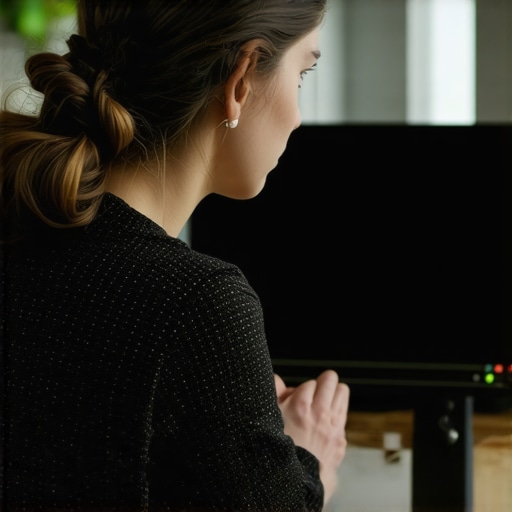
I spent three years thinking my pillow was the enemy. I swapped it for memory foam, buckwheat, and even a rolled-up towel, yet every Tuesday afternoon like clockwork, a searing knot would bloom right under my left shoulder blade. It felt like a hot marble was wedged under my skin. It wasn’t until I caught my reflection in a window that I saw the truth: I looked like a turtle poking its head out of its shell, desperately reaching toward a monitor that was sitting a good three feet away. I was practically climbing across my desk just to read an email. I realized my monitor was far too away, and my neck was paying the price for my ‘clean desk’ aesthetic.
Your chin is following your eyes into the screen
We often focus on lumbar support or keyboard height, but we ignore the silent pull of visual distance. When your screen is too far back, your brain subconsciously commands your body to bridge the gap. You don’t even notice the inch-by-inch drift. This ‘reach’ is a primary reason why your laptop screen height is the primary cause of your headaches and those stubborn knots. My biggest mistake early on was thinking that more desk space equaled better ergonomics. I pushed my 27-inch monitor to the very edge of the desk. In reality, I was just forcing my suboccipital muscles to work overtime. This posture creates a mechanical disadvantage that can lead to many issues, including the reason your neck feels stiff every time you get a headache.
Is a closer screen actually going to ruin my eyesight?
The biggest fear most of us have is that moving the screen closer will fry our retinas or cause permanent eye strain. It’s a valid concern, but the trade-off is often misunderstood. While you don’t want the screen hitting your nose, having it too far away causes ‘environmental myopia’ where you lean in to resolve fine text. Physiatrist Dr. Adalbert Kapandji famously noted in his work, The Physiology of the Joints, that for every inch your head moves forward from its neutral center, it gains 10 pounds of effective weight. That is a massive burden for your small neck muscles to carry for eight hours a day. If you aren’t sure if you’re leaning, you can try the simple test for text neck you can do in the mirror to see your true alignment.
Today, we are going to fix this. I’m going to show you how to find your ‘Goldilocks zone’ for monitor distance so you can finally stop the cycle of constant stretching and temporary relief. Have you ever caught yourself leaning so far forward that your chest is almost touching your desk? I’d love to hear if you’ve felt that burning sensation behind the shoulder blade—drop a comment or reach out through our contact page. Understanding that why your shoulder blade pain might actually be a neck issue is the first step toward permanent relief. We also need to consider other habits, like why looking at your keyboard while typing is ruining your neck, but let’s start with the screen distance first.
Reach out and touch your screen
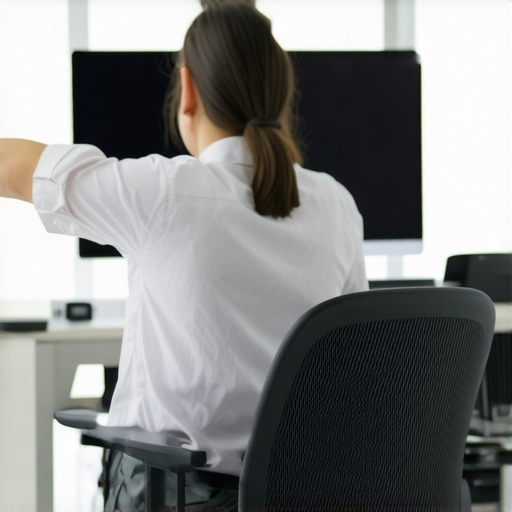
The simplest way to stop the ‘turtle neck’ effect is the High-Five Test. Sit back in your chair, making sure your shoulder blades are resting against the backrest. Now, extend your arm straight out in front of you. Your fingertips should just barely graze the surface of your monitor. If you have to lean forward even an inch to touch it, the screen is too far away. This distance is crucial because your eyes act like magnets for your chin; if the focal point is outside your reach, your head will naturally drift forward to meet it. By pulling the monitor closer, you allow your cervical spine to stack naturally over your shoulders, which is a key component of enhance your back mobility ergonomic tips for everyday comfort.
Stop the squint and save your spine
I remember the day I finally gave up on my ‘minimalist’ desk dream. I had this gorgeous, deep mahogany desk, and I kept my monitor at the very back edge because I liked the look of the open wood. Within three hours of work, I was hunched over like a gargoyle. I eventually pulled the monitor forward, nearly 20 inches from my face. My coworkers thought I was losing my mind because it looked like I was ‘hugging’ my screen, but for the first time in months, that burning knot between my shoulder blades stayed quiet. It felt messy and cluttered at first, but the relief was instantaneous. This adjustment is much like how to fix the head forward posture while reading in bed—it’s about bringing the environment to you, rather than forcing your body to go to the environment.
The font size trap is ruining your posture
Even if your monitor is at the correct distance, you might still find yourself leaning in if the text is too small. Think of your monitor like a book; if the font is tiny, you naturally bring it closer to your face. On a computer, since you can’t easily move the ‘book’ while it’s on a stand, you move your head instead. This creates massive tension in the upper traps. Just as how your phones font size is impacting your neck tension, your desktop settings can be a hidden enemy. Try bumping your display scaling to 125% or 150%. If you can read every word while your back is glued to your chair, you’ve won half the battle against that ‘heavy head’ feeling.
Balance the weight of your bowling ball head
When your screen is poorly positioned, your neck muscles have to act like cables on a suspension bridge that’s under too much load. This constant tension is why your head feels heavy by 3 pm every afternoon. To fix this, ensure the top third of your screen is at eye level. This prevents you from tilting your head up or down, both of which strain the delicate joints in your upper neck. If you are using a laptop, be careful, as why your laptop stand might be making your neck knots worse if it isn’t adjusted to your specific torso height. The goal is a neutral gaze that requires zero muscular effort to maintain, which is the foundation of revitalize your neck effective techniques for lasting pain relief.
Stop acting like a drill sergeant
I used to think that to fix my neck, I just needed to pull my shoulders back and puff my chest out like a drill sergeant. I was wrong. This ‘military posture’ is one of the most common mistakes I see in office workers. When you force your shoulders back without addressing your head position, you’re just layering one tension pattern over another. In fact, why standing up straight is actually making your back pain worse becomes clear when you realize you’re just compressing your mid-back to look ‘straight.’ It feels tight and ‘right’ in the moment, but it’s actually exhausting your spinal stabilizers.
The weight of a heavy head
Dr. Kenneth Hansraj, Chief of Spine Surgery at New York Spine Surgery & Rehabilitation Medicine, published a study in Surgical Technology International that changed how we look at posture. He calculated that while a neutral head weighs about 10 to 12 pounds, tilting it forward just 60 degrees—a common angle for someone leaning into a distant monitor—increases the force on your neck to a staggering 60 pounds. That’s like carrying an average-sized eight-year-old on your neck all day. No amount of massage can overcome that mechanical reality. If you’ve felt this, you know the real reason your adjustment didn’t last through the weekend; the environment is still winning the war against your spine.

Why does my neck hurt more when I try to sit perfectly straight?
This is the question that plagues high-achievers who ‘try’ to have good posture. The answer lies in your rib cage. If your ribs are flared upward because you’re trying to sit tall, you lose the ability to stabilize your neck from below. This is why your rib cage position determines your shoulder health. Without a stacked torso, your neck muscles have to grip even harder to keep you upright. You’re essentially fighting your own anatomy. This is why many people find that neck pain solutions proven techniques to regain your range of motion often start with breathing into the back of the ribs rather than stretching the neck itself.
The trap of the overstretched trap
Another nuance most people miss is that your upper traps aren’t usually ‘tight’ because they are short; they are ‘tight’ because they are being pulled long, like a rubber band stretched to its limit. If you keep stretching them, you might actually be making the problem worse by further weakening a muscle that’s already failing to hold your head up. This deep muscular imbalance is often tied to how your breathing pattern affects your core stability. When you breathe solely into your upper chest, those neck muscles never get a break. Have you ever fallen into the trap of ‘stretching the pain’ only to have it come back worse an hour later? Let me know in the comments. We need to move beyond simple stretches and look at the whole system.
The danger of the ‘flat neck’ correction
If you’ve spent years leaning into a screen, your cervical curve might have flattened out. In this specific case, the generic advice to ‘tuck your chin’ can actually jam the joints of the upper neck. It’s a sophisticated trap. This is why you should stop tucked chin exercises if you have a flat neck and instead focus on bringing the screen to you, as we discussed earlier. Have you checked your curve recently? It might be the missing piece of your recovery puzzle.
The $20 investment that beats a $1000 chair
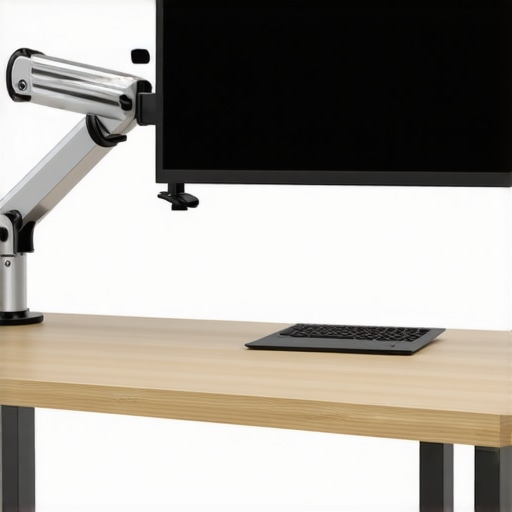
Everyone talks about buying the most expensive ergonomic chair, but if your monitor is still stuck on its default stand, you are fighting a losing battle. I personally swear by a gas-spring monitor arm. Why? Because it lets me change my viewing angle three or four times a day. If I’m feeling a bit tired and starting to slouch, I can pull the screen lower and closer to keep my neck neutral. This is a huge part of how to set up your home office for less than fifty dollars without sacrificing your health. According to the Cornell University Ergonomics Web (CUErgo), the ability to adjust the monitor height so that the center of the screen is 15 to 20 degrees below horizontal eye level is critical for reducing eye muscle strain and neck fatigue.
Don’t let your laptop become a neck trap
If you work on a laptop, you have to separate the screen from the keyboard. There is no other way to win. If the screen is at the right height, the keyboard is too high; if the keyboard is right, the screen is too low. I use a simple collapsible riser and a separate Bluetooth keyboard. This setup ensures I am not falling back into the trap of why your laptop stand might be making your neck knots worse by being fixed in one position. This simple separation is the foundation for mobility mastery daily tips to keep your spine and joints healthy.
How do I stay consistent with these posture changes?
Maintenance isn’t about being perfect for eight hours; it’s about the ‘reset.’ Every time I get a glass of water, I perform a quick check. I ask myself: Is my chin reaching? Are my ribs flared? This mental checklist is far more effective than any expensive gadget. Over time, these check-ins become subconscious. In the near future, I suspect we will see AI-powered webcam software that gently blurs your screen when it detects a ‘turtle neck’ posture, forcing you to sit back to see clearly. Until then, you have to be your own coach. For those dealing with lower extremity issues as well, integrating these habits is vital for unlocking sciatica relief expert strategies for lasting comfort.
If you want to stop the cycle of ‘fix and flare,’ you need a strategy that moves with you. This is why revitalize your neck effective techniques for lasting pain relief focuses so much on environmental control. I want you to try one thing today: move your monitor three inches closer than you think it needs to be and see if that burning sensation in your shoulder blades disappears by 2 PM. If you’ve tried everything and still feel stuck, reach out to us through our contact page so we can help you find the specific mechanical trigger for your pain.
Lessons My Body Taught Me the Hard Way
Reflecting on my three-year battle with that ‘hot marble’ sensation, I realized that ergonomics isn’t a destination; it is a conversation with your nervous system. First, I learned that my monitor was a magnet for my chin. No matter how many times I told myself to sit back, if the screen was too far, my brain would override my will. Second, I discovered that small adjustments like bumping up font sizes often did more for me than a thousand-dollar chair ever could. Finally, I stopped viewing my stiffness as a failure and started seeing it as data. If the burn returned, I knew my environment had drifted, and it was time for a reset to maintain mobility mastery daily tips to keep your spine and joints healthy.
#IMAGE_PLACEHOLDER_E#
My Survival Kit for Digital Overload
If you are serious about ending the cycle of pain, there are a few tools I swear by. A high-quality monitor arm is my number one recommendation because it removes the static nature of your desk. I also highly recommend using a separate keyboard so your hands can stay low while your eyes stay high; this is the only way to truly learn how to fix the rounded shoulders you get from scrolling your phone or working at a laptop. For those moments when tension still creeps in, I keep a simple tennis ball nearby to work out knots, which is surprisingly effective for how a simple tennis ball can release your deep glute tension or mid-back stiffness after a long shift.
Reclaiming Your Comfort One Inch at a Time
The journey to a pain-free neck doesn’t require a total lifestyle overhaul. It starts with that single realization I had while looking in the mirror: you don’t have to reach for your work. By bringing your screen into your personal space, you give your spine permission to relax. This shift, combined with a quick 30 second doorway stretch for people who work at a laptop, can break the cumulative stress on your upper traps. Remember that neck pain and stress how to break the cycle for good is about physical changes as much as it is about mental awareness. You have the tools now to stop being a turtle at your desk and start feeling like yourself again. Have you noticed your chin drifting toward your screen during long meetings? Let me know your biggest struggle in the comments below.