
Why looking at your keyboard while typing is ruining your neck

I’ll never forget the Tuesday my neck finally gave out. I was three hours into a deep-focus session, my eyes darting between my screen and my fingers as I hunted for the ‘percent’ symbol. When I tried to stand up, a searing heat shot from the base of my skull right down into my shoulder blades. It felt like my head was made of lead. I realized right then that my habit of ‘pecking’ at the keys wasn’t just a slow way to work—it was literally crushing my cervical spine. If you’ve ever felt that dull, heavy ache after a long day at the desk, you’re not alone. I’ve been there, and I promise there is a way to work without the constant throbbing. [image placeholder]
Your Head Weighs Sixty Pounds When You Peer at Those Keys
It sounds impossible, but the physics are brutal. According to research published in Surgical Technology International, for every inch your head tilts forward, the pressure on your spine doubles. By the time you’re looking all the way down at your keyboard, your neck is supporting about 60 pounds of weight. That is like carrying an average-sized bulldog around your neck all day. No wonder your phone habits are creating a permanent neck hump. I used to ignore the warning signs until my neck tension started making my eyes feel tired every afternoon. Have you ever felt that strange, heavy-eye sensation after a few hours of typing?
Is it really possible to fix this without becoming a typing pro?
You might be thinking, ‘I’ve typed this way for twenty years, there is no way I can change now.’ I felt the same way. I was skeptical that simply changing my eye line could reverse years of damage. But the truth is, you don’t need to be a 100-word-per-minute typist to see a difference. You just need to stop the constant ‘look down, look up’ cycle that grinds your vertebrae together.
The Expensive Ergonomic Mistake I Made Early On
When I first started feeling the pinch, I did what most people do: I threw money at the problem. I bought a split keyboard, a fancy wrist rest, and even a vertical mouse. None of it mattered because I was still looking down at my hands. It was a classic case of poor posture ruining my progress. I had to learn that the keyboard wasn’t the enemy—my eye line was. To get lasting pain relief, I had to stop treating the symptoms and start looking at the mechanics of my movement. I even found that applying the 15-degree rule to my monitor was useless if my chin was constantly buried in my chest anyway. Today, we’re going to break down how to untether your eyes from your fingers and give your neck the break it deserves.
Start Trusting Your Fingers Instead of Your Eyes
The first step to saving your spine isn’t a new chair; it’s learning to feel the keyboard like a pilot feels the cockpit controls. Most of us hunt-and-peck because we don’t trust our muscle memory, which forces the head into a constant downward tilt. To break this, start by identifying the tiny raised bumps on the ‘F’ and ‘J’ keys. These are your physical anchors. I spent three days practicing placing my index fingers on those bumps every time I sat down, and it acted as a GPS for my hands. Once you know where home is, your eyes don’t need to ‘check in’ on your fingers every five seconds. 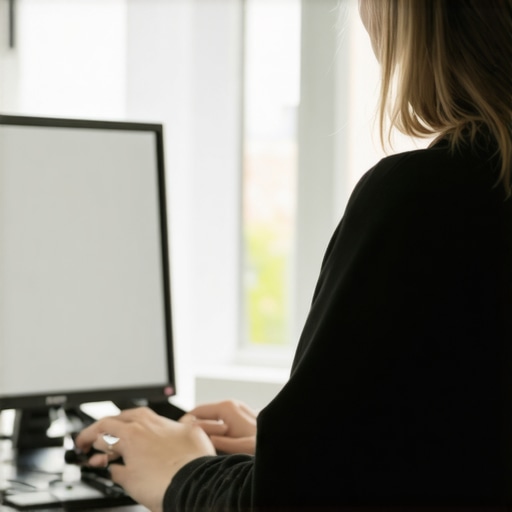
Feel for the Anchors to Prevent the Head Drop
If you can keep your fingers glued to that home row, your chin stays parallel to the floor. When you break that contact to look for the ‘backspace’ or ‘enter’ key, you inevitably tilt your head forward. I once tried to type a full email with a scarf wrapped around my chin and chest—not to look stylish, but to physically block my ability to look down. It was messy and frustrating at first, but it forced me to realize how often I was needlessly straining my cervical joints. This simple tactile shift can help stop why you feel a burning sensation between your shoulder blades after a long shift.
Why Your Screen Needs to Meet Your Eyes Halfway
Even if your fingers are independent, your monitor might still be sabotaging you. If your screen is too low, you’ll naturally slump to compensate. This is where how your monitor height is causing those recurring headaches becomes painfully obvious. The top third of your screen should be at eye level. This isn’t just about the screen; it’s about your jaw. I found that when I moved my monitor up four inches using a simple stand, the 10-second jaw release that softens your neck muscles actually started to stick because my neck wasn’t under constant tension.
Use the Peripheral Vision Hack
You don’t have to be a total ‘blind’ typist to find relief. Use your peripheral vision to see the keyboard while your gaze remains fixed on the screen. If you can’t see your keys in your lower peripheral field, your monitor is likely too high or too far away. Adjusting this distance allows your brain to ‘see’ the board without your neck having to move an inch. When I finally dialed this in, I stopped needing the 10-second wall slide for instant shoulder tension relief every hour just to keep my head up.
The Five-Minute Reset for a Stiff Upper Back
Since your neck is often overcompensating for a frozen thoracic spine, you must mobilize the area between your shoulder blades. I used to think my neck was the problem, but it was actually my stiff upper back forcing my neck to work harder. Integrating the doorway move that opens your chest and fixes your slouch twice a day changed everything. It felt like I was unwinding a tight spring that had been coiled for years. You can even try the wall-supported move that fixes slumping posture fast right after your morning coffee to prime your spine. I remember one morning I was so stiff I couldn’t even reach my arms back properly; after just three days of this routine, that neck cracking when you look over your shoulder finally began to quiet down.
Why your perfect upright posture is actually tensing your spine
I used to think that the solution to my ‘bulldog neck’ was to sit as straight as a soldier, shoulders pinned back and chin tucked tight. I was wrong. In fact, trying to maintain that ‘perfect’ rigid alignment was actually making my pain worse. The Journal of Physical Therapy Science has highlighted that static postures—even those we consider ‘correct’—increase intradiscal pressure because the muscles never get a chance to relax. Real mobility mastery isn’t about finding one fixed position; it’s about the ability to move through many positions. When you force yourself into a rigid upright stance, you’re just trading one type of strain for another. This is exactly why your perfect upright posture is actually tensing your spine and preventing the very relief you’re searching for. 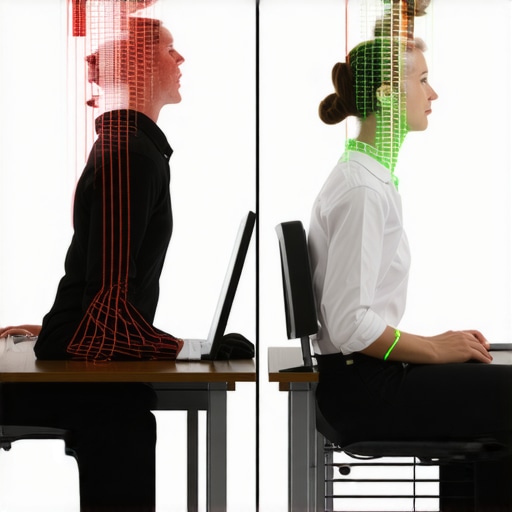
The Hidden Trap of Lumbar Supports
Many of my readers ask if they should buy those bulky lumbar pillows to save their backs. Here is the ‘oops’ factor I learned the hard way: if the support is too aggressive, it pushes your pelvis forward into an anterior tilt, which actually increases the arch in your neck to compensate. I found that why your lumbar support might be making your back stiffer often comes down to this mechanical chain reaction. Instead of relying on a pillow to hold you up, you need to develop the deep core stability that allows your spine to float. If you feel like your back is ‘locking up’ after using a support, you’ve fallen into the trap of external bracing instead of internal strengthening.
Can you really fix your neck by moving your feet?
It sounds like a reach, but the body is a single kinetic chain. I once spent weeks treating my neck only to realize that my limited range of motion was coming from my lower body. If your ankles are stiff, you change the way you walk, which changes how your hips sit, which eventually forces your neck to work overtime just to keep your head level. I’ve seen cases where how a stiff ankle is actually causing your recurrent lower back aches and neck tension was the missing piece of the puzzle. We often ignore the foundation when looking at the roof. This is why I always recommend how to check your own hip mobility in under a minute as part of a total neck recovery plan.
Movement is the Only Real Medicine
The most dangerous mistake you can make is staying still. Whether you are using the best ergonomic chair or a standing desk, the lack of micro-movements is what leads to the ‘heavy head’ feeling at 5:00 PM. I had to learn to embrace what I call ‘fidgeting for health.’ Shift your weight, rotate your wrists, and let your spine breathe. Have you ever fallen into the trap of thinking a more expensive chair would fix your habits? Let me know in the comments—I’d love to hear what gear you’ve tried and if it actually made a dent in your daily tension.
Stop Buying Chairs and Start Setting Timers
If you’re waiting for a $1,200 mesh throne to solve your problems, you’re playing a losing game. I spent years chasing the perfect ergonomic setup, only to realize that the best ‘tool’ in my arsenal was a simple kitchen timer. I follow a strict 20-minute rule: when the bell dings, I stand up, regardless of what I’m typing. This forces the micro-movements your spine craves. Dr. Stuart McGill, one of the world’s leading experts on back biomechanics and author of Back Mechanic, notes that the ‘Big 3’ exercises—the bird-dog, the side bridge, and the modified curl-up—are essential because they build spinal endurance rather than just raw strength. Incorporating these into my morning routine was a massive part of my back pain breakthroughs.
My Two-Dollar Solution for Deep Glute Pain
People are often shocked when I tell them my favorite piece of recovery equipment is a tennis ball. When I feel that familiar, dull ache in my hip that signals a potential flare-up, I don’t reach for ibuprofen; I lean against a wall with that ball tucked into my glute. I’ve found that how a simple tennis ball can release your deep glute tension is more effective than any professional massage I’ve ever paid for. It allows you to pin down the trigger points that are tugging on your sciatic nerve. 
How can I keep my spine healthy for the next twenty years?
Long-term success isn’t about one big change; it’s about the cumulative effect of small, daily habits. I focus on mobility mastery by integrating movement into my chores. For instance, I use the one-foot-up rule for pain-free dishwashing and chores, which keeps my pelvis neutral while I’m standing at the sink. I also swear by the 10-second breathing trick for instant lower back relief whenever I feel a spike in stress, as it prevents my diaphragm from locking up and pulling on my lumbar spine.
Wearable Tech is the Next Frontier for Back Health
Looking ahead, I predict we are going to see a massive shift toward bio-feedback wearables. We already track our steps and heart rate, but soon, smart shirts with embedded sensors will vibrate the moment our cervical spine tilts past that dangerous 15-degree mark. Until those become affordable, your best bet is self-awareness and a commitment to moving before the pain starts. If you’re feeling tight right now, I challenge you to try that ‘one-foot-up’ rule tonight while you’re making dinner—it’s the smallest shift that often yields the biggest relief.
The Brutal Truth About Why Your Desk Setup Still Hurts
After years of struggling, I realized that my neck didn’t care about the price tag on my chair; it cared about the micro-habits I repeated thousands of times a day. One of the hardest lessons I learned was that ‘ergonomic’ is often just a marketing term. For instance, blindly following the generic advice to lift your screen can backfire—sometimes your laptop stand might be making your neck knots worse if it forces you to shrug your shoulders just to reach the keys. I also discovered that my expectation of pain was actually causing me to brace my muscles before I even touched the keyboard. This mental tension is a massive part of neck pain and stress, and no fancy cushion can fix a brain that’s stuck in ‘protection mode’ every time you open your email.
My Minimalist Toolkit for a Resilient Spine
You don’t need a basement full of gym equipment to find relief. My daily routine relies on just three things. First, a simple kitchen timer to break the static hold every twenty minutes. Second, the ‘Back Mechanic’ by Dr. Stuart McGill, which provides the foundational expert tips on managing back pain in 2025 that every desk worker needs. Third, a tennis ball. It sounds too simple to be true, but knowing how a tennis ball can relieve deep glute and sciatic pain was the ‘lightbulb moment’ for my lower body health that eventually freed up my neck. [image placeholder] These tools work because they put the power back in your hands rather than relying on external braces.
Reclaiming Your Day from the Constant Ache
Breaking the hunt-and-peck cycle is about more than just typing speed; it’s about reclaiming your energy. When you stop fighting your own anatomy, that heavy-head feeling starts to evaporate. Whether you are learning how to fix the head forward posture while reading in bed or adjusting your home office, remember that consistency beats intensity. You didn’t develop this tension overnight, and you won’t solve it in a single session, but every minute you spend with your chin neutral is a win for your long-term health. Don’t let neck pain dictate how long you can stay productive or how you feel at the end of the day. Have you ever bought an ‘ergonomic’ gadget that actually made your pain worse? Let me know in the comments below.