
The simple test for ‘Text Neck’ you can do in the mirror

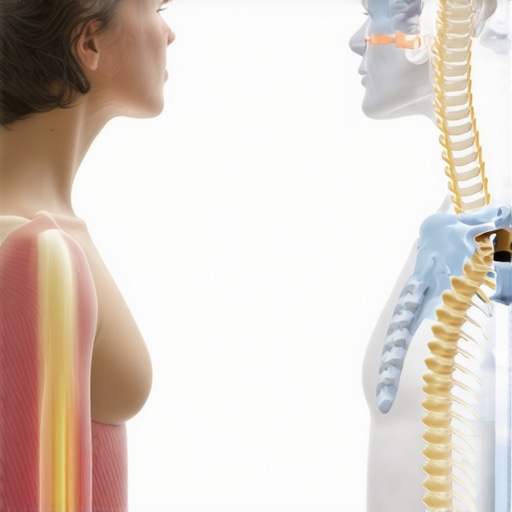
I remember catching my reflection in a coffee shop window last Tuesday and stopping dead in my tracks. I didn’t see a confident person; I saw a human question mark. My chin was jutting so far toward the glass that I looked like I was bracing for an impact that never came. It’s that classic ‘Text Neck’ look we all joke about until it starts causing that nagging ache between the shoulder blades. I used to think I just needed more coffee, but the truth was much heavier—literally.
Stop Guessing if Your Posture is the Problem
For years, I just assumed my fatigue was normal. I figured why my head feels heavy by 3 PM every afternoon was just a lack of sleep. I even made the rookie mistake of buying one of those rigid posture straps, thinking I could just force my bones into place. It was uncomfortable and, frankly, useless. What I actually needed was a reality check that didn’t cost fifty dollars. You see, for every inch your head drifts forward, it adds about 10 pounds of effective weight to your spine. Research published in the journal Surgical Technology International suggests that leaning your head forward at a 60-degree angle to look at a phone can put up to 60 pounds of pressure on the cervical spine. That’s like carrying a heavy suitcase on your neck. No wonder how your phones font size is impacting your neck tension has become such a massive issue for all of us.
Is this mirror test actually worth the hype?
I get the skepticism. It sounds too simple to be a ‘medical’ assessment. But the mirror doesn’t lie, even when our proprioception—that internal sense of where our body is in space—fails us. When you spend hours looking at your keyboard while typing, your brain recalibrates. It starts to think that ‘forward-tilt’ is actually straight. Today, I want to show you how to use a simple mirror trick to reset that internal compass so you can finally begin finding effective techniques for lasting pain relief. Have you ever caught a glimpse of your own ‘turtle profile’ in a shop window and felt that immediate, panicked urge to stand taller? I want to hear about it—because that moment of realization is exactly where the healing starts.
Turn Your Commute into a Posture Training Session
The best way to fix a habit is to build a feedback loop that you can’t ignore. For me, that feedback loop happened in the driver’s seat of my sedan. I used to arrive at work with a burning sensation between my shoulder blades, and I couldn’t figure out why until I realized my car was basically a ‘slump-chamber.’ To fix this, I started using the rearview mirror trick. It’s simple: sit in your car, get your spine perfectly neutral—ears over shoulders, shoulders over hips—and then adjust your rearview mirror to force better driving posture. The moment you start to slouch or your head drifts forward to look at a GPS, the mirror becomes useless. You’ll find yourself staring at the roof of the car or the back seat. This forced me to stay upright just to see the traffic behind me.
Why the Mirror Hack Works Better than a Brace
Think of your car seat like a cockpit. When you adjust your rearview mirror to improve your driving posture, you are creating a physical boundary. Last Friday, I tried this on a three-hour drive. About forty-five minutes in, I realized I could only see the bottom half of the cars behind me. My body had naturally ‘melted’ into the seat. By having that mirror set to my ‘tall’ height, I was forced to engage my core and tuck my chin to see clearly again. It’s a constant, silent coach that prevents you from falling into the trap of how to fix your slump while driving long distances without having to think about it every second.
Unlock Your Chest with the Doorway Move
Most of our neck tension doesn’t actually start in the neck; it starts in the tight muscles of the chest that pull our shoulders forward like a closing book. To counter this, you need to open the front of your body. I make it a rule to perform the doorway move that opens your chest and fixes your slouch every time I walk into my kitchen for a glass of water. Place your forearms on the doorframe with your elbows at shoulder height and gently lean forward. It should feel like untying a tight knot in a garden hose—suddenly, the pressure on your neck just drops. If you feel a sharp pinch, stop. This is about gradual length, not forced stretching. Pair this with the wall angel move that fixes rounded shoulders to build the strength needed to hold that new, open position.

Fix Your Screen Height to Save Your Neck
Your workspace is often the primary suspect in the case of the ‘Heavy Head.’ If you are using a laptop, you are almost certainly looking down, which means you are fighting gravity all day. I spent years hunched over a MacBook until I realized the 15 degree rule for your computer monitor to save your neck. Your eyes should hit the top third of the screen when you are looking straight ahead. I once propped my monitor up on a stack of old textbooks just to see if it made a difference—within two days, the midday tension headaches I’d suffered from for months simply vanished. Don’t forget that why your wrist position at your desk affects your neck health is also a factor; if your wrists are too high, your shoulders will hike up toward your ears, creating a secondary source of strain. Integrating mobility mastery daily tips to keep your spine and joints healthy into your work routine, like the the seated shoulder blade squeeze to kill midday tension headaches, can break the cycle of static loading that leads to chronic pain.
Stop Obsessing Over Being Perfectly Straight
Here is the hard truth that most posture gurus won’t tell you: there is no such thing as a ‘perfect’ static position. For years, I tried to sit like a statue, thinking that a rigid, military-style spine was the goal. But I quickly learned why your straight posture is actually straining your muscles more than helping them. When you force yourself into an unnatural upright position, you are essentially asking your muscles to perform a long-duration isometric hold. Research published in The Journal of Biomechanics indicates that static loading—even in ‘good’ posture—can decrease blood flow to the spinal tissues, leading to that familiar, deep ache. In fact, why your perfect upright posture is actually tensing your spine comes down to the fact that your body was designed for movement, not for being a mannequin.
Why does your MRI say you are fine when you are clearly in pain?
This is the question that keeps many of my readers up at night. They get an imaging report back that shows ‘age-appropriate changes,’ yet they can barely tie their shoes without a lightning bolt of pain. The nuance here is that structure does not always equal function. You can have a ‘messy’ MRI with bulging discs and feel zero pain, or a ‘perfect’ spine and be totally incapacitated. This is why it is vital to know is your back pain a sign of something more serious or if it is a functional movement issue. Often, the culprit is a lack of varied movement rather than a broken bone. If you are struggling to tell the difference, checking the difference between muscular sciatica and a slipped disc can be a massive eye-opener for your recovery strategy.
Don’t Fall for the Hamstring Stretching Trap
One of the most common mistakes I see—and one I fell for myself for nearly a decade—is the belief that tight hamstrings are the root of all back evil. I used to spend twenty minutes every morning touching my toes, only to feel tighter by noon. The reality? Your hamstrings are often tight because they are protecting a weak core or an unstable pelvis. When you yank on them, you are actually triggering a protective stretch reflex that makes the problem worse. This is why stretching your hamstrings wont fix your tight legs in the long run. Sometimes, the issue is actually ‘referred’ tightness from elsewhere, like the front of your hip. I found that why a tight psoas is often actually a weak psoas is a much more common culprit for that nagging lower back pull. Have you ever fallen into this trap? Let me know in the comments.
The Hidden Connection Between Your Core and Your Breath
We talk a lot about ‘bracing the core,’ but if you are holding your breath while doing it, you are creating massive internal pressure that can actually aggravate a disc. Most people treat their core like a solid wall, but it should function more like a pressurized cylinder. If you aren’t using mobility mastery daily tips to keep your spine and joints healthy, you might be missing the breathing component entirely. Real stability comes from the ability to maintain a neutral spine while breathing deeply into your ribs, not just sucking in your gut. This subtle shift was the missing piece for my own recovery, and it’s often the ‘hidden nuance’ that separates people who heal from those who stay stuck in a cycle of effective techniques for lasting pain relief.
If I’m being honest, most of the expensive ‘ergonomic’ gadgets I’ve bought over the years are currently gathering dust in my closet. The real winners in my recovery journey have been the simplest things. For instance, I keep a high-density tennis ball in my bag at all times. I’ve found that how a simple tennis ball can release your deep glute tension is far more effective for my sciatica flares than any $2,000 massage chair. By pinning the ball against a wall and leaning into those ‘trigger points’ in my glutes, I can manually shut off the protective guarding that happens after a long flight or a stressful meeting. It’s about precision, not power. Dr. Stuart McGill, a world-renowned spine biomechanics expert and author of Back Mechanic, emphasizes the importance of ‘spine hygiene’—the idea that it’s not just the exercises you do, but the way you move during the 23 hours you aren’t exercising that determines your long-term success. This is why I stopped believing the hype about super-hard beds; I realized why your firm mattress is making your morning sciatica worse because it doesn’t allow the spine to settle into its natural curves, especially if you have a narrower waist or wider hips.

How do I keep my spine healthy without it becoming a full-time job?
The secret isn’t a 60-minute daily routine; it’s the integration of ‘micro-adjustments’ into your existing life. I call it ‘stacking’ my health habits. For example, while I’m doing the most mundane chores, I use the one foot up rule for pain-free dishwashing and chores. By simply resting one foot on a small stool or the bottom cabinet shelf, I shift my pelvis and take the sheer load off my lumbar discs. It sounds trivial, but doing this every day for five years is what prevents the cumulative damage that leads to a ‘surprise’ back spasm. You should also be aware of is your back pain a sign of something more serious so you know when to back off or seek professional help, but for 90% of us, it’s these tiny, consistent wins that matter.
Wearables and AI Are the Future of Posture Support
Looking ahead, I think we are moving away from passive ‘fixes’ like foam rolling and toward active biofeedback. We are already seeing the rise of wearable sensors that vibrate when your head tilts past that dangerous 15-degree mark. In the next few years, I predict our smartwatches will integrate with our home office setups to nudge us into movement before our glutes have a chance to ‘turn off’ from sitting. Until that tech is perfected, I rely on the truth about using heat packs versus ice for chronic stiffness to manage the transition from a sedentary workday to an active evening. My challenge for you today: next time you’re at the kitchen sink or a standing desk, try that ‘one foot up’ rule for just five minutes. Your lower back will feel the difference before you’re even finished with the dishes.
Lessons from the Year I Stopped Trying to Sit Perfectly Straight
Looking back at my recovery journey, I realized that I was my own worst enemy when I tried to force my body into a rigid ‘military’ pose. Movement is medicine, but only if you stop fighting your own anatomy. I finally understood that consistency beats intensity every single time. My biggest lightbulb moment happened when I stopped worrying about a 30-minute workout and started focusing on mobility mastery daily tips to keep your spine and joints healthy during my actual workday. I also learned that why your head feels heavy by 3 PM every afternoon is usually a sign of muscle fatigue, not a lack of willpower. Lastly, I discovered that my body responds better to gentle nudges than to forceful stretches.
The Low-Tech Tools That Saved My Spine
You don’t need a thousand-dollar chair to find relief. My daily toolkit is surprisingly simple. First, I never go anywhere without a high-density tennis ball; it is the most effective tool for self-massage I’ve ever found. Second, I swear by the book Back Mechanic by Dr. Stuart McGill, which taught me more about ‘spine hygiene’ than any doctor ever did. Third, I always keep a small footstool under my desk to use the one foot up rule for pain-free dishwashing and chores even while I’m typing. These tools are effective because they address the root cause of my tension throughout the day, not just when the pain becomes unbearable.
#IMAGE_PLACEHOLDER_E#
Start Small and Reclaim Your Movement
The path to a pain-free life isn’t paved with complex exercises, but with the small, intentional choices you make every hour. Whether it’s adjusting your monitor or taking a deep breath into your ribs, these moments add up. You have the power to revitalize your neck and protect your back starting right now. Don’t wait for the perfect moment to begin—just start with one better movement today. Have you ever noticed your head feels heavier at a specific time of day or after a certain task? Let me know in the comments below!