
The real reason your hamstrings feel tight after a long walk

I’ll never forget the day I decided to take a ‘relaxing’ four-mile trek through the hills, thinking I was doing my body a world of good. By the time I reached my car, I felt like someone had replaced my muscles with rusted bridge cables. I did what everyone does: I propped my heel up on the bumper and reached for my toes until I saw stars. But instead of relief, the next morning was even worse. It felt like my legs had shrunk overnight. My lower back was screaming, and every step felt like a chore. I was stuck in a cycle of walking for health and then paying for it with days of stiffness.
Stop Pulling on Your Hamstrings Like They’re Old Rubber Bands
For years, I made the classic mistake of thinking that a ‘tight’ feeling always meant a ‘short’ muscle. I spent twenty minutes every night in a deep forward fold, sweating and gritting my teeth. I was convinced that if I could just touch my palms to the floor, my post-walk stiffness would vanish. It didn’t. In fact, I eventually realized that stretching my hamstrings was actually making my sciatica worse. My body wasn’t stiff because the muscles were short; it was stiff because my nervous system was sounding an alarm. When your pelvis is out of alignment, your hamstrings act as ’emergency brakes’ to keep you from falling forward. If you keep stretching those brakes, your brain just pulls them tighter to protect you. It’s a vicious cycle that a lot of us get stuck in. Today, I want to show you why that ‘tight’ sensation is often a lie your brain is telling you. We are going to look at why your gait might be the culprit and how keeping your joints healthy involves way less pulling and way more stabilizing. According to research published in the Journal of Orthopaedic & Sports Physical Therapy, hamstring ‘tightness’ is frequently a symptom of neural tension or pelvic positioning rather than actual muscular shortening. This means your traditional toe-touching is likely useless, or even harmful.
Will this actually feel better or am I just wasting my time?
I get it. You’ve tried the yoga classes, the foam rollers, and the expensive massage guns. You’re skeptical because everything provides a ten-minute window of relief before the ‘steel cable’ feeling returns. But once I stopped focusing on the hamstrings and started looking at the hidden reasons behind that tension, everything changed. I learned that the way my feet hit the ground was a huge factor, and by tweaking my posture, I finally stopped waking up with legs that felt like they belonged to a 90-year-old. Have you ever felt that frustrating ‘snap’ back to stiffness just minutes after a long stretch? Tell me if this sounds like your daily struggle.
Stop Tipping Your Pelvic Bucket
Imagine your pelvis is a bucket filled with water. If that bucket tips forward, the water spills out the front, and the back of the bucket—where your hamstrings attach—rises up. This creates a constant, mechanical pull on those muscles. You aren’t tight because you need more yoga; you’re tight because your ‘bucket’ is permanently dumped over. When I first started lifting heavy, I thought an arched back was a strong back. I’d squat with my tailbone pointed at the ceiling, thinking I was being safe. Instead, I was pinning my hamstrings into a state of perpetual tension. I spent months wondering why my workout was causing a pelvic tilt that made my legs feel like lead. The fix wasn’t more stretching; it was learning to tuck my tailbone and engage my lower abs to level the bucket.
Try This Simple Wall Sit for Instant Feedback
To find neutral, lean your back against a wall and slide down until your knees are at a 90-degree angle. Press your lower back firmly into the wall so there’s no space for a hand to slide through. This position forces your pelvis back into a neutral state and takes the ‘slack’ out of the hamstring line. I used to do this for 30 seconds before every walk, and it was the first time I felt my legs actually move freely without that dragging sensation. It’s one of those simple wall sits that builds spine-supporting strength without overtaxing your joints. 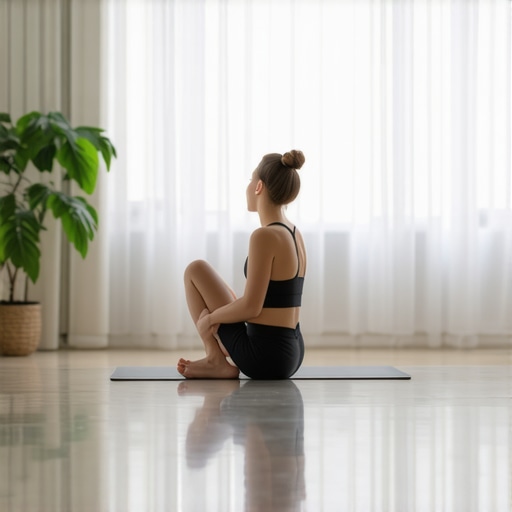
Treat Your Nerves Like a Guitar String
If you’ve ever felt a ‘zing’ or a burning sensation while stretching, you aren’t hitting a muscle; you’re irritating a nerve. Nerves are like guitar strings—they have a specific amount of tension they can handle before they stop sounding good and start causing pain. If your sciatic nerve is caught in some scar tissue or compressed by a disc, pulling on your leg just makes the nerve angrier. This is why you need to learn the nerve glide exercise that calms burning leg pain. Instead of a static hold, you are gently ‘flossing’ the nerve through its pathway. I remember the first time a therapist showed me this. I was terrified to move my leg, but within five reps of gentle pointing and flexing, that deep, gnawing ache in my calf vanished. It felt like magic, but it was just physics.
Release the Pressure Valve with a Tennis Ball
Sometimes the tension isn’t coming from the hamstring itself, but from the glutes acting as a bottleneck. When your glutes are locked up, they squeeze the sciatic nerve right where it exits the pelvis. I started keeping a tennis ball in my gym bag for this exact reason. By sitting on the ball and finding those ‘hot spots’ in the hip, you can essentially trigger a release that travels all the way down to your heel. Using a simple tennis ball to fix deep glute tension is often the missing link for people who feel like their hamstrings are made of wood. I used to do this while watching TV, and the difference in my morning stiffness was night and day. It’s about addresssing the hip tightness that is actually a back issue in disguise.
I see people making the ‘strong core’ mistake every single day. They think doing hundreds of crunches will magically protect their spine from the damage of a sedentary lifestyle. But why your core strength won’t fix your back if your hips are locked is a fundamental concept they miss. If your hip joints don’t rotate freely, the force from walking, lifting, or even standing goes straight into your lumbar discs. It’s like trying to drive a car with the parking brake on; eventually, the engine—your back—is going to start smoking. You don’t need more strength; you need better mechanical efficiency.
Stop Rounding Your Spine into a C-Shape
One of the most dangerous ‘traps’ I fell into early on was the classic back stretch. I thought that by pulling my knees to my chest and rounding my spine, I was ‘opening up’ my vertebrae. In reality, why you should stop stretching your back into a c-shape comes down to basic disc mechanics. When you round your back under tension, you are essentially squeezing the front of your discs and pushing the jelly-like center further back toward your already sensitive nerves. This is often why you feel ‘loose’ for five minutes and then significantly worse an hour later.
What if the pain isn’t in the muscle at all?
This is the advanced nuance most people miss: we often confuse ‘referred pain’ with a local muscular issue. For example, knowing how to tell if your hip tightness is actually a back issue is crucial for effective treatment. A study published in the Journal of Manual & Manipulative Therapy suggests that a significant percentage of patients presenting with hip pain actually have a primary source in their lumbar spine. This means you could foam roll your hips until you are blue in the face and never find relief. You have to address the back pain breakthroughs that involve spinal decompression and neural health first.
The Myth of the Perfect Sitting Posture
We are told to sit up straight, shoulders back, chin tucked. However, why your perfect sitting posture is making you stiffer is a hard truth to swallow. Holding a rigid, ‘perfect’ position creates massive amounts of static load. Your muscles are meant to move, not act as statues. This static tension is a major reason why why your desk chair height is wrecking your hips and causing that secondary hamstring pull. Instead of focusing on a single ‘right’ position, you should be focused on mobility mastery daily tips to keep your spine and joints healthy by changing positions every twenty minutes. Have you ever fallen into this trap of trying to stretch your way out of a stability problem? Let me know in the comments.
The Lumbar Support Secret You Can Build for Free
I used to think I needed a thousand-dollar ergonomic throne to save my spine. I spent weeks researching how to pick a chair that actually supports your lumbar curve, only to find that the chair itself was only half the battle. The most effective tool I use daily isn’t high-tech; it’s a simple rolled-up towel. By placing a firm roll at the small of my back, I can maintain my natural spinal curve even in a subpar car seat or at a dining table. Learning how to use a lumbar roll to prevent mid-day back fatigue was a game-changer because it provides a physical cue to stay out of that dreaded ‘C-shape’ slump. Dr. Stuart McGill, a world-renowned expert in spine biomechanics and author of Back Mechanic, emphasizes the concept of ‘spinal hygiene’—the idea that it’s the small, repetitive movements throughout the day that either build or break your back’s health. If you aren’t protecting that curve during the 8 hours you spend working, no amount of evening stretching will save you.
Stop Wrecking Your Back During Everyday Chores
Maintenance isn’t just about what you do at the gym; it’s about how you move in the kitchen or the laundry room. I used to ‘twinge’ my back at least once a month just doing the dishes. I finally realized I was reaching and twisting in ways that put massive sheer force on my L5-S1 disc. Once I mastered how to load the dishwasher without hurting your lower back—using a ‘golfer’s lift’ or a staggered stance—the frequency of my flare-ups plummeted. The same logic applies to other mundane tasks; for instance, knowing how to vacuum your house without straining your lower back is about keeping the machine close to your center of gravity rather than reaching out with your arms. These small mechanical shifts are the literal backbone of long-term mobility.
How do I keep my spine resilient for the long haul?
Consistency is the only way forward. Many people wait for a crisis before they act, but why maintenance care is better than waiting for a spinal crisis comes down to preventing the accumulation of ‘micro-trauma.’ I believe the future of back health lies in wearable biofeedback. We are already seeing the rise of smart sensors that vibrate when you lose your neutral pelvic alignment, and soon, AI-driven movement analysis will be in every smartphone to help us correct our gait in real-time. Until then, you have to be your own sensor. I highly recommend trying this today: set a timer on your phone for every 30 minutes to check your pelvic tilt. If you find yourself ‘dumping the bucket’ forward, tuck your tailbone and reset. It takes 10 seconds, but it saves hours of pain later. We’ve spent so much time understanding the link between poor posture and chronic back pain, now it’s time to actually automate the solutions in our daily lives.
The Truth I Had to Swallow About Chronic Stiffness
Looking back on my journey from chronic stiffness to fluid movement, the biggest hurdle wasn’t the physical pain; it was the ego. I had to accept that my ‘hard work’ in the gym and my aggressive stretching sessions were actually the very things keeping me locked in a cycle of discomfort. One of the most vital sciatica relief secrets I ever discovered was simply giving myself permission to stop pulling on the nerve. I learned that your body isn’t a machine that needs to be forced into submission; it’s a living system that responds to safety. When I stopped treating my legs like rusted cables and started treating my nervous system like a delicate instrument, the ‘tightness’ finally began to melt away. Another lightbulb moment was realizing that ‘rest’ isn’t just sitting on the couch—it’s actively choosing movements that don’t trigger the alarm bells of your brain. Efficiency always beats intensity when it comes to the spine.
My Zero-Budget Toolkit for Daily Mobility
You don’t need a basement full of gadgets to find relief. My daily routine relies on three incredibly simple things that cost next to nothing. First is the humble tennis ball; knowing how a simple tennis ball can fix deep glute tension is like having a private massage therapist on call 24/7. Second is a standard bath towel. Learning how to use a lumbar roll to prevent mid-day back fatigue changed the way I feel after an eight-hour workday. Finally, I use any flat wall in my house for that 90-degree reset I mentioned earlier. These tools are effective because they address the root cause—pressure and alignment—rather than just masking the symptoms with temporary heat or vibration. I trust these methods because they are grounded in the mechanics of how our bodies actually function.
#IMAGE_PLACEHOLDER_E#
The Road Back to Effortless Movement
You aren’t destined to live with ‘bad hamstrings’ or a ‘tricky back’ forever. The stiffness you feel today is just a snapshot of your current movement habits, and habits can be rewritten. By focusing on stabilizing your pelvis and calming your nerves, you are setting the stage for back pain breakthroughs that can literally change your quality of life. Don’t be afraid to start small. Tucking your tailbone for ten seconds while you wait for the coffee to brew is a victory. Using a staggered stance while you brush your teeth is progress. These tiny mechanical shifts aggregate over time into a body that feels light, resilient, and ready for whatever trek you decide to take next. Have you ever felt like you are stretching your hamstrings every single day with absolutely zero progress? Let me know your experience in the comments below.