
How to carry a heavy laundry basket without a back spasm

I was halfway through a “quick” Sunday chore when it happened. I reached into the dryer for a tangled mess of wet towels, yanked the basket toward my hip, and *snap*. It felt like a hot wire had been threaded through my lower spine. I spent the next four days staring at the ceiling, wondering how a pile of laundry managed to defeat a grown adult. We’ve all been there—trying to be the hero of the household only to end up as a cautionary tale. Today, I’m going to share the exact mechanics I use to move heavy loads without the fear of a week-long recovery. We’re going to fix the way you move so you can enhance your back mobility while actually getting things done.
Keep the Basket Close to Your Heart
My biggest mistake early on was the “arm’s length” reach. I’d grab the handles and let the basket dangle out in front of me. It seems minor, but the further a weight is from your center of gravity, the more your spinal extensors have to scream to keep you upright. It’s the same reason how to load the dishwasher without hurting your lower back is such a hot topic; distance equals danger. Now, I pull that basket tight against my stomach before I even think about taking a step. It feels silly, like you’re hugging your clothes, but your vertebrae will thank you. According to the Mayo Clinic, keeping heavy objects close to the body significantly reduces the torque on your lumbar discs, which is often the difference between a productive day and a back pain emergency.
Is one trip really worth the risk of a flare-up?
We all want to be efficient. The “Single Trip Rule” is a point of pride for many of us, but it’s a trap. I used to stack three baskets high, obscuring my vision and forcing me to waddle like a penguin. This uneven weight distribution is a one-way ticket to sciatica relief secrets searches at 2 AM. If the load is too heavy, split it. It’s much better to walk twice than to spend three days on a heating pad. Have you ever pushed your luck with a heavy load and instantly regretted it?
Stop Bending Like a Candy Cane
Most people approach a laundry basket by hinging at the waist—essentially folding their torso in half like a piece of paper. This creates a massive ‘lever arm’ that puts hundreds of pounds of pressure on your L5-S1 disc. Instead, I learned to use the ‘butt-first’ method. Think of it like trying to close a car door with your rear end because your hands are full of groceries. You push your hips back while keeping your shins vertical. When I finally committed to how to do a proper squat to protect your knees and back, the sharp ‘stabbing’ sensation I used to get when reaching for the bottom of the dryer vanished. You aren’t moving your back; you’re moving your hips. 
Plant Your Feet for Better Balance
I used to stand with my feet perfectly parallel, like a soldier on parade. The problem? It’s an unstable base. Now, I use a staggered stance—one foot about six inches ahead of the other. This wider, longer base of support allows you to shift your weight forward and back without needing to round your shoulders. If your ankles feel stiff during this, you might need to try the simple ankle drill that improves your walking balance to ensure you aren’t compensating with your lower back. I remember trying this while moving a 40-pound bag of dog food last Tuesday; by staggering my feet, I could ‘rock’ the weight upward rather than ‘yanking’ it.
Move Your Feet to Save Your Discs
The absolute deadliest move you can make is the ‘twist-and-reach.’ You know the one: your feet are glued to the floor facing the washer, but you’ve twisted your torso 90 degrees to toss a towel into the basket. This ‘wringing’ motion of the spine is how discs actually tear. Now, I have a strict rule: the nose follows the toes. If I need to move something to the left, my whole body turns. This is the same principle I use when learning how to get out of your car without twisting your lower spine. It feels slower, but it’s the difference between a functional evening and needing unlocking mobility expert tips on managing back pain in 2025 because of a silly mistake.
Stop Fighting Your Natural Curves
A lot of us were told to stand ‘perfectly straight,’ but why your perfect upright posture is actually tensing your spine is a real concern. Your back has natural curves for a reason; they act like shock absorbers. When you’re lifting, don’t try to flatten your back completely. Just keep it ‘stiff’ and neutral. If you feel a spasm coming on because you’re over-tensing, try the 10-second breathing trick for instant lower back relief to reset your nervous system. Last month, I felt that familiar tightness while folding a massive pile of jeans. Instead of pushing through, I took that ten-second breath, reset my hip hinge, and finished the job without the usual ‘post-laundry’ ache. It’s about being deliberate, not just being fast. If you’re worried about whether you’re doing this right, you can even try how to pick up your dog or child without a back injury as a practice run with a lighter load.Let’s dig deeper into why the standard ‘strengthen your core’ advice might actually be the reason you’re stuck in a cycle of stiffness. We’ve been told for decades that a six-pack is the ultimate shield for your spine. But here’s the truth: why your core strength won’t fix your back if your hips are locked is the missing piece of the puzzle. If your hip joints are as stiff as a rusty gate, your lower back has to move extra to compensate every time you walk or bend. You can do all the planks in the world, but your L5-S1 will still take the brunt of the force. It’s like trying to protect a fragile glass with a steel cage that’s too small; eventually, the glass still breaks.
Your Core Strength is Useless Without Hip Mobility
Most of us approach back pain breakthroughs navigating your path to restored mobility by focusing solely on the muscles of the stomach. But the ‘oops’ factor here is ignoring the joints that actually allow the pelvis to tilt. When your hips are locked, your lumbar spine tries to become mobile to make up for it, which is the exact opposite of how the body is designed. This is why addressing understanding the link between poor posture and chronic back pain requires looking at the joints below the injury, not just the site of the pain itself.
Can you actually stretch your way into a sciatica flare-up?
This is where most well-meaning people go wrong. When they feel that ‘pull’ in their leg, they immediately drop into a deep hamstring stretch. However, why stretching your hamstrings can actually flare up sciatica is because you aren’t stretching a muscle—you’re literally tugging on an inflamed nerve like a bowstring. Dr. Stuart McGill, a world-renowned spine biomechanist at the University of Waterloo, notes that ‘nerve flossing’ and stability are far more effective than aggressive static stretching for sensitized nerves. If you’re looking for swift relief for sciatica quick home remedies that work, you have to stop the tug-of-war with your nervous system. One massive ‘trap’ I see is the morning ‘C-curve’ stretch. You wake up stiff, so you bend forward to touch your toes to ‘loosen up.’ This is exactly why you should stop stretching your back into a c-shape during an active flare-up. In the morning, your discs are naturally more hydrated and pressurized; forcing them into a curve is like squeezing a jelly donut—the filling wants to go somewhere, and usually, it’s right toward your nerves. Have you ever fallen into this trap and felt worse ten minutes later? Let me know in the comments. #IMAGE_PLACE_HOLDER_C#
Stop Sitting Like You’re Melting into the Furniture
I used to think my overstuffed leather armchair was the height of luxury, but my lower back begged to differ. After twenty minutes, I’d stand up feeling like I’d been folded into a suitcase. The problem is that soft surfaces offer zero resistance, causing your pelvis to tuck and your lumbar curve to vanish. This is why your favorite armchair is secretly causing your lower back stiffness. Now, I use a firm-base seat with a specific tool that I carry everywhere—a high-density foam lumbar roll. Unlike a soft pillow, the foam doesn’t lose its shape under your weight. It forces your spine to maintain that natural ‘S’ curve while you’re focused on emails. Learning how to use a lumbar roll to prevent mid-day back fatigue was a game-changer for my 9-to-5 productivity. 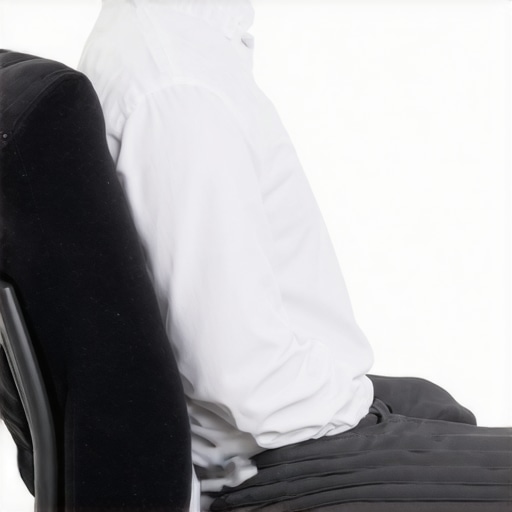
The Simple $15 Tool That Saved My Workday
If you’re dealing with that deep, nagging ache in your hip, you don’t necessarily need an expensive massage. I keep a tennis ball in my desk drawer and my gym bag at all times. By placing it under the glute and gently rolling, you can target specific trigger points that a foam roller is too big to hit. It’s a low-tech version of manual therapy that helps with ‘glute amnesia.’ You can see how a simple tennis ball can fix deep glute tension with just two minutes of work. According to Dr. Robin McKenzie, author of ‘Treat Your Own Back,’ maintaining the lumbar lordosis is the primary defense against ‘derangement syndrome,’ where disc material shifts due to poor postural habits. Consistent, repeated movements are the key to long-term success.
How do I stay consistent when life gets busy?
Consistency isn’t about an hour-long routine; it’s about micro-habits. I’ve integrated ‘greasing the groove’ into my day. Every time I fill my water bottle, I do the 30-second wall stretch that releases shoulder blade knots. It resets my upper back before tension has a chance to turn into a headache. I predict that in the next few years, we’ll see an explosion in ‘active furniture’—desks and chairs with built-in haptic feedback that gently nudges you when your posture slips. Until then, we have to be our own advocates. For mobility mastery daily tips to keep your spine and joints healthy, you have to prioritize these small wins. If you’re washing dishes tonight, I challenge you to try the one foot up rule for pain-free dishwashing and chores—it’s the easiest way to take the pressure off your spine immediately. Give it a shot and see how much lighter your back feels by the time the sink is empty.
The Day I Realized My Abs Weren’t Protecting My Spine
For years, I thought my ‘back issues’ were just a streak of bad luck or a sign of getting older. The truth is, I was treating my body like a rigid statue rather than a functional machine. One of the biggest lessons I learned—and one that experts often gloss over—is that ‘core strength’ is functionally useless if your hips are frozen. If you want to see where your movement is actually breaking down, you should how to check your own hip mobility in under a minute to find your true starting point. I also had to accept that pain isn’t a failure or something to ‘push through’; it is a vital data point from your nervous system. When my back twinges, it’s not an emergency anymore; it’s a request for a different movement strategy. Finally, I stopped falling for the ‘good enough’ posture trap. Stiffly standing upright isn’t the goal—fluidity is. #IMAGE_PLACEHOLDER_E#
What I Pack When My Back Feels Fragile
I don’t believe in expensive gadgets that end up gathering dust in the closet. My ‘survival kit’ for spinal health is intentionally simple and evidence-based. First, the McKenzie Method literature, specifically ‘Treat Your Own Back,’ is mandatory reading for anyone tired of the cycle of morning stiffness. Second, a standard $3 tennis ball is the only way I’ve found to effectively release those deep glute knots that mimic sciatic pain. Third, I never go anywhere without a high-density foam lumbar roll for my office chair. If you are looking for more ways to boost your back mobility simple exercises that make a difference, these low-cost tools are your best entry point. I personally use my lumbar roll every time I drive more than ten minutes; it is my non-negotiable defense against mid-day fatigue.
Your New Chapter of Movement Starts Now
You aren’t fragile, and you aren’t ‘broken’ just because a heavy basket of laundry or a rogue grocery bag took you out for a few days. You simply need a better user manual for your own mechanics. By shifting your weight, hugging the load to your center, and moving your feet instead of twisting your spine, you are making a massive investment in your long-term independence. Finding unlocking sciatica relief expert strategies for lasting comfort is a journey of small, consistent wins rather than a one-time fix. Start today with one tiny change—maybe it is the staggered stance at the dryer or the hip hinge at the dishwasher—and watch how your confidence in your own body returns. You deserve to live and move without the constant shadow of a flare-up hanging over your head. Which laundry room ‘crime’ are you most guilty of—the arm’s length reach or the single-trip stack? Let me know in the comments below!