
How a simple reach-and-breathe move can decompress your back

I was reaching for a mug on the top shelf when it happened. A sharp, lightning-bolt tingle shot down my spine, leaving me frozen in place like a glitching video game character. I couldn’t expand my ribs, and every shallow breath felt like I was poking a bruise. For years, I’d been trying to “perfect” my posture, but I eventually realized that why your perfect upright posture is actually tensing your spine was the very reason I was so brittle. I was holding myself together so tightly that my vertebrae had no room to move. Today, I want to show you the one move that changed everything for me—a simple reach-and-breath technique that physically creates space between those overworked discs. We’re going to stop the “grind” and finally get you some room to breathe.
Stop Fighting Your Body and Start Creating Space
The biggest mistake I made early on was thinking I could just “stretch” my way out of pain. I’d spend twenty minutes on the floor doing deep forward folds, completely unaware of why you should stop stretching your back into a C-shape. I was just aggravating the compression. True decompression doesn’t come from pulling on your muscles; it comes from using your internal pressure—your breath—to expand the ribcage and lift the spine from the inside out. When you combine a specific reach with a targeted inhale, you’re essentially using your lungs as an internal jack to lift your ribs off your hips. It sounds too simple to work, doesn’t it? But according to research published in the Journal of Biomechanics, intra-abdominal pressure and diaphragmatic breathing are key components in stabilizing and decompressing the lumbar spine. If you’ve ever felt like your torso is just getting shorter and heavier as the day goes on, this is the reset button you’ve been looking for.
Is a 10-second move really worth the hype?
I get it. You’ve probably tried the foam rollers, the expensive chairs, and maybe even those weird inversion tables. You’re skeptical that something as “basic” as breathing could do what a $500 gadget couldn’t. I felt the same way until I realized that how a simple breath reset can calm a back spasm is about physics, not magic. This isn’t just about relaxation; it’s about mechanical leverage. Have you ever felt that “stuck” sensation in your mid-back that no amount of twisting seems to pop? The real secret is that our bodies are designed to decompress every time we inhale, but most of us have lost the ability to breathe into our backs. We breathe into our chests or our bellies, leaving the spine to fend for itself. When I finally stopped over-stretching and started focusing on the 10-second breathing trick for instant lower back relief, my chronic stiffness started to melt. It wasn’t overnight, but the relief was immediate enough to keep me coming back. We’re going to dive into the exact mechanics of the reach next, but first, take a second to think: when was the last time you actually felt your lower ribs move?
Reach Toward the Ceiling Like You Mean It
To get started, you aren’t just lifting your arm; you are reaching with the intent to pull your ribcage away from your pelvis. Sit on the edge of a firm chair—not a soft sofa, as we know the specific way to sit on a couch to avoid lower back spasms is critical for long-term health. Plant your feet flat and reach one arm forward and slightly up at a 45-degree angle. The goal here is to feel your shoulder blade slide forward and away from your spine. This isn’t about flexibility; it’s about shifting the bony architecture of your upper back to open the ‘gates’ for your breath. If you’ve been struggling with unlocking mobility: expert tips on managing back pain in 2025, you’ll realize that most of our stiffness comes from these bones being glued together by tension. By reaching, you’re creating the necessary leverage for the next step.
Inhale Until Your Ribs Push Back
Once you’ve found that reach, here is where the magic happens. Take a deep, slow breath through your nose, but don’t let your chest puff out. Instead, try to direct that air into the space between your shoulder blades. Imagine your lungs are two balloons expanding backward and sideways. This internal pressure acts like a hydraulic jack, physically pushing the vertebrae apart from the inside. I often suggest people try how to use a doorway to release chest tension and improve posture to feel the front of the body open, but this breathing move is the only way to truly expand the back. When you exhale, keep the reach. Don’t collapse. You want to maintain that new space you just carved out. For people conquering sciatica: proven approaches to end discomfort now, this decompression is often the first bit of relief they feel because it takes the ‘squeeze’ off the nerves.
The Day My Morning Coffee Almost Became a Casualty
I remember the first time I really ‘got’ this move. I was hunched over my laptop, my back feeling like a sheet of dried leather. I decided to try the reach-and-breath right there at my desk. I reached so vigorously that I swiped my favorite ceramic mug, sending it wobbling dangerously close to the edge. I didn’t care. As I inhaled into my mid-back, I heard a dull ‘thump’ inside my own ribcage—not a painful crack, but a release. It felt like someone had finally unbuckled a belt that had been tightened around my chest for three years. This is far more effective than just ‘sitting up straight’ because you are changing your internal volume. If you pair this with the thoracic bridge move that fixes slouching, you start to rebuild a spine that is resilient rather than rigid.
Why This Beats Any Gadget You Can Buy
The reason this works better than an inversion table or a foam roller is that it is active. Your muscles are learning to support the decompression. When you use external tools, your body often fights back by tensing up to protect itself. But when you use your own breath, your nervous system feels safe. This is the same principle we use when teaching parents how to hold your baby without straining your lower back; it’s about using your body’s natural mechanics to distribute weight rather than localized muscle force. You are essentially teaching your spine how to breathe again, turning every inhale into a mini-treatment for your discs.
While the reach-and-breath is a game-changer, I have to warn you about a trap most people fall into when they start feeling better. We’ve been conditioned to think that “tight” always means “needs stretching,” but that’s often the opposite of the truth.
Stop Pulling on Your Nerves Like a Guitar String
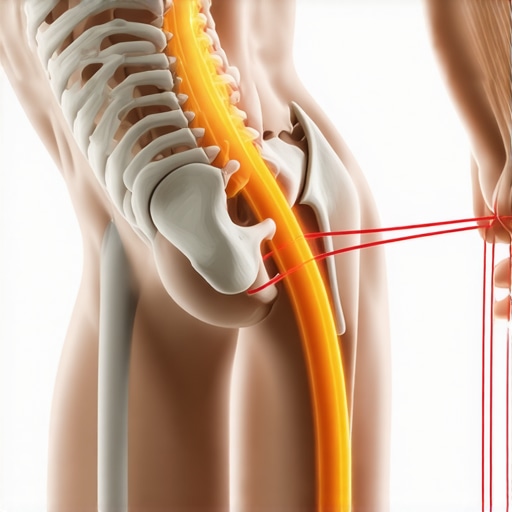
In my early days of chronic pain, I thought touching my toes was the ultimate goal. But I quickly discovered that when you have nerve irritation, stretching your hamstrings is like pulling on both ends of a frayed electrical wire. Most people assume tight legs mean they need to reach for their toes, but why stretching your hamstrings can actually flare up sciatica is a lesson I learned the hard way. This is called neural tension, and your body is tightening those muscles as a protective shield for the nerve. If you force the stretch, you’re just winning a battle while losing the war.
Why Does Your Back Hurt More After You Stretch?
It sounds counterintuitive, right? You stretch, feel a “good” pull, and then two hours later, your back is stiffer than a frozen board. This happens because many of us are hyper-mobile in our spine but locked-up in our joints. If you are looking for unlocking mobility: expert tips on managing back pain in 2025, you have to stop treating your body like a collection of separate parts. World-renowned spine researcher Dr. Stuart McGill explains that the urge to stretch a painful back is often a false signal; what the spine usually needs is stability to protect the nerves, not more range of motion. By over-stretching, you are actually creating micro-instability in the vertebrae.
Quit Chasing the ‘Pop’ Before You Regret It
We’ve all done it—that quick twist or the aggressive lean back to get a satisfying crack. I see it all the time, the person who can’t go an hour without a self-adjustment, but why cracking your own back is making your joints more unstable is a cycle of temporary relief followed by permanent laxity. Every time you “pop” those same joints, you’re stretching the ligaments that are supposed to hold you together. This is a massive “oops” factor for long-term health. Instead, you should be looking at the areas that aren’t moving. It’s a common revelation for my clients when they realize how a stiff ankle is actually causing your recurrent lower back aches by forcing the spine to compensate during every single step. You can do planks all day, but why your core strength won’t fix your back if your hips are locked is because your spine is forced to become the primary mover. This holistic approach is the foundation of mobility mastery: daily tips to keep your spine and joints healthy. If you want to move beyond the basics, you need to understand that back pain breakthroughs: navigating your path to restored mobility require looking at the body as a connected chain rather than just fixing where it hurts. Have you ever fallen into this trap? Let me know in the comments.
Once you’ve stopped the constant ‘grinding’ and started creating space with your breath, the real challenge begins: not losing those gains by noon. I used to spend an hour on mobility in the morning only to undo it all by hunching over my keyboard. If you want to turn your desk into a recovery zone, you have to look at how to set up your laptop for better spine protection. It’s not just about the desk height; it’s about the distance from your eyes to the screen. When your screen is too low, your neck becomes a crane, and your upper back becomes a rigid shell. I personally adjusted my workspace so the top third of my screen is at eye level, which directly addresses how your monitor height is causing those recurring headaches.
How do I keep my spine feeling this good tomorrow?
Long-term maintenance isn’t about doing more exercises; it’s about micro-resets. I live by the 20-20-20 rule for neck and eye strain relief, but I’ve modified it for the spine. Every 20 minutes, I stand up, perform one ‘reach-and-breath’ cycle, and look 20 feet away. This breaks the static loading on your discs. If I’m traveling or stuck in a long meeting, I use how to use a lumbar roll to prevent mid-day back fatigue. I don’t buy the fancy $100 versions; a rolled-up bath towel works just as well to maintain that natural curve.
Three Gadgets That Aren’t Total Snake Oil
People ask me about tools constantly. Most are junk, but three things are always in my bag. First, a simple tennis ball. I use it for how a simple tennis ball can fix deep glute tension while sitting in my car—it’s like a targeted massage for your piriformis. Second, a firm step stool. Using how to use a step stool to save your lower back in the kitchen while washing dishes changed my life by taking the pressure off my sacroiliac joint. Third, a specific pillow. Finding the specific pillow height for back sleepers was the missing link for my neck pain.
#IMAGE_PLACE_HOLDER_D#
Robin McKenzie, the founder of the McKenzie Method of Mechanical Diagnosis and Therapy, emphasized in his clinical documentation that the patient must be their own therapist. He argued that most mechanical back pain is a result of our own ‘postural neglect,’ and maintenance requires frequent, opposite-direction movements. I predict that in the next five years, we’ll move away from foam rollers toward wearable biofeedback sensors that alert us the second our posture begins to fail. This will make mobility mastery: daily tips to keep your spine and joints healthy an automated process rather than a mental chore. If you want to start today, I challenge you to try the 2-minute hip reset for better sleep tonight before you climb into bed. It’s the ultimate way to close the loop on your day’s progress.
Why I Finally Quit Trying to Stand Up Straight
For years, I believed that if I just pulled my shoulders back hard enough, my pain would vanish. The hardest lesson I learned was that tension is not the same thing as stability. I was so focused on forced alignment that I forgot my spine is meant to be a dynamic, fluid system. When you realize understanding the link between poor posture and chronic back pain is actually about finding ease rather than rigid control, your recovery accelerates. I stopped viewing my back as a broken machine and started seeing it as a pressurized system that simply needed more internal room. My biggest ‘lightbulb moment’ was discovering that relaxation is an active skill. You cannot decompress a spine that you are holding under a state of constant muscular siege.
The Three Low-Tech Tools I Can’t Live Without
You don’t need a thousand-dollar home gym to find relief. My daily routine relies on three specific items that provide more value than any electronic massager. First, I always have a tennis ball nearby; knowing how a tennis ball can relieve deep glute and sciatic pain is a total game-changer for those long office days. Second, I rely on a simple lumbar roll to keep my spine from collapsing during commutes. Finally, I recommend the work of Dr. Stuart McGill, particularly ‘The Back Mechanic,’ which helped me realize that boost your back mobility: simple exercises that make a difference aren’t about intensity, but about the quality of the movement. These tools work because they put the power back in your hands, allowing you to manage symptoms the moment they arise. #IMAGE_PLACEHOLDER_E#
You Are More Resilient Than Your MRI Says
It is easy to feel defeated when you see a scary-looking report or feel a sharp twinge in your lower back. However, your body is incredibly capable of healing if you give it the right environment. While it is important to know is your back pain a sign of something more serious: key symptoms to watch, remember that most mechanical issues respond beautifully to consistent, gentle movement. You are not a ‘bad back’ person; you are simply a person learning to navigate back pain breakthroughs: navigating your path to restored mobility. Take it one reach and one breath at a time. The goal isn’t just to be pain-free for an hour, but to build a foundation of mobility that lasts a lifetime. Have you ever noticed that your back pain flares up more during times of high stress or shallow breathing? Let me know your experience in the comments below.