
The specific way to roll over in bed without triggering a flare-up

3:00 AM. The house is silent, except for the sound of my own breath catching in my throat because I made the mistake of trying to turn over to my left side. I thought I was being gentle. Instead, I felt that sickening pop and a white-hot sear of pain radiating down my leg. I spent the next twenty minutes frozen, staring at the ceiling, wondering how something as natural as rolling over had become a high-stakes gamble. If you have ever felt like your own bed was a minefield, you are not alone. We are going to fix that today.
Stop the Corkscrew Move Before It Ruins Your Sleep
For years, I did what everyone does: I twisted my shoulders first, then dragged my hips along for the ride. It is the corkscrew move, and it is a one-way ticket to a nasty flare-up. I used to blame my bed, thinking I just needed more support. I even fell for the myth that harder is better, only to realize that my firm mattress was making my morning sciatica worse. The truth was much more visceral. I was shearing my spine every time I reached for the alarm clock or adjusted my pillow. If you want to wake up without feeling like you have been in a car wreck, you have to prioritize restored mobility and learn the art of the log roll.
Does the way you move really matter more than your mattress?
It sounds a bit skeptical, does it not? We are told to buy better pillows or fancy toppers, but rarely are we taught how to actually use our core to protect our discs while we sleep. I made the mistake of thinking I could just tough it out with stretches, but some sciatica stretches actually pinch the nerve further if your mechanics are off. According to the Mayo Clinic, spinal hygiene—the way we maintain our back’s natural curves during daily and nightly activities—is a primary factor in preventing disc-related injuries. Learning to move your shoulders and hips as a single, solid unit is the secret to maintaining a healthy spine through the night. Whether you are dealing with a lower back tweak or looking for the best sleeping position for a herniated disc in your neck, the way you transition between those positions is where the real relief lives. Have you ever spent a night afraid to move because you knew your back would catch? I have been there, and I want to hear your story. Let us get into the step-by-step mechanics of the perfect, pain-free roll.
Move Your Body Like a Single Piece of Timber
Think of your torso not as a flexible Slinky, but as a solid log. When a log rolls, the top and the bottom move at the exact same speed. Most people fail because they try to segment their movement, moving the head, then the shoulders, and finally the hips. This creates a torsion force—a literal wringing out of your spinal discs. I learned this the hard way when I tried to grab a glass of water at 2 AM. I reached with my arm, twisted my neck, and felt a lightning bolt of pain because my pelvis stayed glued to the sheets. I was effectively trying to wring my own spine like a wet towel.
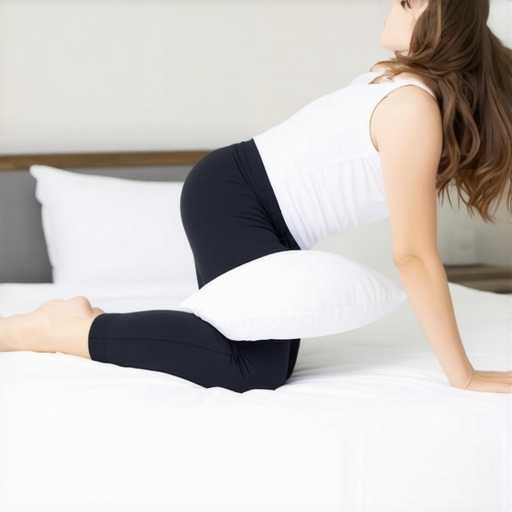
Turn Your Knees Into a Steering Wheel
To start a safe roll, you need to prep your foundation. While lying on your back, gently bend both knees so your feet are flat on the bed. This hooks your lower back into a neutral position. If you try to roll with straight legs, you are fighting physics and gravity. You might find that why your straight posture is actually straining your muscles is often due to this lack of foundational bracing. Once your knees are up, imagine there is a steel rod connecting your shoulder to your hip on the same side. They must move together as a single unit to prevent any shearing forces on the vertebrae.
Engage Your Core Without Bracing for Impact
You do not need to flex your abs like you are about to take a punch; that just creates more internal pressure. Instead, use a soft engagement. Think about drawing your belly button toward your spine just enough to feel stable. If you feel a sharp catch during this phase, stop and try the 10-second breathing trick for instant lower back relief to drop the tension in your nervous system. This small adjustment turns your core into a protective shield for your discs, allowing the muscles to support the transition rather than fight it.
The Way to Sleep on Your Side Without Crushing Your Shoulder
As you complete the roll and land on your side, the battle is not over. Most people collapse their top shoulder forward, which leads to nagging burning between the blades or head forward posture while reading in bed if they are propped up. You must maintain the gap. Stick a pillow between your knees immediately. This keeps your hips stacked and prevents the top leg from pulling your pelvis out of alignment. This is a foundational part of conquering sciatica because it stops the nerve from being tugged for eight hours straight. I once forgot my knee pillow on a trip; I woke up feeling like my hip was out of its socket. Consistency is what keeps you out of the doctor’s office.
Watch Your Neck During the Transition
Your head weighs about as much as a bowling ball. If you let it flop while you roll, you are putting massive strain on the small joints of your upper back. As you move, keep your nose in line with your breastbone. If you are struggling with the way to sleep on your side without crushing your shoulder, ensure your pillow height fills the space between your ear and the mattress perfectly. This keeps your neck from kinking like a garden hose, ensuring blood flow and nerve signals remain uninterrupted throughout the night.
We often think that once we master the log roll, the work is done. But let us dig deeper into why so many of us still wake up stiff despite ‘doing everything right.’ Most of us were taught that a tight muscle needs to be pulled and lengthened to find relief. I fell for this for years, spending thirty minutes every morning reaching for my toes, only to find my back felt more fragile afterward. The truth is, why stretching your hamstrings wont fix your tight legs is often because that tightness is a protective reflex, not a length issue. Your brain is intentionally tightening those muscles to act as ’emergency cables’ because it doesn’t trust your spine to stay stable. When you force a stretch, you are essentially cutting the safety lines, which is why reaching for your toes is the worst way to stretch your back when you are in an active flare-up.
Stop trying to force the perfect upright posture
Here is a contrarian view that might shock you: your quest for ‘perfect’ posture might be the very thing keeping you in pain. I used to walk around with my chest puffed out and shoulders pinned back like a soldier, thinking I was doing my spine a favor. In reality, why your perfect upright posture is actually tensing your spine comes down to muscle fatigue. Constant rigidity creates a ‘bracing’ effect that never allows your deep stabilizers to relax. A study published in the Journal of Orthopaedic & Sports Physical Therapy suggests that there is no single ‘ideal’ posture that prevents pain; rather, it is the lack of movement and variety that causes issues. If you are constantly stiffening up to look ‘straight,’ you are likely understanding the link between poor posture and chronic back pain from a place of tension rather than fluid restored mobility.
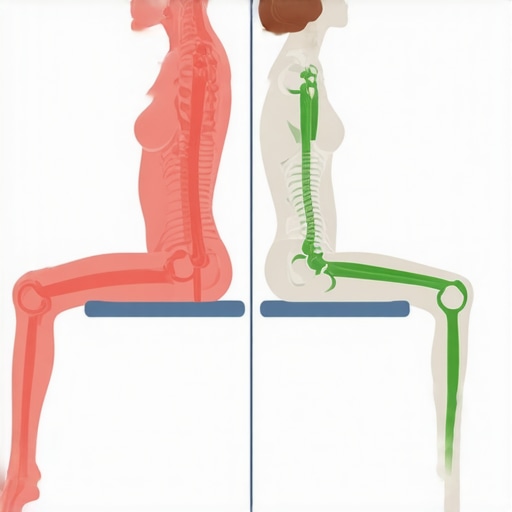
Could your breath be locking your spine in place?
This is the hidden nuance most people miss. When we are in pain, we tend to take shallow ‘chest breaths.’ This keeps the rib cage high and the lower back muscles under constant load. I discovered that the breathing habit that is keeping your back muscles tight acts like an internal pressure cooker. If your diaphragm isn’t moving properly, your lower back muscles have to work double-time just to keep you upright. This is why you might feel why your back hurts more after a day of resting on the couch; your body hasn’t actually ‘rested’ because your nervous system has been in a state of high-alert, shallow-breathing defense for twelve hours. Have you ever fallen into this trap of trying to ‘rest’ your way out of pain, only to feel like a tin man when you finally stand up? Let me know in the comments.
The trap of the soft sofa and the evening slump
Another ‘oops’ factor we have to address is how we spend our time *before* we hit the bed. You can do the perfect log roll at 11 PM, but if you spent three hours prior in a deep, plush recliner, the damage is already done. I noticed the truth about soft sofas and chronic mid-back stiffness early in my recovery journey. Those soft cushions allow your pelvis to tuck under, putting your discs in a ‘C’ shape for hours. By the time you get into bed, your spinal ligaments are already overstretched. Instead of just lying there, try the simple morning move to prime your spine for the day even in the evening to reset that curvature. Real recovery isn’t just about the eight hours you sleep; it is about not sabotaging yourself in the four hours before your head hits the pillow.
Once you have ditched the sofa slump, you need a proactive toolkit to keep the momentum going. I used to spend hundreds on fancy massage guns and high-tech vibrating rollers, but the most effective tool in my kit today costs about fifty cents at a garage sale: a simple tennis ball. The reason it works isn’t just about the pressure; it is about the targeted precision you can achieve at home. When you learn how a simple tennis ball can release your deep glute tension, you are effectively self-treating the piriformis muscle, which often clamps down on the sciatic nerve when we sit too long. I personally place the ball between my hip and a wall, leaning in just enough to find that ‘good hurt.’ It is often more effective than a generic massage because you can pinpoint the exact millimeter of tension that a therapist might miss during a broad session.
How do I keep my spine resilient for the long haul?
Maintenance is not about committing to an hour-long grueling routine every morning; it is about micro-interventions that happen throughout your workday. I swear by mobility mastery daily tips to keep your spine and joints healthy because they focus on frequency over intensity. Dr. Stuart McGill, a world-renowned expert in spine biomechanics and author of Back Mechanic, emphasizes that long-term relief is about ‘sparing’ the spinal tissues from repetitive micro-trauma. This means your primary goal is not necessarily to get ‘stronger’ in the traditional sense, but to develop the endurance and discipline to stop the daily habits that constantly re-irritate your discs.
Your Monitor Height Is the Hidden Thief of Progress
I eventually realized that my stubborn neck pain was actually a byproduct of my desk setup rather than my gym form. I was looking down just enough to create a constant, low-level tug at the base of my skull for eight hours a day. Implementing the 15 degree rule for your computer monitor to save your neck changed my life. If your screen is too low, your head drifts forward, and suddenly your neck muscles are tasked with holding up a sixty-pound weight instead of the twelve pounds it actually weighs. Looking ahead, I suspect we will soon see AI-powered webcams and haptic-feedback wearables that subtly dim your screen or vibrate your wrist the moment your posture breaks the ‘safe’ threshold, making manual ergonomics a thing of the past.
My challenge for you today is to take one immediate, physical action to protect your progress. Head out to your car right now and use how to adjust your rearview mirror to improve your driving posture. This is one of those sciatica relief secrets how to banish pain quickly today that actually sticks because it uses your environment to keep you honest. When you sit up tall with a neutral spine, adjust that mirror perfectly. Later, the moment you start to slump during your commute, you will lose your line of sight on the traffic behind you, forcing you to sit back up without even thinking about it. This is how you transition from temporary fixes to true back pain breakthroughs navigating your path to restored mobility.
The Hard Lessons My Spine Taught Me the Long Way
Looking back, I realized that I spent way too much time searching for a ‘cure’ instead of focusing on ‘management.’ If you are still waiting for a magic pill, let me save you some time. First, stop treating your pain like an enemy to be crushed; it is actually your body’s way of telling you that your movement mechanics are failing. Second, is your back pain a sign of something more serious? Usually, it is a sign that your daily habits need an overhaul, not necessarily a surgeon. Lastly, remember that nerves heal much slower than muscles. You might see the one sign that your sciatica is finally starting to heal—a process called centralization—even when you still feel stiff. That is a major win you should celebrate because it means the nerve is no longer being compressed.
Tools That Actually Earned Their Spot in My Life
I have tried every gadget on the market, but only a few actually make the cut for long-term relief. I highly recommend reading the work of Dr. Stuart McGill, specifically his research on spine hygiene which underpins everything I have shared. For daily maintenance, learning how to use a foam roller on your mid-back without causing pain is a skill you need to master to keep your upper body fluid. I also swear by using a simple yoga block or a firm pillow between the knees every single night to keep the pelvis neutral. Finally, if you are struggling with upper body tension, focusing on revitalize your neck effective techniques for lasting pain relief like chin tucks will provide more relief than any expensive massage chair ever could.
Your Path Toward Living Without That Constant Fear
It is easy to feel like your body has betrayed you when you are stuck in a cycle of stiffness and flares. But the reality is that your spine is incredibly resilient when you give it the right environment to heal. By mastering the log roll, adjusting your monitor height, and paying attention to your breathing, you are taking the power back. You do not have to live your life in a ‘braced’ state, afraid of the next tweak. Consistency with these small shifts is the fastest way to conquer back pain and get back to the activities you love. You have the tools; now it is just about putting them into practice one morning at a time. Have you tried the log roll yet, or do you still find yourself twisting out of bed in the morning? Let me know your experience below.