
Why your head feels ‘heavy’ by 3 PM every afternoon

It happened again today, didn’t it? It’s 3:00 PM, and suddenly your skull feels like an eighty-pound bowling ball precariously perched on a toothpick. Your eyes start to glaze over, and you find yourself propping your chin up with your palm just to keep looking at your screen. I spent years in this exact cycle, convinced that I just needed a more ergonomic chair or perhaps a stronger prescription of espresso. But the truth was much more visceral. My body wasn’t tired; my neck was simply exhausted from carrying a load it wasn’t designed to handle. We’re going to stop that ‘heavy head’ sensation once and for all by looking at the small habits that are quietly wrecking your afternoons.
Your Head Effectively Weighs Fifty Pounds Right Now
When you sit with perfect alignment, your head weighs about 10 to 12 pounds. But the moment you lean forward—a habit many of us fall into when looking at your keyboard while typing—the physics change dramatically. According to a landmark study published in Surgical Technology International, tilting your head forward at a 60-degree angle increases the stress on your cervical spine to about 60 pounds. That is like carrying an average-sized eight-year-old on your shoulders for eight hours a day! No wonder you feel like you’re dragging by mid-afternoon. I made the mistake for years of trying to ‘power through’ the tension, but I only found relief when I learned how to break the cycle of neck pain and stress by addressing the root mechanical cause.
Is my neck actually the problem or am I just tired?
It’s easy to blame the mid-afternoon slump on your lunch or a lack of sleep. However, if you notice that your ‘tiredness’ comes with a side of tightness between your shoulder blades or a dull ache at the base of your skull, it’s mechanical, not metabolic. I remember one specific Tuesday when I couldn’t even keep my head straight while driving home; that was my wake-up call. We often ignore how poor posture and chronic pain are inextricably linked. The good news is that you don’t need a total lifestyle overhaul to find relief. Sometimes, all it takes is a 10-second jaw release to signal to your nervous system that it’s okay to let go of that mounting tension. Have you ever felt that weird, heavy-skull sensation right as the clock hits 3 PM?
Force Yourself into Better Posture While Driving
Most people don’t realize their morning commute is actually a training session for poor alignment. I used to sink into my car seat like it was a recliner, letting my chin drift toward my chest while my lower back rounded into a ‘C’ shape. The result? A neck that felt like it was made of rusted gears by lunch. To stop this, you need a physical ‘alarm.’ Sit up as tall as you can—imagine a string pulling the crown of your head toward the roof of the car—and adjust your rearview mirror to force better driving posture. If you slouch even an inch, the mirror becomes useless, forcing you to sit back up to see the traffic behind you. It’s a passive coach that doesn’t let you cheat. I did this for two weeks straight, and the mid-morning stiffness I thought was ‘just part of getting older’ virtually vanished.
Make Your Screen Work for Your Eyes
Your eyes and your neck are best friends; where the eyes go, the head follows. If you find yourself leaning in to read small text, you’re essentially inviting that fifty-pound weight to crush your cervical discs. This is why how your phones font size is impacting your neck tension is a conversation we need to have. Increase your zoom level to 125%. It feels like a ‘grandpa’ setting, but it keeps your spine stacked because you no longer need to crane forward. Pair this with the 15-degree rule for your computer monitor to save your neck. Your gaze should hit the top third of the screen so your chin stays parallel to the floor. 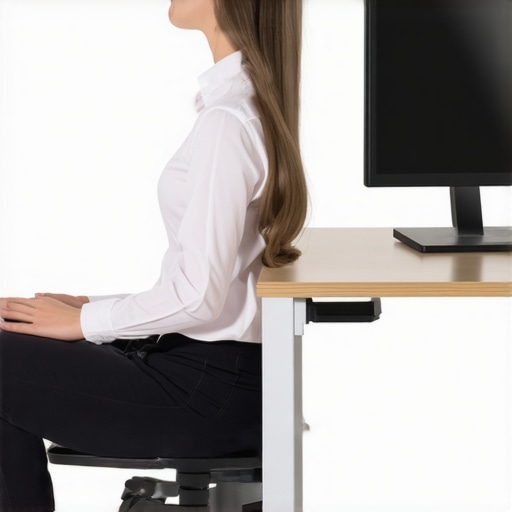 I remember one specific marathon session where I was squinting at a spreadsheet for four hours. By the end, my vision was blurry, and my neck was on fire. I realized that why your neck tension is making your eyes feel tired isn’t just a theory—it’s a physiological loop. When those suboccipital muscles at the base of your skull tighten, they can actually affect the nerves that control eye focus, making the screen look fuzzy and causing you to lean in even further.
Reset Your Frame with the Wall Angel
If you’re already in the thick of it and the ‘heavy head’ has arrived, you need a hard reset. Find a flat wall in your office or hallway. Stand with your heels, glutes, and head touching the surface. Tuck your chin slightly so the back of your neck feels long and decompressed. Perform the wall angel move that fixes rounded shoulders by sliding your arms up and down like you’re making a snow angel, keeping your elbows and wrists against the wall. It’s significantly harder than it sounds. The first time I tried it, I couldn’t even get my left wrist to touch the wall without my back arching like a bridge. It revealed exactly how much my chest had tightened from years of desk work. If you’re stuck at your desk and can’t find a wall, try the seated shoulder blade squeeze to kill midday tension headaches. Squeeze your blades down and back, imagining you’re trying to put them into your back pockets, which signals the overactive muscles in the front of your neck to finally relax.We’ve all heard the advice: ‘Sit up straight! Pull those shoulders back!’ But here is the nuance that usually gets lost in the noise: rigid posture is a recipe for disaster. When you force yourself into what you think is a perfect, military-style alignment, you aren’t actually relaxing. You’re just trading one set of overactive muscles for another. In fact, why your perfect upright posture is actually tensing your spine is a phenomenon I see daily. Your muscles weren’t built to be static pillars; they are meant to be dynamic shock absorbers. One of the biggest ‘traps’ people fall into is the ‘stretch-first’ mentality. If your leg feels tight, you stretch the hamstring, right? Wrong. If you’re dealing with nerve issues, why stretching your hamstrings wont fix your tight legs becomes painfully obvious once you realize you’re actually tugging on an inflamed sciatic nerve. This is the ‘Oops’ factor that keeps people in a six-month recovery loop for something that should have taken two weeks. You have to understand the difference between muscular sciatica and a slipped disc before you start yanking on your limbs.
Is your rib cage secretly sabotaging your shoulders?
Here’s the advanced level of this puzzle. You can do all the neck retractions in the world, but if your rib cage is flared out like a peacock, your shoulders have no stable base to sit on. Research from the Journal of Bodywork and Movement Therapies suggests that diaphragmatic positioning and rib cage ‘stacking’ are more critical for upper-body tension than simple neck position. This is why your rib cage position determines your shoulder health—if the canister of your core is ‘leaking’ pressure because of flared ribs, your neck muscles have to act like guy-wires to keep you upright. I also want to touch on the psoas. We’re told it’s ‘tight’ from sitting, so we stretch it. But often, why a tight psoas is often actually a weak psoas is the real culprit. A weak muscle will feel tight because it’s constantly overworking to provide the stability your spine lacks. If you keep stretching a muscle that is already crying out for strength, you’re just making the instability worse. 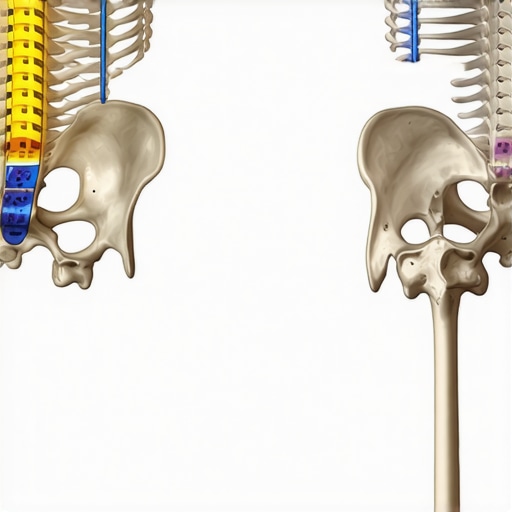 Have you ever fallen into this trap of over-stretching a ‘tight’ muscle only to have it feel worse the next day? Let me know in the comments. We need to stop treating our bodies like a collection of isolated parts and start seeing them as an integrated system. If you aren’t sure where your pain is coming from, it might be time to check is your back pain a sign of something more serious-key symptoms to watch. Knowledge is the first step toward back pain breakthroughs-navigating your path to restored mobility. Don’t be afraid to contact us if you feel like you’ve hit a wall.If you’re serious about never going back to that ‘bowling ball’ neck sensation, we have to talk about the physical environment you inhabit for forty hours a week. I spent a fortune on fancy ergonomic chairs before I realized the real culprit was my twelve-inch laptop screen. You cannot win a fight against gravity when your focal point is below your eye line. This is the moment I suggest you look at how to set up your laptop for better spine protection. I personally use a simple aluminum riser combined with a separate mechanical keyboard. Why? Because it allows me to keep my wrists neutral—which, believe it or not, directly influences the tension in your traps. If you ignore this, you’ll find why your wrist position at your desk affects your neck health is a hard lesson to learn repeatedly. However, be careful not to create a ‘crane neck’ by putting the stand too high; why your laptop stand might be making your neck knots worse often comes down to that extra inch of height that forces you to tilt your chin up instead of keeping it parallel to the floor.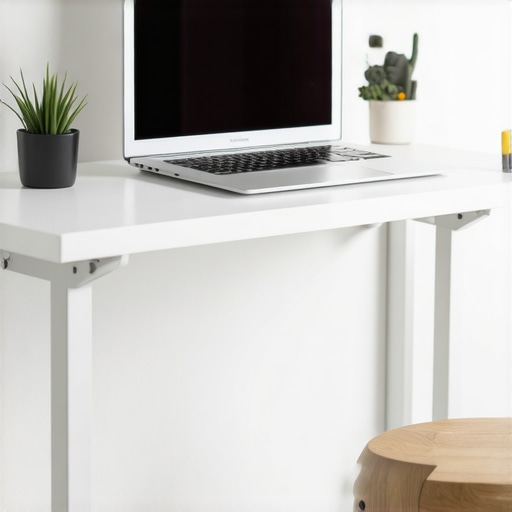
A Footstool Changed My Entire Lower Back
It sounds like something out of a Victorian parlor, but a small footstool is my non-negotiable tool for sciatica prevention. When your feet are flat on the floor, your pelvis often tilts forward, arching your low back and compressing those sensitive nerves. By elevating your knees slightly higher than your hips, you flatten the lumbar spine and take the pressure off. I learned about the simple footstool trick to stop lower back pain while sitting from a physical therapist colleague, and it was a game-changer for my evening leg heaviness. It’s much more effective than buying a new mattress, especially if you’ve already noticed why your firm mattress is making your morning sciatica worse. If your lower half feels locked up, don’t just sit there—use the 2-minute foot massage that helps your lower back relax to signal the posterior chain to let go.
How do I keep these results without thinking about them?
The secret isn’t a two-hour gym session; it’s the integration of ‘micro-adjustments’ into your existing life. Dr. Stuart McGill, a world-renowned expert in spinal biomechanics and author of Low Back Disorders, emphasizes that the ‘cumulative load’ on your spine is what leads to injury, not just one single event. This means your goal should be mobility mastery-daily tips to keep your spine and joints healthy. I predict that in the next five years, we will see a massive shift toward AI-integrated monitors that track your shoulder alignment and gently dim the screen when you start to slouch, forcing a biological reset. Until that tech arrives, you are your own monitor. Start your day with the simple morning move to prime your spine for the day. It takes thirty seconds, but it sets the ‘neutral’ tone for your nervous system. My biggest advice for right now? Try the footstool trick today—even if it’s just a stack of books under your feet—and feel how much slack it gives your sciatic nerve immediately.
The Hard Lessons That Finally Stopped My Daily Neck Aches
I spent a decade fighting my own body before I realized that most of what we are told about ‘fixing’ our alignment is incomplete. The biggest breakthrough came when I stopped trying to force myself into a rigid, military-style pose. I learned the hard way that why your straight posture is actually straining your muscles is a physiological reality; your body wants to be dynamic, not a statue. Another lightbulb moment was realizing that my morning runs were being undermined by my choice of footwear, and exploring why your current sneakers are causing your lower back to ache changed how I approached every step of my day. Finally, I had to accept that my ‘tight’ hamstrings were actually a neurological defense mechanism. Once I understood why stretching your hamstrings wont fix your tight legs, the tension in my upper back finally started to dissipate because the pressure on my spinal cord was relieved.
Gear That Actually Earned a Permanent Spot in My Office
I’ve tested hundreds of gadgets, but only a few actually made a difference in my neck pain management. First, the simple footstool. It sounds primitive, but the simple footstool trick to stop lower back pain while sitting is the most effective way to reset your pelvis and take the strain off your lumbar discs. #IMAGE_PLACEHOLDER_E# Next, I never go anywhere without a standard tennis ball in my bag. Using it for a few minutes can provide a massive release; I highly recommend learning how a simple tennis ball can release your deep glute tension for a quick home-relief strategy. Lastly, I rely heavily on the works of Dr. Stuart McGill and the principles of mobility mastery-daily tips to keep your spine and joints healthy to keep my joints resilient against the cumulative load of office life.
A Reliable Way to Own Your Afternoons
You don’t have to live in a state of constant physical exhaustion. By making these micro-adjustments to how you sit, drive, and even how you look at your screen, you are essentially giving your nervous system permission to relax. It’s about building a sustainable environment where your body can thrive rather than just survive. If you feel like you’ve hit a wall and your symptoms are persistent, don’t hesitate to explore back pain breakthroughs-navigating your path to restored mobility or even contact us for professional guidance. Your journey to a lighter, more mobile version of yourself starts with that first small change today. Have you tried the rearview mirror trick yet, or do you have another secret for staying upright during your commute? Let me know in the comments below!