
The nerve tension test you can do in your living room

I remember sitting on my living room rug, trying to yank my toes toward my face because my leg felt “tight.” Big mistake. It felt like an electric wire had snapped behind my knee. I thought I was just stiff, but I was actually aggravating a nerve. I spent weeks trying to stretch out a “tight hamstring” that refused to budge. Every morning, I’d reach for my toes, grit my teeth, and wonder why the pain was actually getting sharper. Turns out, I wasn’t tight; my sciatic nerve was pinned like a garden hose under a truck tire. I was making it worse every single day by ignoring how to tell if your leg pain is a muscle strain or a pinched nerve. If you’ve ever felt that weird, electric zing or a dull ache that just won’t quit, you know exactly what I’m talking about. Today, I’m going to show you how I finally figured out the difference between a simple muscle pull and true nerve tension—all from the comfort of my own living room.
You Need to Know What You are Actually Stretching
[image_placeholder] Listen, most of us treat every ache like a knot that needs to be rubbed out or a muscle that needs to be lengthened. But nerves don’t like to be stretched; they like to slide. I learned the hard way that why stretching your hamstrings won’t fix your tight legs. When you have nerve tension, that traditional “toes-to-the-sky” stretch is like pulling on a frayed rope. It creates more inflammation, not less. Early on, I made the mistake of thinking more intensity meant faster healing. I’d push through the burning sensation, convinced that I was just “breaking up scar tissue,” when in reality, I was just screaming at my nervous system to tighten up even more. You might even find that why your favorite recliner is the worst place for your sciatica because of how it puts that nerve on a constant, subtle stretch.
Is it really safe to poke around at your own nerves?
I get it. The idea of “nerve testing” sounds like something that requires a white coat and a clipboard. But here is the reality: you are already testing your nerves every time you sit on a low sofa or reach for the floor. According to research published by the Cleveland Clinic, sciatica and related nerve tensions affect up to 40% of people during their lifetime, yet so many of us treat it with the wrong movements. You aren’t “fixing” the nerve today; you are just gathering data so you can stop doing the things that hurt. Have you ever felt that “zing” when you tie your shoes and wondered if it was more than just a tight back? Let me know in the comments if that sounds familiar. Once you realize that your back pain breakthroughs-navigating-your-path-to-restored-mobility usually start with identifying the source, everything changes. You stop fighting your body and start working with it. If you’ve been struggling with leg heaviness, check out the hidden reason your legs feel heavy during your evening walk before we dive into the specific test.
Test your tension without leaving your chair
You don’t need a medical degree to run a basic diagnostic on your own legs. The goal here isn’t to diagnose a specific disc issue—it’s to see if your pain changes when you move the nerve specifically, rather than the muscle. Think of your sciatic nerve like a brake cable inside a bike’s housing. If the cable is frayed or the housing is pinched, pulling harder on the lever just breaks the system. To find out if you are dealing with a nerve, sit on a firm chair and let your shoulders slump forward. Tuck your chin to your chest. Now, slowly straighten your painful leg. If that familiar ‘zing’ or pull starts in your calf or behind your knee, stop right there. Now, here is the trick: lift your chin and look at the ceiling. If the pain in your leg magically disappears or softens when you move your neck, you’ve got nerve tension. This is because you just gave the ‘brake cable’ some slack from the top. Knowing how to tell if your leg pain is a muscle pull or a nerve root changes your entire recovery strategy. You realize you aren’t fighting a tight hamstring; you are managing a sensitive cord.
How to floss a nerve without snapping it
Since we know we can’t ‘stretch’ a nerve, we have to ‘glide’ it. This is often called nerve flossing. I remember the first time I tried this after a long day of yard work. I was so used to the ‘no pain, no gain’ mentality that I tried to do 50 reps with maximum intensity. Ten minutes later, my foot was buzzing like a beehive. I had to learn that with nerves, less is infinitely more. The secret is to never feel the pain during the movement. You want to move the nerve back and forth through the tissues without creating tension at both ends at the same time. It’s like a see-saw. When you flex your foot toward your face, you must bend your knee or tuck your chin to give the nerve slack elsewhere. If you feel a stretch, you’ve gone too far. This nerve flossing routine for stubborn leg numbness and tingling is about convincing your brain that it is safe to move again. You might also want to investigate the difference between muscular sciatica and a slipped disc because the approach for each can vary slightly, but the ‘gentle’ rule remains absolute.
Stop the constant tug-of-war at your desk
Your daily environment is often the silent saboteur. I spent years trying to figure out why my right side always flared up by noon. It turned out that how your wallet in your back pocket is ruining your alignment was the culprit. It was like sitting on a small brick for eight hours a day, tilting my pelvis and putting the nerve on a constant stretch. We often overlook these tiny mechanical traps. For instance, why some sciatica stretches actually pinch the nerve further is usually down to the angle of your hip while you sit. Even your sleep setup matters; I found that why your firm mattress is making your morning sciatica worse was because it didn’t allow my hips to sink in, forcing my spine into a side-bend that irritated the nerve all night long. The core of recovery isn’t just the ten minutes of exercise; it’s the hours of the day spent not picking the inflammatory scab.
Stop trying to sit like a statue
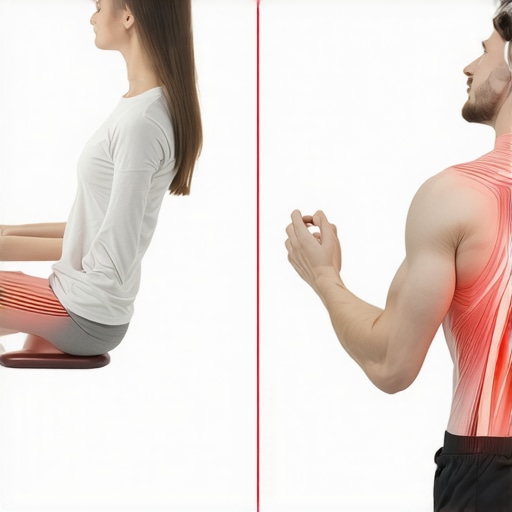
We’ve been told since kindergarten to ‘sit up straight,’ but forcing a rigid, military-style posture is one of the most exhausting things you can do to your spine. In my own recovery, I spent months trying to keep my spine perfectly vertical, only to find my mid-back burning by noon. Research published in the British Journal of Sports Medicine suggests that there is no single ‘correct’ posture that prevents pain. In fact, why your straight posture is actually straining your muscles is often because you are locking your joints and preventing the natural micro-movements your discs need to stay hydrated. If you are constantly bracing, you are just trading one type of pain for another. Real mobility mastery comes from movement, not from staying frozen in a ‘perfect’ position.
Don’t let your couch become a recovery trap
The most common ‘oops’ factor I see is what I call the ‘Resting Trap.’ When your back or leg starts to scream, the natural instinct is to crawl into bed and stay there. However, a landmark study in The Lancet highlighted that for low back pain, staying active is far superior to bed rest. I learned this the hard way: why your back hurts more after a day of resting on the couch is usually because the lack of movement allows inflammatory fluid to pool around the nerve, making it more sensitive when you finally do try to stand up. Instead of total rest, try the simple morning move to prime your spine for the day to keep the ‘brake cable’ sliding without irritation.
Can your pain actually get ‘worse’ while you’re getting better?
This is a nuance that confuses almost everyone. In the world of physical therapy, we look for ‘centralization.’ If you have pain in your foot and it moves up to your calf, then your thigh, and finally settles in your lower back—congratulations, you are actually healing. Even if the back pain feels sharper, the fact that it is leaving your leg is the one sign that your sciatica is finally starting to heal. Conversely, if your back feels great but your foot is going numb, you are ‘peripheralizing,’ which means the nerve is under more pressure. Understanding this shift is vital for back pain breakthroughs-navigating-your-path-to-restored-mobility. Have you ever fallen into this trap where you thought you were getting worse because the pain changed locations? Let me know in the comments.
The cheap tools that actually saved my spine
I used to think that fixing my back required a five-figure investment in ergonomic chairs and high-end massage tables. I was wrong. The most effective items in my recovery kit actually cost less than a fancy lunch. I started by looking at how I sat in my car and at my desk. Using the specific way to use a lumbar roll for maximum relief changed everything for my long commutes; it kept my spine from collapsing into that ‘C’ shape that pinches the nerve. For the stubborn knots in my hips that felt like rocks, I found that how a simple tennis ball can release your deep glute tension was more effective than any vibrating massage gun I ever tried. It’s about precision, not power. I also had to get serious about my workstation. Following the 15-degree rule for your computer monitor to save your neck meant I stopped tilting my head forward, which finally gave my upper back a break.

As Dr. Stuart McGill, a world-renowned spine biomechanics expert, often emphasizes in his research on ‘spinal hygiene,’ it’s the cumulative load of small daily movements that determines your disc health more than any single heavy lift. This is why I started focusing on revitalize your neck-effective techniques for lasting pain relief that I could do while waiting for my coffee to brew. It isn’t about a one-time fix; it is about reducing the ‘micro-insults’ you give your spine every hour.
How do I keep my back healthy in the long run?
Maintenance is where most people fail because they stop their routine the second the ‘zing’ goes away. I made it a non-negotiable to follow the morning routine that prevents lower back stiffness every single day, even when I feel great. Think of it like brushing your teeth for your joints. You don’t wait for a cavity to start brushing, right? True mobility mastery comes from these boring, repetitive wins. If you find yourself slipping back into old habits, try boost your back mobility-simple exercises that make a difference without requiring a full gym setup. The goal is to keep the nerve sliding and the joints lubricated so that a sudden movement—like sneezing or reaching for a grocery bag—doesn’t send you back to square one.
The future of back health is in your pocket
Looking ahead, I predict we are going to see a massive shift toward real-time biofeedback through wearable tech and computer vision. We are already seeing apps that can track your ‘text neck’ angle via your phone’s camera, and soon, we’ll have smart clothing that gently vibrates when your pelvis tilts into a high-risk position. While the tech is cool, it will never replace the foundational work. For now, I want you to try one thing today: Grab a tennis ball or a rolled-up towel and place it in the small of your back the next time you sit down. Notice how it changes your leg tension. If you’re ready to get serious, dive into these back pain breakthroughs-navigating-your-path-to-restored-mobility and pick just one movement to master this week. Your future self will thank you for the five minutes you spent today.
What Your Body Actually Needs When It Zings
After years of fighting my own anatomy, I realized that nerves have a long memory. If you poke the bear every day with aggressive stretching, the bear never goes to sleep. I had to learn that the goal isn’t to ‘beat’ the pain into submission but to create an environment where the nervous system feels safe enough to let go. One major lightbulb moment was realizing why stretching your hamstrings won’t fix your tight legs if the nerve is the one sounding the alarm.
Another lesson: Consistency beats intensity every single time. Doing three minutes of gentle gliding three times a day is infinitely more effective than a grueling hour-long session once a week. You are training your brain, not just your tissues. When you stop the constant tug-of-war, you’ll notice that the one sign that your sciatica is finally starting to heal is often a subtle shift in where you feel the sensation, rather than just how much it hurts.
Simple Tools That Actually Support Your Spine
You don’t need a high-tech rehab facility to get results. My most trusted tool is a simple tennis ball because how a simple tennis ball can release your deep glute tension is unmatched for targeted relief. I also swear by a basic lumbar roll for any drive longer than fifteen minutes. It’s not about the cost; it’s about the support. I also recommend looking at how you handle daily chores, as learning how to unload the dishwasher without rounding your spine can prevent those micro-insults from adding up throughout the week.
You Are Built to Move Again
It is easy to feel like your body has betrayed you when every step feels like a gamble. But remember: your nervous system is just trying to protect you. By using these gentle techniques and focusing on mobility mastery, you are giving it the signal that the danger has passed. Don’t let a temporary flare-up convince you that you’re broken. Every small movement counts toward your long-term back pain breakthroughs-navigating-your-path-to-restored-mobility. You have the tools now—it’s just about taking that first gentle step toward recovery.
Have you ever noticed your leg pain getting worse after a long day of sitting on a soft couch? Let me know in the comments below!