
How your kitchen counter height is straining your neck every single day

It happened halfway through a batch of Sunday meal prep. I was leaning over the granite, slicing peppers, when a lightning bolt of tension shot up my cervical spine and forced me to drop the knife. My neck didn’t just hurt; it felt stuck, heavy, and completely exhausted. For months, I had blamed my pillow, my stress levels, or my phone habits, but the culprit was right in front of me. I never thought to look at the very surface I spent three hours a day standing over. We often focus on office desks and ergonomic chairs, but your kitchen is often a silent killer for posture. If you have ever wondered about the real reason your head feels heavy at the end of the day, look no further than your meal prep routine. Today, I am going to show you exactly how to identify if your setup is the problem and share the simple, low-cost tweaks that saved my sanity.
Stop Fighting Your Countertop Height
Most kitchen counters are set at exactly 36 inches. It is the industry standard. However, if you are five-foot-two or six-foot-four, that “standard” is a recipe for a chronic physical disaster. I made the classic mistake of trying to power through the discomfort by bracing my core and tensing my shoulders, but learning why your straight posture is actually straining your muscles was a total game-changer for me. Trying to stand perfectly tall while your work surface is too low actually forces your neck into a crane-like position that pulls on every muscle from your jaw to your mid-back. According to ergonomic research from Cornell University’s Ergonomics Web, the ideal work surface height should be roughly 1 to 2 inches below your elbow height for precision tasks like chopping. If yours is off by even a tiny bit, your neck pays the price in real-time. Have you ever felt that dull, nagging ache between your shoulder blades while simply doing the dishes? If so, you are not alone, and it is likely your counter, not your age. To start feeling better, we need to revitalize your neck by changing how you interact with your home environment.
Can a Few Inches Really Save My Spine?
I know what you are thinking. It sounds too simple to be true, or perhaps you are worried that fixing this requires a five-figure kitchen remodel. I was skeptical too until I realized that small adjustments to my stance, like implementing the one foot up rule for pain-free dishwashing and chores, immediately took the pressure off my lower back and allowed my neck to settle into a more neutral position. We are going to look at how to bring the work to you, rather than you stooping to the work.
Bring the Chopping Block Up to Your Level
I used to think my cutting board was a permanent fixture of the counter surface. It was not until I propped it up on a thick, two-inch butcher block that I realized I had been leaning forward just enough to put my neck into a ‘shear’ state. Think of your head as a 10-pound bowling ball. When it sits directly over your shoulders, it is easy to carry. However, the second you tilt it forward to see your dicing work, that ball effectively weighs 40 or 50 pounds. By elevating the board, I brought the task to my eyes, which is essential to revitalize your neck without the constant downward strain. Last Thanksgiving, my kitchen looked like a bit of a mess because I had my massive cutting board balanced on top of two sturdy, thick cookbooks. It looked silly to my guests, but for the first time in five years, I did not wake up the next morning with a ‘knotted’ feeling in my traps. You can achieve this same result with a dedicated elevated board or even a sturdy cooling rack placed under your work surface to raise it just those few necessary inches. 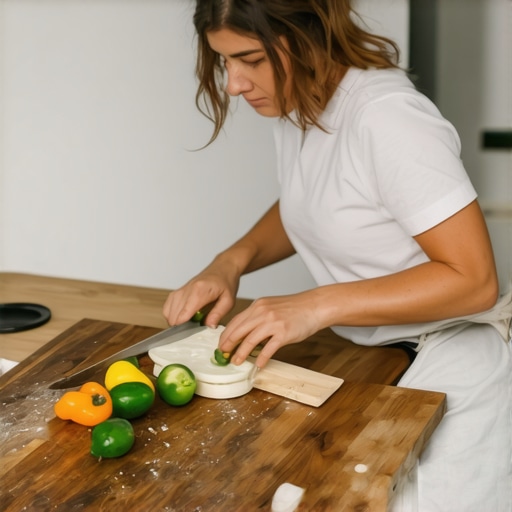
Open Your Cabinets to Relieve Your Spine
The most effective tool for stopping back pain during chores is already in your kitchen, and it is the cabinet under your sink. When you stand with your feet together, your pelvis often tilts forward, putting a massive load on your lumbar discs. This is a primary factor in understanding the link between poor posture and chronic back pain. To fix this, simply open the cabinet door and place one foot on the bottom shelf inside. This small elevation shifts your pelvic tilt, flattens your lower back, and turns off the ‘alarm’ bells in your paraspinal muscles. I call this the one foot up rule for pain-free dishwashing and chores, and it is the only way I can get through a mountain of dishes without feeling like my spine is about to snap in half.
Why Your Stiff Ankles Make Your Back Work Harder
We rarely look at our feet when our neck hurts, but the body is a single kinetic chain. If your ankles are stiff from years of wearing unsupportive shoes or old injuries, your body compensates by leaning the torso further forward to reach the counter. You might think you have a ‘bad back,’ but how a stiff ankle is actually causing your recurrent lower back aches is a revelation for most people. When your ankles do not flex properly, your center of gravity shifts, and your lower back muscles have to work overtime just to keep you upright. While you are waiting for the pasta water to boil, try a quick 30-second ankle drill to loosen the joint. This increased mobility allows you to stand closer to the counter without straining, which directly reduces the tension pulling on your mid-back and neck. Also, pay attention to how to reach for items in the bottom cupboard safely by lunging rather than bending, ensuring you are using your legs as shock absorbers rather than your spine as a crane.Most people think that if a muscle feels tight, they should immediately stretch it. This was the biggest mistake I made in my own recovery journey. When your back or neck hurts after a long meal prep session, your first instinct is probably to touch your toes or roll your head in circles. But here is the nuance: stretching a sensitized nerve is like pulling on a frayed rope; it doesn’t make it longer, it just makes it angrier. If you are dealing with shooting pain, you must understand that stretching your hamstrings can actually flare up sciatica rather than providing the relief you crave. This happens because the ‘tightness’ you feel is often neural tension, not a short muscle. As Dr. Stuart McGill, a world-renowned spine biomechanist, often highlights, ‘spine hygiene’ is about avoiding the triggers, not just adding more movement. Repetitive flexion—the act of bending forward over that counter—can cause disc material to slowly migrate toward the nerve. Adding a deep stretch on top of that is often the ‘oops’ factor that turns a dull ache into a week-long spasm.
Stop Stretching Your Way into More Pain
In my experience, the most common trap is the ‘C-shape’ stretch. We have been taught that rounding our back feels good in the moment, but why you should stop stretching your back into a C-shape becomes clear when you realize you are actually increasing the pressure on your spinal discs. If you have been doing this and wondering why your progress has stalled, it is time to pivot toward stability. This is also a primary reason why your core strength won’t fix your back if your hips are locked. You can have the strongest abs in the world, but if your hip joints aren’t moving, your lower back will be forced to compensate, leading to that familiar kitchen-counter fatigue. 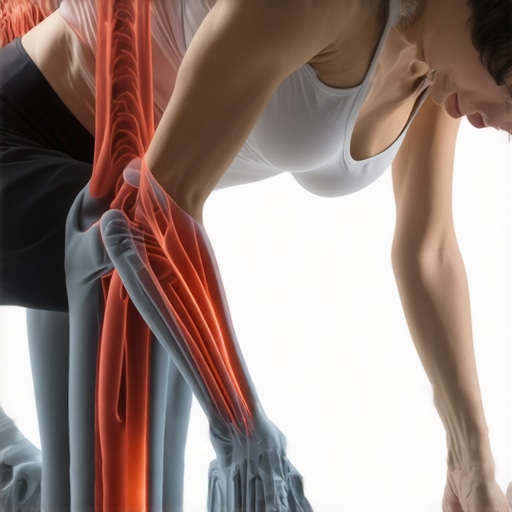
Is Your Stretching Routine Actually Aggravating Your Sciatic Nerve?
For those of you who have tried every yoga pose in the book and still feel ‘stuck,’ consider that you might be over-stretching the very tissues that are trying to protect you. Real conquering sciatica involves identifying these mechanical triggers. Instead of forcing a range of motion your body isn’t ready for, focus on decompressing the spine. Similarly, managing the intersection of neck pain and stress requires more than just stretching your traps; it requires changing the environment that caused the tension in the first place, like those counter heights we discussed earlier. Have you ever fallen into the trap of stretching through the pain, only to feel significantly worse an hour later? Let me know in the comments.The gear I swear by isn’t a collection of high-tech gadgets; they are simple mechanical fixes that address the root cause of my fatigue. For instance, I eventually replaced my thin, decorative kitchen rug with a professional-grade anti-fatigue mat. This isn’t just for ‘cushion’—the specific density of these mats creates micro-instability that keeps your calf muscles firing. This constant, subtle movement prevents blood from pooling in your lower extremities and stops your lower back from locking into a static, painful pose. It’s a foundational step in unlocking mobility that lasts through a whole day of meal prep. I also keep a simple tennis ball in my kitchen junk drawer. Whenever I feel a ‘zing’ of tension in my hip, I take 60 seconds to lean against the pantry door and roll it out. This is how a tennis ball can relieve deep glute and sciatic pain without needing a massage therapist on standby.
How can I keep my back healthy in the long run?
Maintenance is about micro-adjustments and consistency, not marathon recovery sessions. I’ve found that mobility mastery comes from the thirty seconds you spend while the microwave is running. I’ve also learned to stop ignoring the car ride home after a long day on my feet. I keep a lumbar roll in my driver’s seat because it is one of the best ergonomic tips for everyday comfort, maintaining your natural spinal curve even when a car seat tries to collapse you into a slouch. Learning how to use a lumbar roll to prevent mid-day back fatigue properly was a revelation; it’s not just a cushion, it’s a physical reminder to keep your pelvis neutral. As Dr. Eric Goodman, the creator of Foundation Training, notes in his technical protocols, ‘the key to a healthy spine is learning to load the posterior chain rather than the joints.’ This mindset shift—viewing your hips as the engine and your spine as a stabilizer—is the technical secret to overcoming sciatica for good. Looking forward, I predict we will see a massive shift toward ‘active’ flooring in residential kitchens—surfaces that provide varying textures to stimulate the small muscles in our feet, preventing the static load that kills our lower backs. We might even see AI-driven mirrors that give haptic feedback on your head position while you chop vegetables. 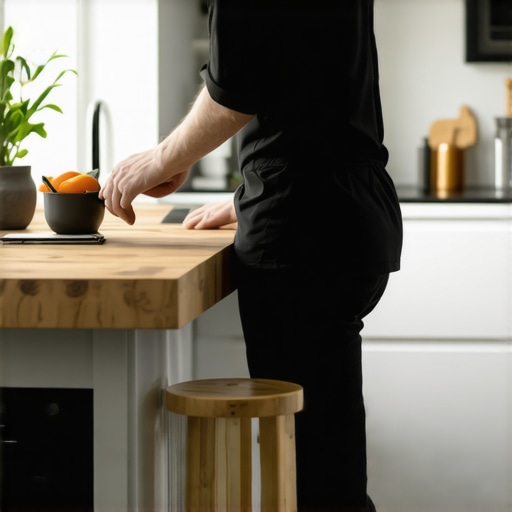 Don’t wait for your next flare-up to take action. My challenge to you is to try one advanced tip tomorrow: before you start your meal prep, perform a quick 30-second ankle drill to ensure your base is mobile, and then stack a second board to raise your work surface. Your neck and spine will feel the difference within minutes.
The Hardest Lessons I Learned While Healing My Spine
Through months of trial and error, I realized that my body wasn’t ‘weak’—it was simply reacting to a poorly designed workspace. First, I had to accept that rest alone wasn’t the answer; I needed to change the physics of how I stood. Second, I learned that why your perfect upright posture is actually tensing your spine was the reason my shoulders were constantly hiked up to my ears. Finally, the biggest ‘aha’ moment was realizing that how a stiff upper back is forcing your neck to move too much was the root of my ‘heavy head’ feeling. My neck was doing the work my thoracic spine should have been doing, and no amount of stretching would fix that until I addressed the mobility in my ribcage.
My Go-To Essentials for a Spine-Friendly Kitchen
If you are serious about unlocking sciatica relief and neck comfort, these three items are non-negotiable for me. I swear by a high-density anti-fatigue mat; it’s the single best investment for anyone who spends more than thirty minutes at the stove. I also highly recommend the clinical work of Dr. Stuart McGill, which helped me identify is your back pain a sign of something more serious before I wasted more time on the wrong stretches. Lastly, keep a tennis ball in your utility drawer—it’s a life-saver for how a simple tennis ball can fix deep glute tension while you wait for the oven timer to go off. These simple tools provide the mechanical support that willpower alone cannot sustain.
Reclaim the Joy of Cooking Without the Fear
You shouldn’t have to choose between a healthy, home-cooked meal and a week of debilitating stiffness. By making these small environmental tweaks, you are shifting the mechanical burden away from your joints and back onto your structural system where it belongs. This is the true path toward back pain breakthroughs that stick. Start small, be consistent with your ‘one foot up’ rule, and trust that your body wants to heal when you stop aggravating it. Have you ever felt that specific ‘zing’ in your lower back while standing at the kitchen sink, and what’s the one thing that usually helps you find relief? Let me know in the comments below!