
The real reason your adjustment didn’t last through the weekend

I remember the feeling vividly. It was a crisp Friday afternoon, and I had just walked out of the clinic feeling like I’d finally hit the reset button on my spine. That nagging pinch in my lower back? Gone. The tension in my shoulders? Melted away. I felt like a million bucks. But then came Sunday morning. I rolled over to hit the snooze button and—snap—that familiar, sharp ache was right back where it started. I felt betrayed. I thought my provider hadn’t “fixed” me right. But after years of trial, error, and a lot of frustrated research, I realized the uncomfortable truth: my 20-minute appointment was fighting a losing battle against my 40-hour work week and my 56-hour weekend habits.
The Friday High and the Sunday Slump
The reality is that a manual adjustment is an incredible tool to reset your nervous system. It helps how a manual adjustment helps your body process stress by resetting the mechanical alignment of your vertebrae. But we often treat it like a car wash—you go in dirty, come out clean, and expect to stay that way regardless of where you drive. I made the classic mistake of thinking the “pop” was the cure. In my early days of dealing with chronic issues, I would leave an appointment and immediately head home to sink into my soft, saggy sofa for a movie marathon. Little did I know, why your favorite recliner is the worst place for your sciatica is a lesson most of us learn the hard way. We spend twenty minutes getting “straightened out” and then spend the next forty-eight hours reinforcing the very patterns that caused the pain in the first place.
Is professional care actually worth the money if the pain just returns?
It is a fair question to ask. If you’re paying for relief that only lasts as long as a grocery store rotisserie chicken, it feels like a waste. However, the adjustment isn’t failing; your “maintenance mode” is. Think of the adjustment as opening a window of opportunity. For a few days, your muscles are less guarded, and your joints move more freely. If you don’t use that window to change how you move, your brain will revert to its “safety settings,” which usually means tightening everything back up. According to a report by the National Center for Complementary and Integrative Health, spinal manipulation is most effective when paired with active lifestyle modifications. Have you ever felt that frustration of feeling great on Friday and broken by Monday?
Your habits are louder than your therapist
Your body is a masterpiece of adaptation. If you spend eight hours a day hunched over a laptop, your fascia and muscles literally reshape themselves to support that position. When a professional comes in and moves those structures back, your body actually perceives it as a threat because it’s no longer used to being “normal.” This is why the the morning habit that prevents your sciatica from flaring up is so vital to understand; it’s about consistent signals, not just a physical one-off. If we want that relief to stick, we have to stop “undoing” the work the moment we leave the parking lot. I am going to show you how to protect that investment in your health so you can finally stop living in a cycle of temporary fixes.Once you have cleared the immediate fog of pain, the real work starts in the mundane moments—like how you reach for a coffee mug or how you stare at your phone. I learned this lesson the hard way. A few years ago, I had a perfect session with my therapist. I felt light, mobile, and ready to take on the world. Two hours later, I was hunched over my laptop, chin tucked into my chest, grinding through emails. By mid-afternoon, that familiar tightness was back. It was not the therapist’s fault; I was essentially asking my neck to hold up a heavy bowling ball at a 60-degree angle. This is why why your head feels heavy by 3 pm every afternoon is often less about your energy and more about your mechanical strain.
Stop the bleeding by changing how you sit
The couch is a silent killer of recovery. We think resting means melting into a plush cushion, but that lack of support forces your spine into a C-shape, overstretching the very ligaments your therapist just tried to stabilize. I used to spend my evenings in a deep recliner, wondering why my legs felt heavy the next morning. It turns out why your favorite recliner is the worst place for your sciatica is because it creates a massive amount of posterior pelvic tilt. Instead, I started using a firm cushion or a lumbar roll to keep my natural curve intact. If you are not sure how to position yourself, learning how to sit on a couch without ruining your spinal alignment can be the difference between waking up refreshed or waking up stiff. 
The simple shift that saves your lower back
Sometimes it is not about the chair itself, but the angle of your hips. If your knees are significantly higher than your hips, your pelvis tucks under, pulling on the sciatic nerve. I found that how a slight change in your sitting angle stops leg numbness was an instant game-changer during my long commutes. I simply adjusted my car seat so my hips were slightly higher than my knees. It felt weird for ten minutes, but for the first time in months, I did not have to limp out of my car at the end of the drive.
Lifting without the dreaded pop
I remember one Saturday morning specifically. I was feeling great, fixed from my Friday appointment, and I decided to move a heavy bin of holiday decorations. I reached down, rounded my back, and—bam—I felt that sickening shift. I had not even lifted the box yet; the mere act of rounding my spine under tension was enough to undo the alignment. Now, I treat every lift like a gym session. Whether you are grabbing a laundry basket or learning how to pick up your toddler without a lower back tweak, the secret is the hip hinge. Keep your spine like a steel rod and let your glutes do the heavy work.
Fix your home office for less than a lunch out
You do not need a thousand-dollar ergonomic throne to protect your neck. I spent years thinking I needed the best gear, but I eventually realized how to set up your home office for less than fifty dollars using things I already had. A stack of books under my monitor and a separate keyboard meant I could keep my head neutral. This stops the text neck cycle and prevents those afternoon slumps. If you find yourself constantly rubbing your shoulders, it is likely because why your laptop screen height is the primary cause of your headaches is creating a constant tug-of-war in your upper traps. Keeping that monitor at eye level is the most effective way to how to fix the head forward posture that ruins your progress overnight.
Once we realize that monitor height matters, we have to look at the even more deceptive nuances of recovery. For example, everyone tells you to stretch your hamstrings if your back is tight. It is the most common advice in the fitness world. But here is the hard truth: for many of us, those hamstrings are not actually short. They are under tension because your pelvis is tilted forward, pulling them tight like a guitar string. When you stretch them, you are often just pulling on a nerve that is already screaming. I spent years doing forward folds only to find that why your hamstrings are not the real reason your back is tight was the key to my relief. In fact, why some sciatica stretches actually pinch the nerve further is a reality that leaves many people bedridden for days after they thought they were helping themselves.
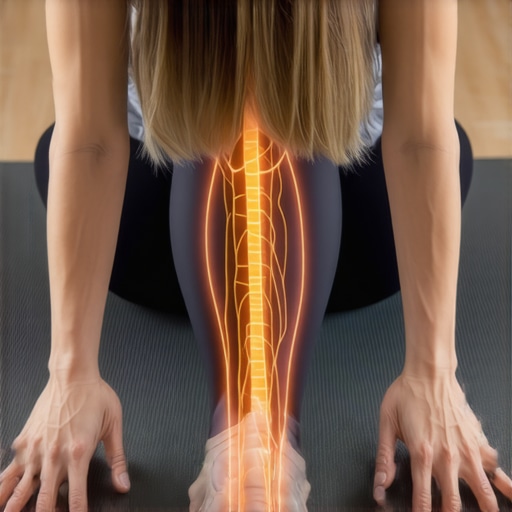
Is your ice pack actually keeping you in pain?
Another common trap is the heavy reliance on the ice pack. We have been conditioned to ice everything to dull the sensation, but why icing your lower back might be slowing down your recovery is a conversation more people need to have. Ice restricts blood flow, and your spinal discs, which already have a naturally poor blood supply, need that circulation to flush out inflammatory markers and bring in nutrients for healing. According to research published by Harvard Health, the modern approach to recovery emphasizes movement and gentle heat over prolonged immobilization and cooling. If you are not moving and bringing blood to the area, you are essentially putting the healing process on pause. Moving from a mindset of icing to one of active circulation is vital for conquering sciatica proven approaches to end discomfort now.
Can you really fix a disc that has already shifted?
It is the question that keeps people up at night. The word herniation sounds permanent, but the body is remarkably good at resorbing disc material if given the right mechanical environment. This is where the work shifts from passive treatments to active lifestyle management. You need to focus on foundational elements like how proper hydration keeps your spinal discs plump and healthy and implementing a consistent the nerve flossing routine for stubborn leg numbness and tingling instead of just waiting for the pain to vanish on its own. Have you ever fallen into this trap where you stretched more and felt worse, or iced until you were stiff? Let me know in the comments below.
After years of fighting frustrating flare-ups, I realized that the most effective tools aren’t always the most expensive. I used to think I needed a high-end massage chair to stay functional, but I eventually found that my long-term success came from a few humble items and a very specific mindset shift. When you are moving from acute pain into the world of long-term maintenance, your focus has to change from ‘fixing’ to ‘sustaining.’ This is the essence of mobility mastery daily tips to keep your spine and joints healthy. It is not just about the gadgets; it is about the consistent mechanical signals you send to your brain every single day. For example, I stopped using a foam roller on my lower back entirely because it was actually irritating my spinal discs. Instead, I learned how to use a foam roller on your mid-back without causing pain to open up my thoracic extension, which took the pressure off my lumbar spine by default.
How do I maintain my spinal mobility over time?
Maintaining a healthy back for the next decade is less about heavy lifting and more about the small, frequent inputs you give your nervous system. I follow a simple ‘Rule of 30’ that has saved my sanity. Every 30 minutes, I perform one movement that counters my current static position. If I have been sitting, I stand and reach for the ceiling. If I have been looking down at a screen, I perform a gentle retraction. This proactive approach is the core of unlocking mobility expert tips on managing back pain in 2025. I also lean heavily on the dead bug exercise variation that actually protects your spine to keep my deep stabilizers awake throughout the day. Without that active stabilization, my spine is just a stack of blocks waiting to tumble the moment I reach for a dropped pen.

One of the most transformative ‘internal’ tools I discovered was my own breathing pattern. Most people breathe shallowly into their chest when they are stressed or focused, which keeps the neck and shoulder muscles in a state of constant, low-grade tension. I had to consciously train myself how to breathe into your lower back to release deep muscle tension to actually expand my torso from the inside out. This isn’t just a relaxation technique; it is a mechanical necessity for spinal decompression. Dr. Stuart McGill, a world-renowned spine biomechanics expert and author of The Back Mechanic, emphasizes that creating a ‘stiffened’ core through specific bracing is what prevents the micro-movements that lead to chronic disc irritation. By using your breath to create intra-abdominal pressure, you are essentially building an internal back brace that works better than anything you can buy at a drugstore.
Looking toward the future, I see a massive shift toward biofeedback technology and AI-driven posture sensors. We are entering an era where wearable devices will alert us the moment our pelvic tilt shifts out of alignment, making understanding the link between poor posture and chronic back pain a real-time correction rather than a painful realization at the end of a long work week. But until that technology is perfect, you have to be your own sensor. If your hips feel tight after a movie, don’t just go to bed; try the floor seated position that actually fixes your stiff hips while you unwind. My challenge for you today is simple: take 30 seconds right now and perform the 30 second wall slide for better shoulder alignment. It is the fastest way to reset your upper body and stop a tension headache before it even starts.
Hard-Earned Lessons from the Spinal Trenches
If I could go back and talk to my younger, stiffer self, I would tell him that pain is a lagging indicator. By the time you feel that sharp pinch, your body has been compensation-heavy for weeks. I learned that chasing the ‘pop’ is a distraction; the real magic happens in the boring stuff like fixing why looking at your phone on your lap is a disaster for your spine. Another lightbulb moment was realizing that ‘perfect’ posture doesn’t exist—only the next posture. Your body craves variety, and even the best ergonomic chair won’t save you if you don’t move for four hours. Finally, I had to accept that healing isn’t linear. You will have bad days, but those flares are just data points, not failures in your back pain breakthroughs navigating your path to restored mobility.
My Personal Recovery Toolkit
Beyond the professional adjustments, I rely on a few specific resources to stay functional. First, I always keep a firm lumbar roll in my car; it is the most cost-effective way to manage sciatica relief secrets how to banish pain quickly today while commuting. For my workspace, I swear by a simple external keyboard so I can elevate my screen—this single shift is one of the best neck pain solutions proven techniques to regain your range of motion. I also recommend ‘The Back Mechanic’ for anyone who wants to understand the ‘why’ behind their injury. Lastly, never underestimate a simple tennis ball; it’s my go-to for boost your back mobility simple exercises that make a difference when I feel my glutes tightening up after a long flight.
#IMAGE_PLACEHOLDER_E#
The Road to a Pain-Free Tomorrow
Reclaiming your life from chronic discomfort isn’t about one Herculean effort; it is about the quiet, daily choices that respect your biology. You have the tools now to stop the cycle of the ‘Sunday Slump’ and start building a foundation that lasts. Whether you are dealing with a minor ache or a major flare-up, remember that your body is designed to heal if you provide the right environment. If you’re ever worried that things aren’t progressing correctly, check is your back pain a sign of something more serious key symptoms to watch to stay informed and safe. You deserve to move without fear, so keep showing up for yourself and your spine will thank you.
Have you ever found a specific habit that finally made your sciatica feel better for more than a few hours? Let me know in the comments below.