
How to pick up your toddler without a lower back ‘tweak’

It happened right between the toy bin and the overflowing pile of laundry. My daughter, Lily, reached up with those chubby little arms, and like any dad, I lunged forward to scoop her up. Then it hit. A sharp, searing ‘tweak’ in my lower back that made the world go grey for a split second. I didn’t drop her—thank God—but for the next three days, I moved like a rusted-out tin man. I felt like a total failure. How could a thirty-pound toddler take down a grown man? I realized then that my body wasn’t failing; my mechanics were.
No More Groaning Every Time You Reach for Your Kid
I used to think I was just ‘getting old’ or that my back was inherently fragile. I was wrong. The reality is that we often treat our spines like construction cranes rather than the delicate support systems they actually are. If you’ve been struggling with managing back pain in 2025, you know that one wrong move can ruin your entire week of productivity and play. My biggest mistake early on—one I see neighbors and friends make every single day—was ‘reaching.’ I would plant my heels and extend my arms way out from my body to grab my kid. It’s the fastest way to invite a disc bulge or a painful muscle spasm. [image_placeholder]
Is it really possible to lift a kid without pain?
You might think that once your back ‘goes’ once, it’s gone for good and you’re destined for a life of heating pads. But the secret isn’t just about getting ‘stronger’ in the gym; it’s about the physics of the ‘parent-lift.’ We’re going to solve this today by retraining your brain to move with your hips, not your vertebrae. According to research published in the journal Spine, lifting with a rounded back can increase compressive loads on your lumbar discs by over 300% compared to maintaining a neutral spine. That is a massive amount of unnecessary pressure. This is why learning how to pick up your child without a back injury is a non-negotiable skill for any parent or grandparent. We’ll also look at how how to hold your baby without straining your lower back once they are actually in your arms, because the ‘side-hip carry’ is a silent killer for your alignment. Plus, I’ll show you why your breathing habit that is keeping your back muscles tight might be the hidden culprit behind that constant morning stiffness. Have you ever felt that sudden, terrifying ‘zing’ in your lower back while just trying to be a present parent? It’s a lonely feeling when you’re stuck on the couch while the kids are playing, but it doesn’t have to be your permanent reality. Let’s get you moving again.The biggest shift I had to make was treating Lily like a 30-pound kettlebell instead of a feather. When you see a pro-lifter, they don’t reach across the room; they get their center of gravity directly over the weight. I remember trying to grab her out of her car seat while standing on the curb. I reached, twisted, and felt that familiar, sickening tightness. Now, I make it a rule to get my chest as close to her as possible before my hands even touch her. This is why understanding the link between poor posture and chronic back pain is so critical; your everyday stance dictates how your muscles react under sudden stress.
Get Your Hips Under the Load
Think of your hips as the engine and your spine as the transmission. If the engine isn’t engaged, the transmission has to do all the heavy work—and it isn’t built for that. To lift safely, you need to ‘hinge.’ This means pushing your butt back toward the wall behind you rather than rounding your shoulders forward. It’s the same logic behind the proper way to brush your teeth without straining your back. By keeping your shins vertical and letting your glutes take the weight, you spare your lumbar discs from that massive pressure spike I mentioned earlier. 
Stop Reaching and Start Stepping
Every inch your child is away from your torso multiplies the weight on your lower back. If your toddler is three feet away, they don’t weigh 30 pounds anymore—to your spine, they weigh closer to 100. I once tried to ‘hook’ Lily’s stroller bag from the backseat while leaning in from the driver’s side. That’s a classic mistake. It’s why I always tell people why you should never reach into the backseat from the drivers seat. Instead, take the extra two seconds to walk around. It sounds tedious, but it’s the difference between a fun afternoon at the park and a week on the floor with an ice pack.
Exhale on the Effort
Most of us instinctively hold our breath when we lift something heavy. We ‘brace’ by creating internal pressure, but if you don’t know how to channel that pressure, it just squashes your discs. I started practicing the 10-second breathing trick for instant lower back relief during my daily routine. Now, as I scoop Lily up, I make a conscious ‘hissing’ sound as I exhale. This engages the deep core muscles that act like a natural weight belt. If you feel like your legs are too tight to even get into a good squat, be careful—why stretching your hamstrings can actually flare up sciatica is a real risk if you’re pulling on nerves instead of muscles. To see where you currently stand, try the toe touch test that reveals your actual back injury risk before you try to change your entire lifting form.
Be the Elevator Not the Crane
Visualize yourself as an elevator moving straight up and down. A crane reaches out and pivots; an elevator stays within its shaft. When I pick up toys off the floor now, I drop one knee down or perform a deep hinge. I don’t bend at the belly button anymore. Small adjustments like these boost your back mobility by teaching your body to move in segments rather than as one stiff, vulnerable board.
While the ‘elevator lift’ changed my life, I quickly learned that mobility is about more than just how you pick up a toddler. We’ve all been told since grade school to ‘stand up straight,’ but one of the biggest myths I had to unlearn was the idea of a perfect, rigid posture. In fact, if you’re constantly trying to pull your shoulders back and tuck your chin, you might be making things worse. In my experience, trying to maintain a ‘military’ stance actually creates a new kind of stiffness that eventually leads to a flare-up. This is because movement is medicine, and static positions—no matter how ‘straight’ they look—eventually starve your tissues of blood flow. Research published in the Journal of Biomechanics suggests that the ‘ideal’ posture is actually a myth; what matters most is the frequency of your movement rather than the perfection of your alignment. This is why your perfect upright posture is actually tensing your spine and causing that nagging fatigue by the end of the day. Have you ever fallen into this trap of trying to hold a ‘perfect’ pose all day? Let me know in the comments.

Stop Stretching Your Hamstrings if You Have Nerve Pain
Here is the ‘oops’ factor that almost cost me a trip to the ER: stretching through the pain. When my back first started acting up, I felt a tight, pulling sensation down the back of my leg. Naturally, I thought my hamstrings were tight, so I spent twenty minutes a day doing deep toe touches. I was actually making my condition much worse. If that tightness is actually neural—meaning it’s coming from your sciatic nerve—aggressive stretching is like pulling on a frayed wire. You aren’t loosening a muscle; you’re irritating a nerve. Before you dive into a stretching routine, you should use the simple test to see if your leg pain is actually sciatica. If you fail that test, why stretching your hamstrings can actually flare up sciatica becomes a very real and painful reality. Instead of pulling, we need to focus on ‘flossing’ the nerve and addressing the pressure at the source.
Could Your Footwear or Even Your Wallet Be the Real Culprit?
We often look for the problem exactly where it hurts, but the spine is a master of compensation. If you’ve been dealing with overcoming sciatica, you have to look at your foundation. For example, how your wallet in your back pocket is ruining your alignment is a classic example of a small habit causing a massive shift in your pelvis. Even your choice of shoes matters; I discovered that why your high arched shoes are causing your lower back to ache was the missing piece of my recovery puzzle. When your feet can’t absorb shock, your lower back has to do it for them. If your back pain feels like a mystery that won’t go away, it’s worth considering how a stiff ankle is actually causing your recurrent lower back aches. When your ankle doesn’t flex, your body finds that range of motion somewhere else—usually your lumbar spine. For those also dealing with upper body tension, remember that neck pain solutions often require looking lower down the chain. Sometimes how a stiff upper back is forcing your neck to move too much is the real reason you can’t turn your head to check your blind spot. By zooming out and looking at your body as a whole, you can finally move past the temporary fixes and find lasting relief.
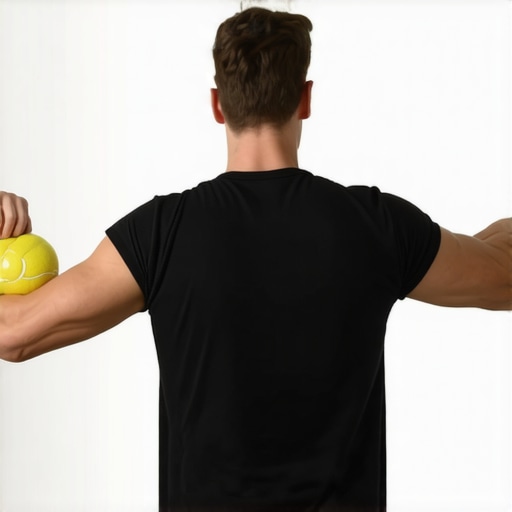
I used to think ‘maintenance’ meant a thirty-minute yoga session that I never actually had time for. The truth is, my back stays happy because of the weird stuff I do while the coffee is brewing. I’ve found that the best tools aren’t the expensive five-hundred-dollar ergonomic chairs; my favorite recovery tool is literally a two-dollar tennis ball. When I feel that familiar, dull ache in my glute, I know my piriformis is acting up and starting to pinch. I just lean against a wall and let the ball do the work. This is exactly how a tennis ball can relieve deep glute and sciatic pain without having to book a professional massage. If I am feeling a broader stiffness in my legs, I reach for my foam roller, but you have to be extremely careful. If you roll directly over a flared nerve, you are just asking for a week of misery. I had to learn how to use a foam roller for sciatica without making it worse by focusing on the soft tissue around the hip rather than the nerve itself.
Dr. Stuart McGill, a world-renowned expert in spine biomechanics and author of Back Mechanic, emphasizes the concept of ‘spine hygiene.’ He argues that it is the small, repetitive things we do—like how we brush our teeth or tie our shoes—that build up over time to cause injury. It is why I now swear by mobility mastery daily tips to keep your spine and joints healthy. It is not about the one hour you spend in the gym; it is about the other twenty-three hours you spend moving through the world.
How do I maintain my back and neck health as I get older?
The secret I discovered is ‘greasing the groove.’ Instead of waiting for a weekend workout, I sprinkle ‘micro-resets’ throughout my day. Every time I walk through a specific doorway in my house, I perform the doorway move that opens your chest and fixes your slouch. It takes five seconds, but it undoes an hour of looking at my phone or typing. If I feel a tension headache creeping up, I find a flat wall and do the wall angel move that fixes rounded shoulders. These aren’t just exercises; they are physical reminders to my nervous system that it is safe and capable of movement. If you are looking for sciatica relief secrets, stop looking for one big miracle cure and start looking for twenty tiny, daily adjustments.
In the next few years, I predict we will see a massive shift toward AI-powered wearable sensors that integrate with our phones to analyze our gait and lumbar load in real-time. We will get a notification before the injury even happens. Until then, you have to be your own sensor. If you ever wonder is your back pain a sign of something more serious, do not ignore those red flags. But for most of us, back pain breakthroughs happen in the kitchen or the home office. My challenge for you today is simple: find a wall and try the 30-second wall stretch that releases shoulder blade knots. It is the single most effective way I have found to stop neck pain before it starts. Do not wait for the next ‘zing’ to hit your spine—reset your alignment right now.
Why Being Too Careful Is Actually Making You Fragile
The hardest lesson I had to learn was that ‘protecting’ my back by moving less was actually the fastest way to get hurt again. When you stop moving because you’re afraid of a spasm, your muscles become deconditioned and your joints get stiff. I spent months avoiding the floor, but I eventually realized that learning how to sit on the floor with your kids without hurting your hips was better for my long-term health than staying on the couch. Here are a few ‘lightbulb moments’ that finally clicked for me:
- The ‘Freeze’ Response: When we feel pain, we tend to hold our breath and lock our joints. This actually increases the pressure on your nerves rather than relieving it.
- Movement is Lubrication: Your spinal discs don’t have a direct blood supply; they rely on movement to ‘pump’ nutrients in. Total rest is often the enemy of recovery.
- Fear is a Physical Weight: The more you worry about your back ‘going out,’ the more your brain keeps your muscles in a state of high tension, making a tweak more likely.
The Few Simple Tools That Changed Everything for Me
I don’t believe in expensive gadgets, but I do believe in having a reliable ‘first aid kit’ for movement. If you’re looking for quick home remedies for sciatica that work, start with the basics. [image_placeholder] My daily toolkit includes:
- A Lacrosse or Tennis Ball: For digging into those tight glutes when expert strategies for lasting comfort require pinpoint pressure to release the piriformis.
- Knowledge over Ice: Understanding the truth about using heat packs versus ice for chronic stiffness saved me from many sleepless nights; I now lean toward heat for muscle relaxation.
- Consistency over Complexity: I trust the principles of ‘Spine Hygiene’ over any fad workout. It is about how you move every hour, not just for one hour at the gym.
Your Body Is Resilient Enough to Heal
If you’ve been struggling with managing back pain in 2025, please know that your current state isn’t your permanent identity. You aren’t ‘broken’ or ‘old’—you’re likely just using a movement pattern that doesn’t serve your anatomy anymore. By shifting your focus from ‘avoiding pain’ to ‘regaining function,’ you can revitalize your neck and back naturally. Don’t be afraid to take that first step, even if it’s just a 10-second breath or a different way of picking up a toy. You’ve got this. Have you ever found that ‘resting’ actually made your stiffness worse instead of better? Let me know your experience in the comments below!