
How to use heat and ice the right way for neck stiffness
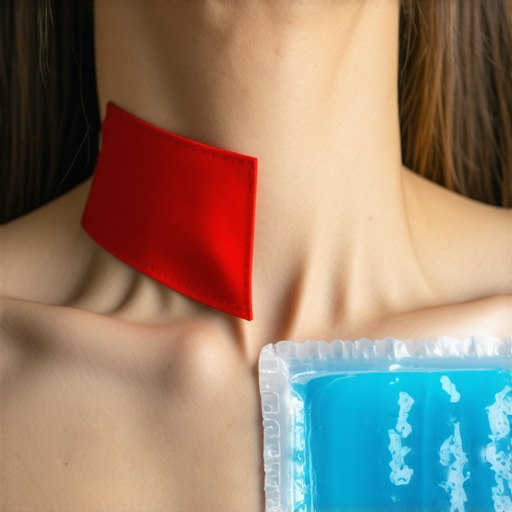
I still remember that Tuesday morning vividly. I reached for my phone on the nightstand, and a sharp, electric jolt shot straight from the base of my skull down to my shoulder blade. I froze. My neck wasn’t just tight; it was locked. For the next three hours, I moved like a Lego figurine, turning my entire body just to look at whoever was talking to me. My first instinct? I grabbed a massive ice pack and held it there until my skin turned beet red. Big mistake. I spent years thinking cold for pain and heat for comfort, but that simplified logic is exactly why my recovery took twice as long as it should have.
Stop Chasing the Wrong Temperature
It is a common trap we all fall into when the text neck or a bad night’s sleep finally catches up with us. We want relief right now, so we grab whatever is in the freezer or the back of the linen closet. But here is the thing: applying the wrong sensation at the wrong time can actually trigger a protective spasm. If your muscles are already tight and guarding an area, hitting them with an icy shock might make them clench even harder. I have learned the hard way that revitalizing your neck requires a bit more strategy than just numb-and-go. We are going to fix that today. I will walk you through the precise temperature timing that actually releases those deep knots instead of just masking the ache for twenty minutes.
Does this actually work better than ibuprofen?
You might be wondering if swapping a heating pad for an ice pack is really enough to handle that deep, grinding sensation. It is a fair question. While pills can dampen the signal, thermal therapy actually changes the environment of your tissues. According to Harvard Health Publishing, heat is generally better for chronic pain and muscle stiffness because it improves circulation and relaxes the tightness in the soft tissues. My mistake early on was using ice for everything, which is a trap many fall into, especially when they think icing a stiff area is the universal gold standard. In reality, unless you have just had a blunt force injury, heat is often the unsung hero for that nagging, stuck feeling.
The Early Mistake That Kept Me Stiff for Weeks
When my neck first started acting up, I treated it like a sports injury. I iced it religiously every twenty minutes. I thought I was numbing the fire, but I was actually cooling down muscles that desperately needed blood flow to relax. This led to a cycle where the reason my neck felt stiff was actually exacerbated by the very thing I thought was helping. Have you ever spent a whole weekend alternating between hot and cold without feeling any real change? If so, tell me in the comments—I would love to know what your go-to method has been so far. We need to look at how simple tricks for better sleep combined with the right thermal approach can stop these flare-ups before they start.
The Three-Step Reset for a Locked Neck
Think of your neck muscles like a stick of cold taffy. If you try to bend it right out of the fridge, it snaps or cracks. But if you warm it in your hands, it becomes pliable, stretchy, and resilient. This is exactly why the first step in any recovery is 15 minutes of moist heat. I learned this the hard way during a particularly bad flare-up three years ago. I thought I could ‘stretch out’ the stiffness while waiting for my coffee to brew. I did one aggressive pull toward my shoulder and felt a sickening pop that left my vision swimming. By skipping the warm-up, I had forced a guarded, cold muscle to overextend. Now, I never move until the tissue is soft.
Warm the Engine Before You Drive
Once you have applied heat, you are not looking for a deep, painful stretch. You want ‘micro-movements’ that tell your nervous system it is safe to let go. Imagine your head is a heavy bowling ball sitting on a precarious spring. Your neck muscles are the tiny cables trying to keep that ball from falling off. When you lean forward to check a text, those cables have to work ten times harder. To fix this, gently rotate your chin toward your shoulder just until you feel the first hint of resistance, then stop. This is how you regain your range of motion without triggering a protective spasm. If you push into the pain, your brain sends a signal to the muscle to tighten up even more to protect the joint. It is a biological stalemate you will never win. 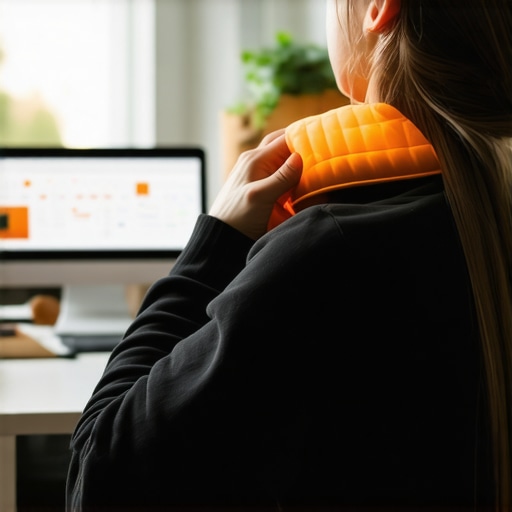
Stop the Daily Drain on Your Spine
You can do all the heat therapy in the world, but if you go right back to staring at your lap, the pain will return by lunch. I realized that your phone’s font size might be the hidden reason you are leaning forward into ‘text neck’ territory. If you have to squint or lean to read, you are putting 60 pounds of pressure on those tiny cervical vertebrae. A quick fix is the 15-degree rule for your monitor. By raising your screen so the top third is at eye level, you allow your head to sit naturally over your shoulders. This ‘stacking’ effect is the only way to let those overworked muscles finally go ‘off duty’ and recover.
Fix Your Environment While You Sleep
Finally, look at your bed mechanics. Many people think they need a giant, fluffy pillow to cushion the pain, but that actually kinks the neck into a permanent side-bend for eight hours. When I was struggling most, I switched to the simple towel roll trick to support the natural curve of my neck rather than just elevating my head. It felt strange for the first few nights, but I stopped waking up with that ‘rust-coated’ feeling in my joints. If you are a side sleeper, make sure you are not crushing your shoulder, which can pull on the nerves leading up to your skull and cause a referral headache. Small, mechanical changes in how you sit and sleep are what make the heat therapy stick long-term.We often treat our bodies like a collection of separate parts—a neck issue here, a lower back ache there. But the biggest mistake I see people make is assuming that ‘tightness’ always means a muscle needs to be stretched. I used to be a ‘stretching junkie.’ If my back felt stiff, I would spend twenty minutes reaching for my toes. I thought I was doing the right thing, but reaching for your toes can be a disaster if your discs are sensitized.
Stop Trying to Stand Like a Statue
There is this pervasive myth that ‘perfect posture’ means being as straight as a board. In reality, why your straight posture is actually straining your muscles is because it forces your stabilizers to fire constantly without rest. Your spine is designed for movement, not for rigid, static endurance. When we force that military-style chest-out position, we often end up with a ‘locked’ mid-back. This is where enhancing your back mobility through gentle, varied movement beats ‘perfect’ sitting every single time. Have you ever tried to maintain perfect posture all day only to feel more exhausted by 5 PM? Let me know in the comments—I suspect I am not the only one who fell for this.
The Hamstring Stretch That Is Actually Hurting Your Nerve
Here is a nuance that even some seasoned gym-goers miss: the difference between a tight muscle and a ‘tensioned’ nerve. If you have shooting pain down your leg, your instinct is probably to stretch your hamstrings. However, why some sciatica stretches actually pinch the nerve further is a critical lesson in anatomy. Nerves do not like to be stretched; they like to be ‘glided.’ If you pull on a nerve that is already irritated, you are just increasing the inflammation. Instead of a hard pull, you should be looking into a nerve flossing routine. According to experts at the Mayo Clinic, neural gliding exercises can help the nerve move freely through its canal without adding mechanical stress. 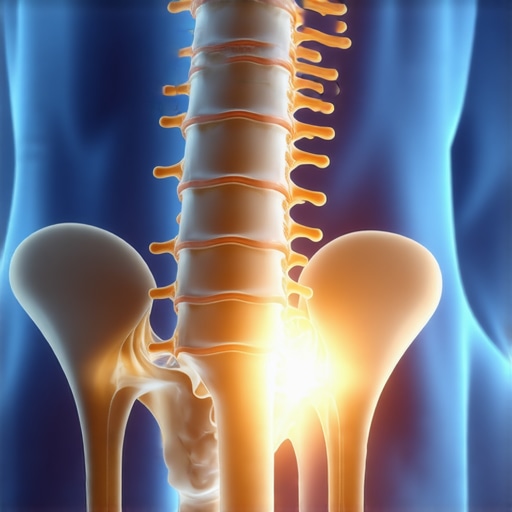
What does it mean when the pain shifts toward your spine?
Many people panic when their back starts hurting more even as their leg pain disappears. This is actually a phenomenon called ‘centralization.’ Understanding the one sign that your sciatica is finally starting to heal is vital so you do not quit your rehab too early. When pain moves from your foot or calf up toward your lower back, it usually means the pressure on the nerve root is decreasing. It is a win, even if the back itself feels a bit cranky. Another ‘oops’ factor to watch for is the ‘heavy leg’ sensation. You might think you just need a better pair of shoes, but the hidden reason your legs feel heavy often traces back to the lumbar spine or a psoas that is working overtime. Remember, why a tight psoas is often actually a weak psoas is the key to understanding why stretching it never seems to provide permanent relief. You need to build stability, not just find more length.Once you have moved past the emergency phase of a flare-up, the game changes from survival to maintenance. I used to think I could just go back to my old habits once the sharp pain subsided, but that is exactly how you end up in a six-month cycle of being better and then worse. Now, I treat my spine like a high-maintenance car that needs a daily oil check. My first non-negotiable is the foam roller. I see people rolling their lower back all the time, which can actually be too much pressure on the floating ribs, so I stick to using a foam roller on the mid-back to open up that thoracic cage and improve shoulder alignment. When I am traveling and cannot fit a roller in my carry-on, I use the tennis ball hack. You would not believe how a simple tennis ball releases deep glute tension that otherwise pulls on your sciatic nerve while you are trapped in a cramped airplane seat.
The Gear That Actually Lives in My Daily Routine
I spent a small fortune on an ergonomic chair, only to realize that the chair was not the problem—it was my lack of variety. A study published in the Journal of Physical Therapy Science found that even with optimal ergonomics, staying in any static position for over two hours leads to measurable muscle fatigue. This is why I now use a mix of tools to force movement throughout the day. I swear by the simple footstool trick to change my hip angle every hour. If I am working from a laptop, I am incredibly picky about height. I have found that why your laptop stand might be making your neck knots worse often comes down to the angle of your wrists versus the height of your eyes. 
Why Your Expensive Office Chair Isn’t Saving You
Looking ahead, I think we are going to see a huge shift toward wearable bio-feedback—think shirts that vibrate when your shoulders round too far forward or apps that track your spinal angle via your webcam. But until then, we have to be our own sensors. You need to keep practicing daily mobility mastery to ensure your joints stay lubricated and your nervous system does not revert to its guarded, painful state.
How do I maintain these results for the long haul?
The secret is not doing a sixty-minute workout once a week; it is the two-minute micro-resets. I have integrated a morning routine that prevents lower back stiffness into my coffee-brewing time every single morning. If you really want to feel a difference by tomorrow, I challenge you to try this 2-minute foot massage tonight before bed. It sounds disconnected, but releasing the fascia in your feet is one of the fastest ways to tell your lower back it is okay to let go of the day’s tension. You have already made the back pain breakthroughs necessary to get here; do not let a lack of consistency drag you back to square one.
Hard Lessons Learned While My Spine Was in Lockdown
Looking back at years of trial and error, the biggest realization I had was that pain is a conversation, not a sentence. I spent so much time trying to ‘shut up’ my body with ice and pills that I forgot to listen to what the tension was actually saying. First, I learned that stress is a physical weight. It is impossible to fully heal your neck if your nervous system is in a constant state of high alert. I had to learn how to break the cycle of neck pain and stress by addressing my breathing as much as my posture. Second, you have to know when to stop DIY-ing. While most stiffness is mechanical, it is vital to recognize if your back pain is a sign of something more serious, like nerve impingement that requires professional eyes. Finally, consistency beats intensity every single time. A two-minute stretch done every day is worth more than a two-hour gym session once a month.
The Tiny Toolset That Keeps Me Moving
You do not need a garage full of equipment to maintain your results. I have narrowed my daily recovery down to three specific items that I trust implicitly. First, the standard tennis ball. It is the most effective tool I have found for pinpointing trigger points in the hips that lead to conquering sciatica symptoms. I use it against a wall to reach the spots a foam roller misses. Second, a simple bathroom hand towel. Rolled up and placed under the neck during sleep, it provides better support than most fifty-dollar ‘orthopedic’ pillows. Third, a clear patch of wall. I use it for the 30-second wall slide which resets my shoulder alignment after a long day at the computer. These tools are low-cost but high-impact because they remove the friction of ‘getting ready’ to exercise.
Take the First Step Toward Your Mobility Breakthrough
The journey from a locked neck to fluid movement is rarely a straight line, but it is always worth the effort. You have the tools now to stop guessing and start responding to your body with the right temperature, the right movement, and the right ergonomics. Do not wait for the next major spasm to start prioritizing your spinal health. By making small, intentional adjustments today, you are securing your ability to move freely ten years from now. You have already started your journey toward significant back pain breakthroughs—now it is just about keeping that momentum. Have you ever tried the towel-roll trick or the tennis ball hack, and did it provide that ‘instant’ release you were looking for? Let me know in the comments below!